

A car blower motor wholesale order should be released as a controlled assembly, not as a carton count. The sellable unit may include only a motor, a motor with a centrifugal wheel, or a complete housing with a resistor or electronic controller. Those versions can share a similar silhouette while differing in voltage, connector, rotation, wheel offset, mounting depth, speed control, current draw, noise, and delivered airflow.
This guide is for importers, distributors, regional warehouses, aftermarket brands, and service networks that need repeatable lot acceptance. It begins after a promising sample has been found. The task is to preserve what was approved as quantities grow, cartons are consolidated, and inventory moves through more than one warehouse.
Define the sellable unit before comparing quotations
Write down exactly what enters the customer box. A bare motor may require the installer to transfer the old wheel. A motor-and-wheel assembly needs controlled wheel geometry and balance. A complete module adds a housing, seal, resistor, transistor, controller, harness, or mounting hardware. Unit price is meaningless until every bidder quotes the same boundary.
Photograph the approved sample from several angles and record its mass, label, connector face, mounting flange, shaft or wheel position, wire routing, and included parts. Add the customer reference, supplier reference, application, OE or cross-reference, drawing revision, and packaging revision. That record becomes the comparison point for the first production lot and every later change.
| Quoted format | What must be frozen | Common receiving mistake |
|---|---|---|
| Motor only | Shaft, direction, speed, current, connector and wheel-transfer method | Assuming any original wheel can be reused |
| Motor plus wheel | Wheel diameter, width, offset, blade direction, retention and balance | Checking the motor while ignoring the wheel |
| Complete module | Housing, seal, controller pairing, mounting, harness and fasteners | Mixing integrated and separate-controller versions |
Build the application record around the vehicle, not a picture
Start with year, make, model, trim, engine, market, drive position where relevant, climate-control option, original part number, and VIN evidence. A vehicle platform can use more than one HVAC housing or electrical architecture during a model run. A connector that plugs in does not prove the wheel sits at the right depth or that the controller will command the expected speed.
For US-market vehicle identity, the official NHTSA vPIC VIN decoder can help confirm information encoded in a VIN. It does not select the replacement part by itself. Keep service data, the removed unit, physical measurements, connector details, and supplier application evidence in the same file.
Use three status labels in the catalog: verified application, conditional application, and cross-reference candidate. A candidate should not become a published fitment simply because two aftermarket lists repeat the same number. Record the evidence and approval owner behind every verified line.
Freeze five interfaces for car blower motor wholesale
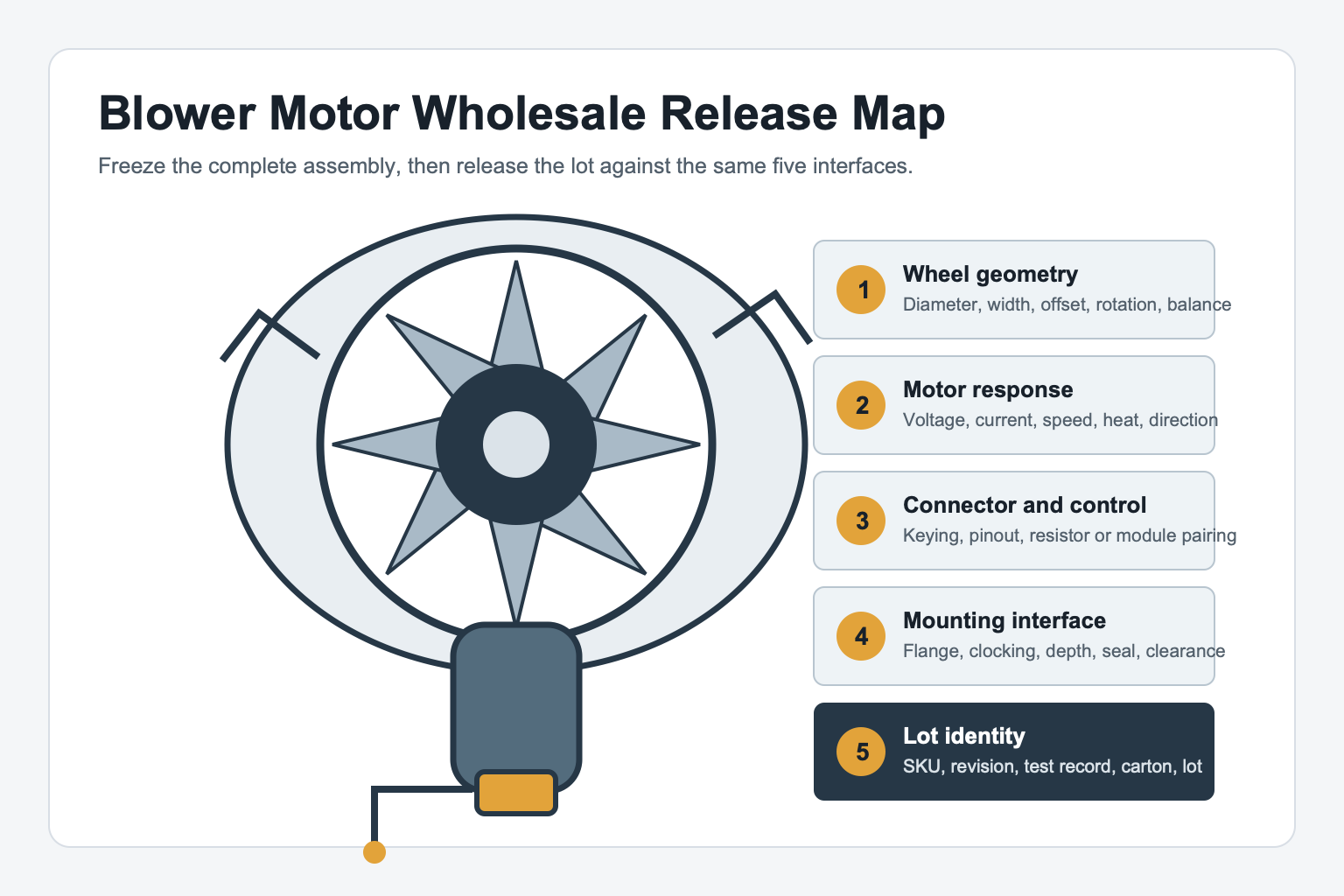
The car blower motor wholesale dossier needs five linked interfaces: the wheel, motor, connector and control route, mounting, and lot identity. If any one changes, the buyer should assess whether fit, electrical load, airflow, noise, installation, or traceability needs to be checked again.
| Interface | Fields to record | Evidence |
|---|---|---|
| Wheel | Diameter, width, offset, blade direction, rotation, material, retention | Drawing, measurement and approved sample |
| Motor | Nominal voltage, polarity, speed points, current, direction, thermal behavior | Controlled test conditions and results |
| Control | Connector keying, pins, resistor, module, command method, approved pairing | Pin map and functional test |
| Mounting | Flange pattern, clocking, insertion depth, seal, fasteners, clearance | Fixture or vehicle-housing trial |
| Lot | Part number, revision, date or lot, source, line, test status, carton and pallet | Trace record and shipping file |
Do not compress these fields into “same as OE.” An OE number can be a useful reference, but the approved wholesale file should show which physical and electrical characteristics were actually checked. That makes future substitutions visible rather than accidental.
Test the assembly under a defined load
A free-running motor test is good for polarity, obvious noise, and an initial current reading. It does not represent the aerodynamic load created by the wheel, housing, filter, evaporator, and duct restriction. Release evidence should identify the wheel and housing or correlated fixture, supply voltage, command point, test duration, ambient condition, instrumentation, result, and acceptance source.
Use multiple operating points when the application has several speeds or an electronic control. Compare speed response, current, airflow or pressure behavior, noise, vibration, starting, and temperature. The purpose is not to collect one attractive maximum value. It is to confirm that the unit behaves consistently across the range the customer will use.
Automotive electrical components may also need environmental evidence appropriate to their mounting location and customer requirement. The official ISO 16750-1:2023 overview explains the general framework for environmental stresses and tests for vehicle electrical and electronic equipment. It is context, not automatic approval: the buyer and supplier still need an agreed blower-motor validation plan.
Separate sample approval from lot release
A hand-picked sample can prove that one assembly is promising. It cannot show whether winding, brush, bearing, wheel molding, balance, connector, controller, assembly, test, and packaging remain stable across production. Before the first bulk order, define which characteristics are checked on every unit, which are sampled by lot, and which are verified by periodic or change-based testing.
Keep a controlled golden sample or an approved measurement record rather than an unlabelled part on a shelf. The reference needs identity, revision, approval date, storage owner, and rules for replacement. When production results drift, the team should compare data and controlled characteristics, not memories of how the sample sounded.
For a first car blower motor wholesale shipment, add a launch release that ties purchase order, SKU, production lot, inspection results, deviations, carton labels, quantity, pallet map, and approver. Repeat the gate after a significant component, tool, process, software, source, test, or site change.
Make noise evidence reproducible
“Quiet” is not a test result. Record the mounting fixture or HVAC housing, orientation, wheel, voltage or command, operating point, background condition, microphone or evaluation position, warm-up, and run time. Distinguish motor electrical noise, bearing noise, brush sound, wheel imbalance, blade interaction, housing contact, and installation resonance.
Use a defect vocabulary that warehouse, supplier, and warranty teams share. A short audio or video may support a complaint, but it should travel with part identity and operating conditions. Otherwise one team may call a normal commutation sound a bearing fault while another misses a wheel rubbing only after the assembly is installed.
Connect packaging to wheel protection and identification
The centrifugal wheel is both functional and easy to damage. A bent blade, shifted wheel, cracked hub, compressed wire, deformed flange, or broken connector lock can pass an unopened-carton count and fail at installation. The inner pack should prevent the assembly from becoming a load-bearing point and keep neighboring units from touching the wheel or wiring.
Validate the complete distribution route: unit box, dividers, master carton, pallet pattern, stacking, consolidation, moisture exposure where relevant, and receiving handling. Mark orientation only when it has a defined purpose. Place the product label where a warehouse can scan it without unpacking the protected assembly.
The label hierarchy should connect unit, carton, and pallet. Include the controlled SKU and lot identifier; add revision or date coding according to the trace plan. Mixed-SKU pallets need a visible map. Do not allow a generic family label to hide different wheel or controller versions.
Release inventory with a two-way trace exercise
At receiving, pick one carton and trace it backward to the supplier lot, inspection record, approved revision, and production evidence. Then choose one production lot and trace forward to units, cartons, pallets, warehouse locations, and customers. Record the time required and any missing links. A label that cannot support containment is decoration, not traceability.
Quarantine rules matter as much as labels. Define who can stop a lot, where suspect stock is held, what evidence releases it, and how corrected labels or repacking remain visible. If a carton is damaged but the unit appears sound, use an agreed inspection and disposition route rather than quietly replacing the box.
Price the program, not only the motor
Compare quotation scope, sample cost, tooling, testing, controller or resistor inclusion, packaging, labels, minimum quantities, mixed-SKU rules, lead time, warranty handling, documentation, and change notification. A lower unit price may move wheel assembly, testing, packaging, or claim analysis to the buyer.
For car blower motor wholesale, calculate working capital and return risk by SKU. Fast-moving verified applications can justify different stock depth from uncertain or low-volume references. Keep a review date for slow inventory and do not expand coverage merely to make a catalog look larger.
Turn returns into usable supplier evidence
A useful return record includes vehicle and application, installation date, mileage or operating time where available, symptom, affected speed, voltage at the motor, voltage drop, current, controller or resistor state, filter and duct condition, wheel damage, connector condition, noise evidence, part label, lot, and packaging. Preserve the unit before destructive inspection.
Use cause categories that allow “no fault found,” application error, vehicle electrical fault, installation damage, transport damage, wheel interference, controller mismatch, and confirmed product defect. That prevents every no-air complaint from being booked against the motor and gives purchasing a clearer view of actual supplier performance.
Prepare a ZUA inquiry that can be answered precisely
ZUA lists automotive blower motors for cabin-airflow and replacement applications within its broader climate-control product portfolio. Its public company profile identifies automotive A/C compressors as the core manufacturing focus, so buyers should confirm the responsible blower-motor production route, test ownership, and warranty boundary for the quoted SKU rather than transferring compressor evidence to another category.
Send the vehicle list, references, photos, connector view, wheel and mounting measurements, motor-only or assembly boundary, control architecture, annual estimate, launch quantity, destination, packaging, label, validation, and trace requirements through the ZUA contact page. Link the request to the company capability profile only for verified company information.
A structured inquiry lets ZUA identify open points before quoting and state whether a catalog item, sourced assembly, modified configuration, or new validation route is required. Keep each answer beside the drawing and approved sample so commercial changes do not overwrite the technical baseline.
Questions buyers ask about blower motor bulk orders
What is the first check for a wholesale blower motor order?
Define whether the unit is a motor, motor-and-wheel assembly, or complete module, then tie that boundary to the application and approved sample.
Can two blower motors with the same connector be interchangeable?
No. Rotation, wheel geometry, offset, mounting, speed, current, control pairing, and airflow can differ even when the connector mates.
Should airflow be tested without the HVAC housing?
A free-air test can screen a motor, but release evidence should use the intended housing or a correlated fixture when installed airflow is the requirement.
What should appear on the unit label?
Use the controlled SKU and lot identity, plus revision, date, source, or other fields required by the agreed trace plan.
Why does wheel offset matter?
It affects clearance and the wheel's position in the housing. An incorrect offset can cause rubbing, noise, poor airflow, or installation failure.
Is current draw enough to approve a blower motor?
No. Current must be interpreted with voltage, command, wheel, load, speed, airflow, temperature, and the controlled acceptance criteria.
How should mixed-SKU pallets be handled?
Separate the SKUs physically, label each unit and carton, and provide a pallet map that receiving can verify without opening every box.
When should a production change trigger reapproval?
Review any change that may affect fit, control, electrical load, airflow, noise, durability, traceability, packaging, or the approved production route.
Does ZUA manufacture every listed blower motor?
Do not assume that. ZUA presents compressors as its core manufacturing focus and lists blower motors in its supply portfolio; confirm the responsible route for each quotation.
What should a buyer include in a ZUA blower motor inquiry?
Send applications, references, photos, interfaces, control type, volume, destination, pack, label, test, trace, and warranty requirements.
Release car blower motor wholesale lots as one connected record
A dependable car blower motor wholesale program connects the vehicle record, sellable-unit boundary, wheel, motor, connector, controller, mounting, performance evidence, golden sample, lot release, packaging, traceability, receiving, and warranty feedback. That connection is what keeps the hundredth carton aligned with the sample that won the order.
ZUA Auto Parts can review the requested product boundary and application evidence before a quotation. Give the supplier enough data to expose uncertainty early; it is cheaper to close an interface question in the RFQ than to discover it after inventory reaches several warehouses.