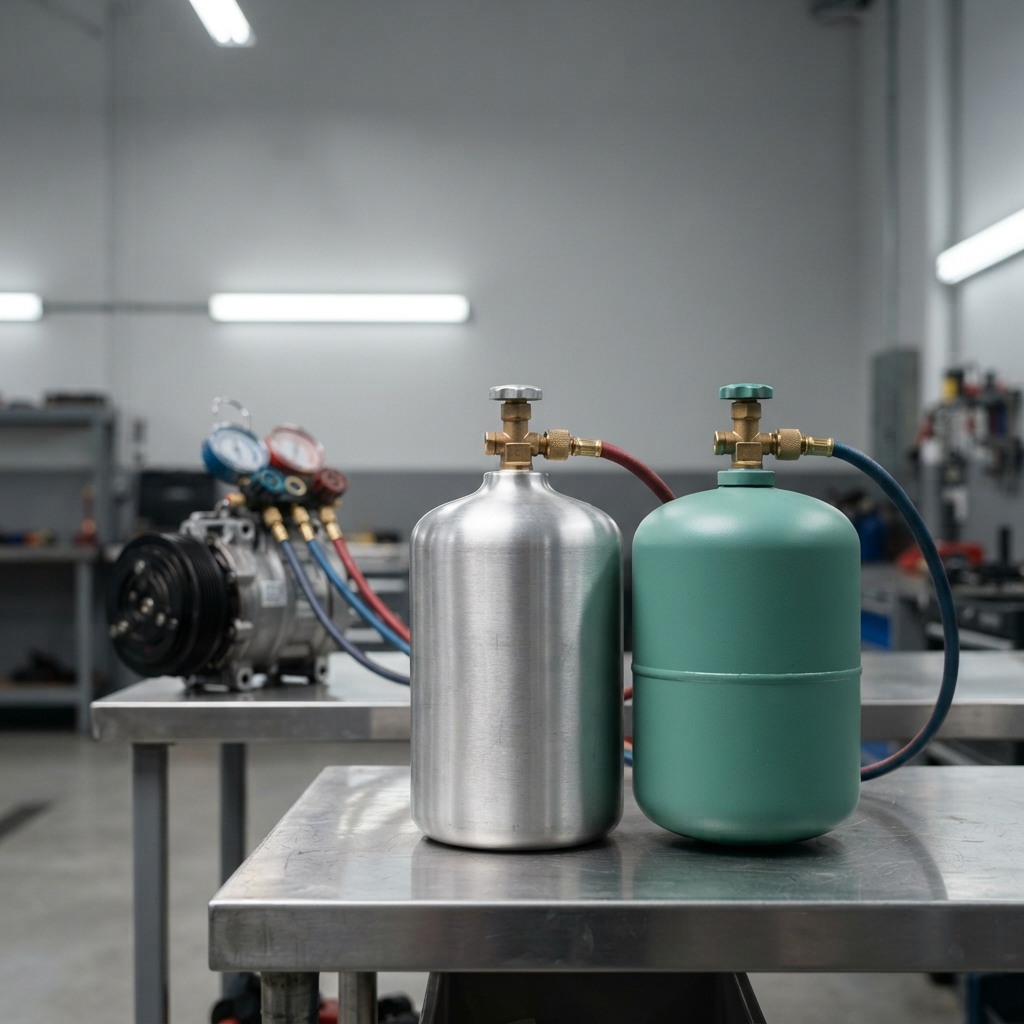
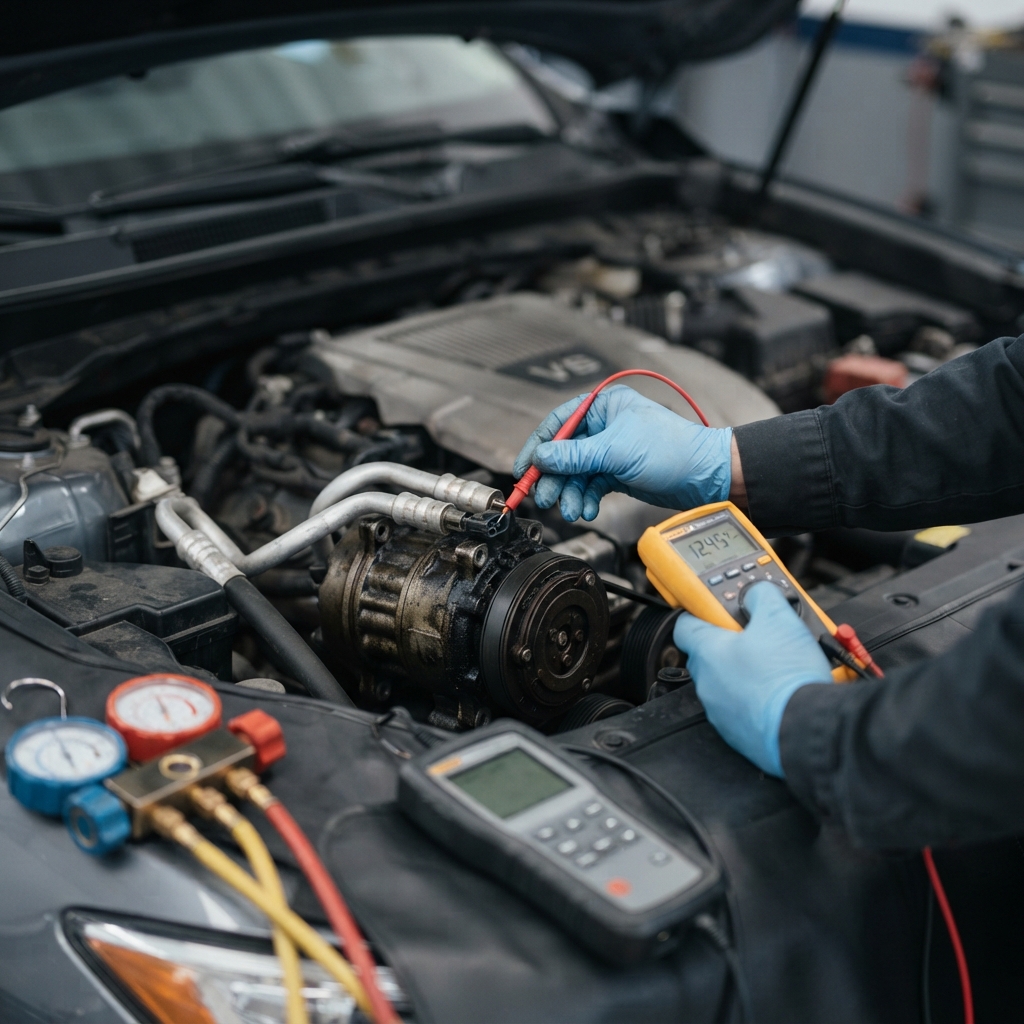
AC compressor not engaging is usually an electrical or protection fault, not a failed compressor. The clutch is the last link in a chain that starts with the HVAC request, passes through the engine control module, relay, pressure switch and coil, and only then pulls the armature plate against the pulley. Test that chain in order and most no-engage complaints are resolved before anyone removes the compressor.
This sequence is written for repair shops and for distributors supporting them. It separates the three families of cause — no command, command present but no engagement, and engagement without cooling — and it lists the evidence to record at each step so a warranty conversation starts from data rather than opinion.
What "AC compressor not engaging" actually means
The phrase describes a visible symptom: the pulley turns with the belt, but the hub and the inner part of the clutch do not. With the engine off, the armature plate should be free to rotate by hand on a disengaged clutch; with the engine running and the system requested, it should lock to the pulley.
Three different faults produce that same picture. The first is electrical: no request, no relay output, no supply to the coil, or an open coil. The second is protection: low or high refrigerant pressure, an over-temperature condition, or a control strategy that inhibits the compressor. The third is mechanical: an air gap too wide for the magnet to close, a worn or contaminated friction face, or a compressor too stiff to turn.
Treating an AC compressor not engaging as "the compressor is bad" is the most expensive way to diagnose it. A clutch coil and a pressure switch cost a fraction of a compressor, and both fail more often than the compressor itself.
The command chain, in the order you should test it
- Request: the cabin controls ask for cooling and the blower is running.
- Enable: the ECM or HVAC controller allows the compressor, given engine temperature, engine speed, ambient conditions and fault status.
- Output: the controller drives the AC compressor relay or a direct output.
- Protection: the pressure switch or sensor permits engagement across the safe pressure window.
- Supply: voltage reaches the clutch coil through the harness and connector.
- Coil: the winding draws its specified current and produces a magnetic field.
- Mechanics: the air gap, friction faces and compressor internals allow the clutch to pull in and the shaft to turn.
Every step has one cheap measurement. That is the whole method: measure at the boundary between steps and the fault localises to a single component.
Step 1: confirm the symptom and record a baseline
Start the engine, switch the AC on, set the blower to a mid speed and the temperature to its coldest setting, and confirm that the blower actually runs. A blower that is dead, or a control head that never sends the request, will produce an AC compressor not engaging complaint with nothing wrong under the hood.
Then watch the clutch with the engine running. If the outer pulley spins and the inner hub stays still, the clutch is disengaged. If the hub turns but the air is warm, the clutch is engaged and the fault is in the refrigerant circuit or the compressor's internal pumping. A car AC not blowing cold with a spinning hub is therefore a refrigerant-side fault, not a clutch fault, and should be written down as a separate diagnosis.
Record ambient temperature, vent temperature, engine coolant temperature, belt condition and any noise. These four numbers make a later comparison possible and take under two minutes.
Step 2: read the command before touching the circuit
Connect a scan tool and look for an AC request parameter, a compressor command or relay output, pressure sensor voltage, and stored codes in both the engine and HVAC modules. The distinction that matters is whether the controller is asking for engagement.
If the command is present and the clutch is not engaging, the fault is downstream: relay, fuse, harness, pressure switch or coil. If the command is absent, the fault is upstream: request, enable condition, sensor plausibility or a stored fault. An AC compressor not engaging with no command and no codes usually points to a control input the scan tool does not display by default, such as evap temperature, blower status or ambient plausibility.
Step 3: verify charge and pressures
Low refrigerant charge is the most common protection trigger. When suction pressure falls below the low-pressure cutout, the control system disengages the clutch to protect the compressor, and the symptom at the pulley is exactly the one described in this article. Compressor makers and the US EPA's motor vehicle air conditioner servicing rules both put refrigerant recovery and pressure release ahead of any electrical work, and this diagnosis should follow the same order.
Connect manifold gauges and compare both static and running pressures with the vehicle specification. A system that is empty, or that will not hold pressure, needs leak detection and repair before any electrical diagnosis is worth continuing. Do not add refrigerant to "see if it engages" without finding out where the last charge went.
High-side overpressure produces the same result from the opposite direction: the high-pressure cutout opens the clutch circuit, often in traffic or on a hot day, and the clutch re-engages once the system cools. An intermittent AC compressor not engaging complaint that only appears in traffic is a pressure problem until proven otherwise.
Step 4: test the AC pressure switch or trinary switch
A trinary switch typically performs three jobs: low-pressure cutout, high-pressure cutout, and cooling-fan control. Test it against the specification for each state rather than assuming continuity means healthy. The relationship is easy to confirm from a service manual: most air conditioners cycle the compressor on and off through a thermostat or a low-pressure switch that controls the compressor clutch, which is exactly why a switch fault and a charge fault look identical at the pulley.
With the harness disconnected, check continuity across the relevant terminals and compare with the switch's stated behaviour. Then check that the signal reaching the controller changes when pressure changes. A switch that is stuck open will hold the compressor off permanently; one that is stuck closed removes protection and can damage the compressor.
Bypassing a pressure switch is a diagnostic step with a jumper and a gauge attached, never a repair and never something a vehicle leaves the bay with.
Step 5: measure coil resistance and supply voltage
Disconnect the clutch connector and measure the coil resistance across the coil terminals. Compare it with the compressor manufacturer's specification for that part number; an open circuit means a failed coil, and a very low reading suggests a shorted winding.
Then reconnect and back-probe the supply while the system is commanded on. If the coil has voltage but no current draw and no magnetic pull, the coil or its ground is at fault. If there is no voltage at the coil, work backwards through the connector, harness and relay rather than replacing the clutch.
Compressor coil resistance specifications are part-specific, which is one reason the compressor identity has to be correct before the test means anything. The same clutch family can be wound differently across 12 V and 24 V applications.
Step 6: check the air gap and the friction faces
Even a healthy coil cannot pull an armature plate across an excessive air gap. Measure the gap with a feeler gauge and compare it with the specification for that clutch. Rust, oil mist, a bent plate or a worn friction face will all reduce or defeat engagement.
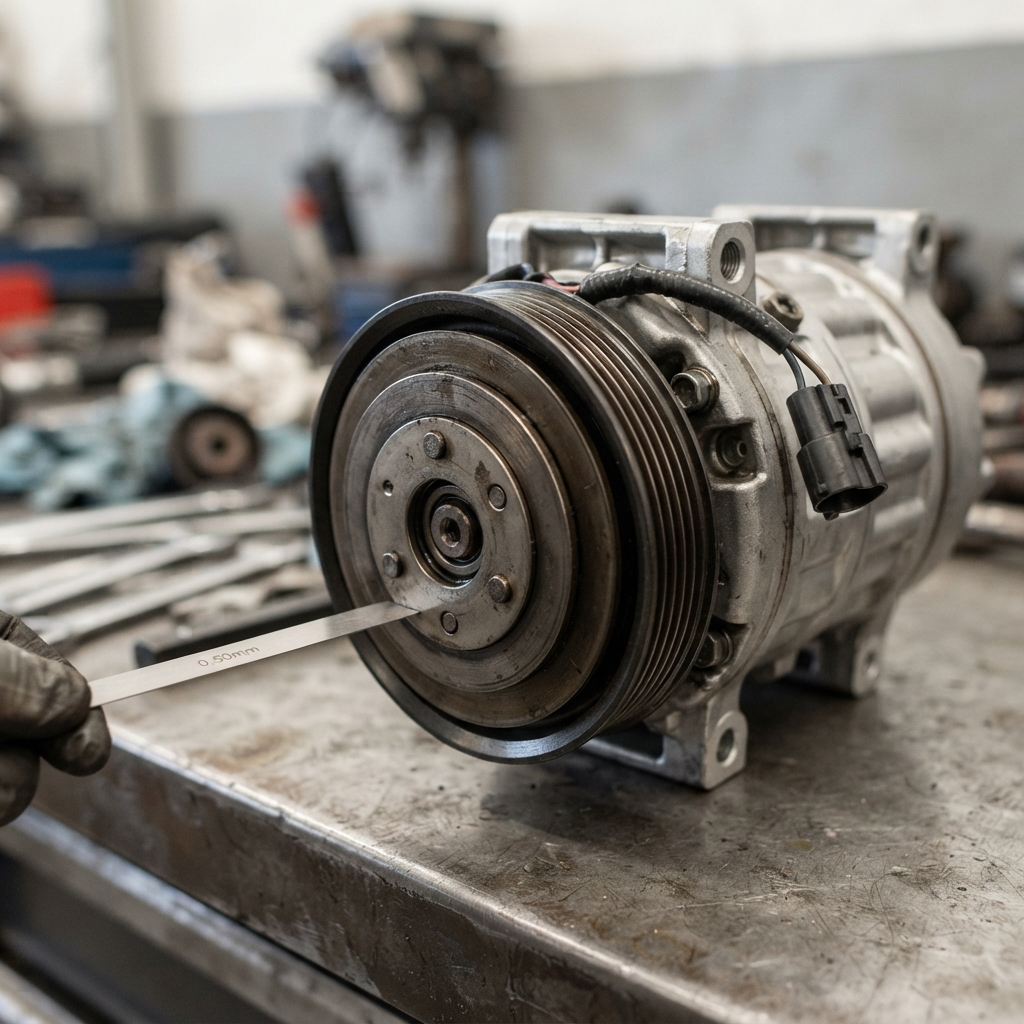
Look at the friction surfaces as well: a glazed or oil-contaminated face can engage weakly, slip, and overheat until the coil fails. If the gap is out of specification, follow the manufacturer's shimming or replacement procedure rather than improvising with washers.
Step 7: relay, fuse and voltage drop
Swap the AC compressor relay with an identical known-good relay from a non-critical circuit, and check the fuse under load rather than by eye. A fuse that looks intact can still fail open when current rises.
Then measure voltage drop on both the feed and the ground side of the coil circuit while it is commanded on. High resistance in a corroded connector, a chafed harness or a poor ground will show as voltage at the coil that collapses under load. This is the classic cause of an AC compressor not engaging when the system tests fine with the engine off.
Step 8: confirm the enable conditions
Controllers disengage the compressor for reasons that have nothing to do with the air conditioning: wide-open throttle, very low engine speed, overheating, low ambient temperature, a blower fault, or an evap-temperature limit. Some strategies also disengage during certain defrost modes.
Read those parameters live rather than assuming. An AC compressor not engaging at idle but working normally on the road is often an enable condition or a pressure issue, not a clutch fault. The same logic applies to a vehicle that engages for a few seconds and then drops out.
Step 9: rule out mechanical seizure and internal failure
If the clutch engages but the belt squeals, the engine labour changes, or the hub stops turning under load, stop the test. A seized compressor can destroy a belt and damage the mounting brackets, and continued running turns a rebuildable core into scrap.
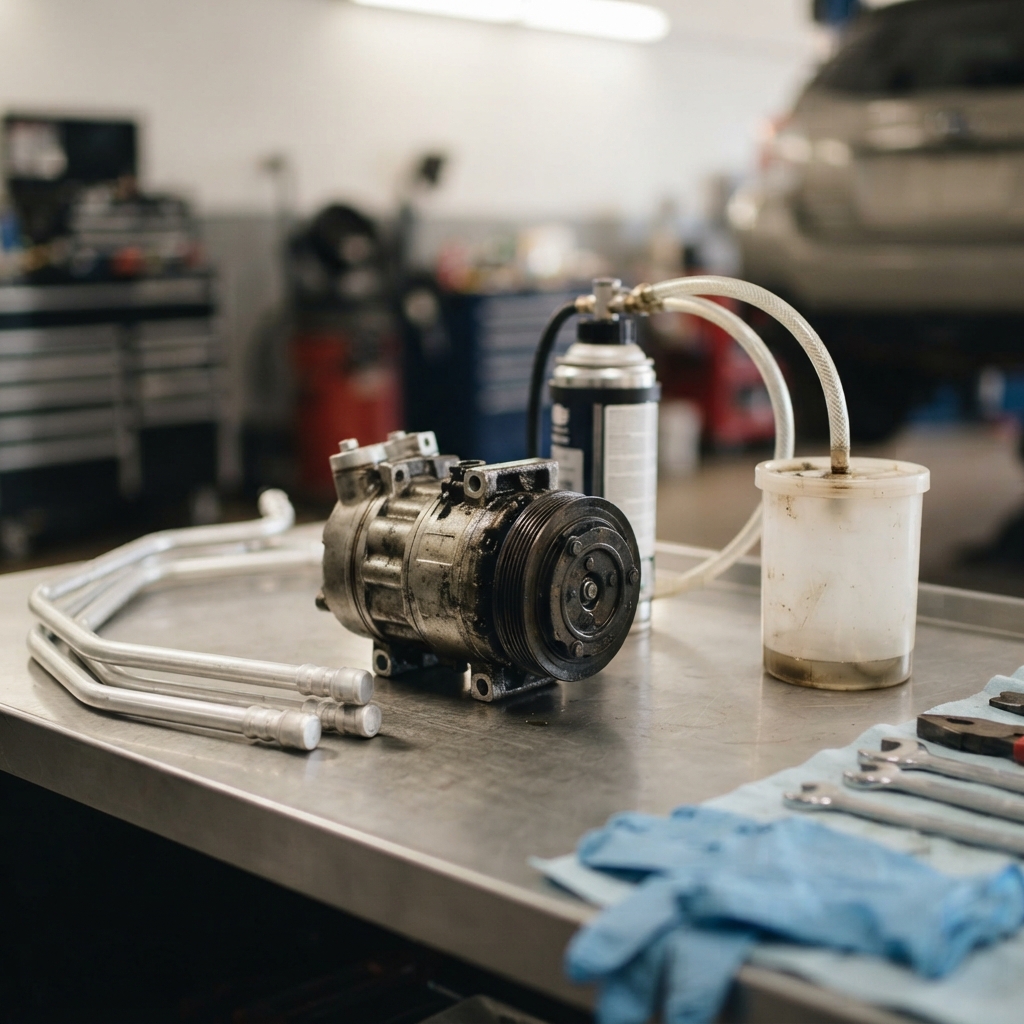
With the belt removed, turn the compressor shaft by hand where the design allows. Roughness, tight spots or metallic debris in the oil point to internal failure. In that case the repair is a compressor replacement plus a flush, a new receiver-drier and the correct lubricant charge, not a clutch.
This is also where an AC compressor not engaging diagnosis becomes a parts decision. Once the electrical chain is proven good and the compressor will not turn, the evidence supports replacement rather than further electrical testing.
Symptom, cause and next test
| Observation | Most likely cause | Confirming test |
|---|---|---|
| No command shown, no codes | Request or enable condition missing | Live data for request, blower, ambient and coolant temperature |
| Command present, no voltage at coil | Relay, fuse, harness or ground | Relay swap, fuse load test, voltage drop |
| Voltage at coil, no magnetic pull | Open coil or excessive air gap | Coil resistance and feeler-gauge gap check |
| Engages briefly, then drops out | Pressure cutout or enable condition | Gauge readings logged while it cycles |
| Never engages in hot traffic only | High-pressure protection | High-side pressure and fan operation |
| Engages, belt slips, no cooling | Seized compressor or clutch slip | Shaft rotation by hand, debris in oil |
| Engages and cools weakly | Charge, expansion device or airflow | Pressure cross-check and vent temperature |
Clutch, coil or compressor: what to replace
| Finding | Correct repair | Why |
|---|---|---|
| Open or shorted coil | Clutch coil or clutch assembly | The compressor and refrigerant circuit are untouched |
| Air gap out of specification | Reshim or replace the clutch per the maker | A new compressor will not fix a gap problem |
| Worn or glazed friction face | Clutch assembly | Slip generates heat and kills the coil |
| Pressure switch stuck open | Switch, after confirming the charge | The switch is reporting a condition, so verify it is real |
| Shaft will not turn, debris in oil | Compressor, drier and system flush | Contamination travels through the circuit |
What distributors should stock for this failure
The parts that resolve most AC compressor not engaging jobs are small and slow-moving until summer arrives: clutch coils, complete clutch assemblies, AC compressor relays, pressure switches, connector pigtails, O-rings and receiver-driers. Stocking them by compressor platform rather than by vehicle name keeps the range manageable.
Fitment discipline matters more than depth. Pulley diameter, groove count, coil voltage and connector shape all vary within the same compressor family, so a counter sale based on the vehicle alone will eventually produce a return. The clutch coil testing guide sets out the measurements a shop should be able to make before it orders.
Common mistakes in this diagnosis
- Replacing the compressor first. The clutch and the protection circuit fail more often and cost far less.
- Jumping the pressure switch and leaving it jumped. That removes the protection that keeps a compressor alive.
- Topping up refrigerant to force engagement. It hides the leak and overcharges the system.
- Checking a fuse by eye. A fuse can look intact and still be open under load.
- Ignoring the ground side. Voltage drop tests on both sides are the only reliable check.
- Measuring coil resistance without the specification. A number without a reference proves nothing.
Compressors and clutch hardware from Bailin
Bailin (Guangzhou Berlin Auto Parts Manufacturing Co., Ltd.) has manufactured piston-type automotive A/C compressors in Guangzhou since 2006, with an annual capacity stated at 450,000 units and a range spanning variable and fixed displacement platforms from 80cc to 320cc. That spread matters for diagnostic work, because the clutch and pulley fitted to a 10PA17C are not the ones fitted to a 10P15C. The company profile sets out the plant and the engineering team behind that range.
Two catalogue examples show the level of detail a shop needs before ordering. The 10PA17C compressor for the Toyota HiAce RZH10 is listed as a 12 V R134a unit with a 112 mm pulley, PV4 groove, aluminium and copper construction and a shipping weight of 8 kg. The 10P15C 12 V compressor for the Jacto Uniport carries factory number BL.81.144 on the same 10P15C platform. Both product records state ISO/TS16949 certification, and both are listed in the compressor catalogue.
When a shop sends a compressor back as "not engaging", the useful information is the coil resistance, the supply voltage under load, the air gap and the pressure readings. With those four values, the catalogue can be matched to the right platform and the contact page is the fastest route to a fitment check.
Frequently asked questions
Why is my AC compressor not engaging when the AC is switched on?
Most often because the control system is protecting the compressor: low refrigerant charge, high pressure, or an enable condition such as low ambient temperature. Less often it is an open clutch coil, a relay or a wiring fault.
Can a low refrigerant charge stop the clutch from engaging?
Yes. The low-pressure cutout opens the clutch circuit when suction pressure falls below the threshold, which protects the compressor from running without lubrication. The fix is leak detection and repair, not a top-up.
How do I test an AC compressor clutch coil?
Disconnect the connector, measure resistance across the coil terminals and compare it with the specification for that part number, then check that supply voltage arrives when the system is commanded on. An open reading means a failed coil.
What causes a compressor clutch not engaging even with good pressure?
An open coil, a relay or fuse fault, a corroded connector, an excessive air gap or a missing enable condition. The command-chain test separates them in a few minutes.
Can I drive with the AC compressor not engaging?
Yes, the vehicle is safe to drive, but the fault should be found rather than ignored. A seized compressor that is still driven can damage the belt and the mounting hardware.
Is it cheaper to replace the clutch or the whole compressor?
The clutch, when the compressor turns freely and the circuit is clean. A compressor is only justified when the shaft will not turn, the oil carries debris, or the pumping performance has failed.
Why does the compressor engage at speed but not at idle?
Low engine speed reduces both the alternator output and the compressor's pumping capacity, so a marginal pressure or a weak electrical supply shows up first at idle. Check the enable conditions and the voltage drop under load.
Conclusion
An AC compressor not engaging is a chain diagnosis: request, enable, relay, protection, supply, coil, air gap, then mechanics. Testing in that order costs minutes and prevents the most common mistake in this repair, which is replacing a healthy compressor because the clutch coil was open.
If the evidence points to the compressor itself, match the platform, pulley, voltage and refrigerant before ordering. Send the vehicle details, OE number or the four measurements above to our team through the contact page, and the compressor quality-control tests article explains what the replacement should be able to prove.