R1234yf vs R134a is a system decision before it is a purchasing decision. R1234yf is the low-GWP HFO that European type approval pushed into new passenger cars, while R134a remains the HFC behind most vehicles already on the road and most of the aftermarket's installed base. A buyer who treats the two as interchangeable ends up with the wrong compressor, the wrong seals, and service equipment that cannot recover the charge.
This guide compares the two refrigerants on the criteria that actually decide an automotive A/C sourcing program: global warming potential and regulation, safety classification, compressor and system design, lubricant and material compatibility, service equipment, availability, and retrofit risk. It closes with a decision checklist you can attach to an RFQ.
R1234yf vs R134a: the quick verdict
The short answer to R1234yf vs R134a is that the vehicle system and the destination market decide, not the price list. For a new passenger-car platform sold in the European Union, the answer is a refrigerant with a GWP below 150, which in practice means R1234yf or CO2 (R744). For replacement compressors covering vehicles built from the mid-1990s to the mid-2010s, R134a refrigerant remains the reference fluid for most of that fleet. For a distributor range serving mixed vehicle ages, you need both, plus catalog discipline strict enough that a counter clerk cannot order across the boundary by accident.
| Criterion | R134a | R1234yf |
|---|---|---|
| Chemical family | HFC | HFO |
| GWP (100-year) | 1,430 under IPCC AR4; the European Commission cites 1,300 | Far below the 150 threshold set by EU rules |
| Safety classification | A1, non-flammable | A2L, mildly flammable |
| Charge and pressure data | Vehicle-specific | Vehicle-specific; never interchangeable with R134a data |
| Lubricant | As specified by the compressor maker | As specified by the compressor maker; never assume the R134a oil is approved |
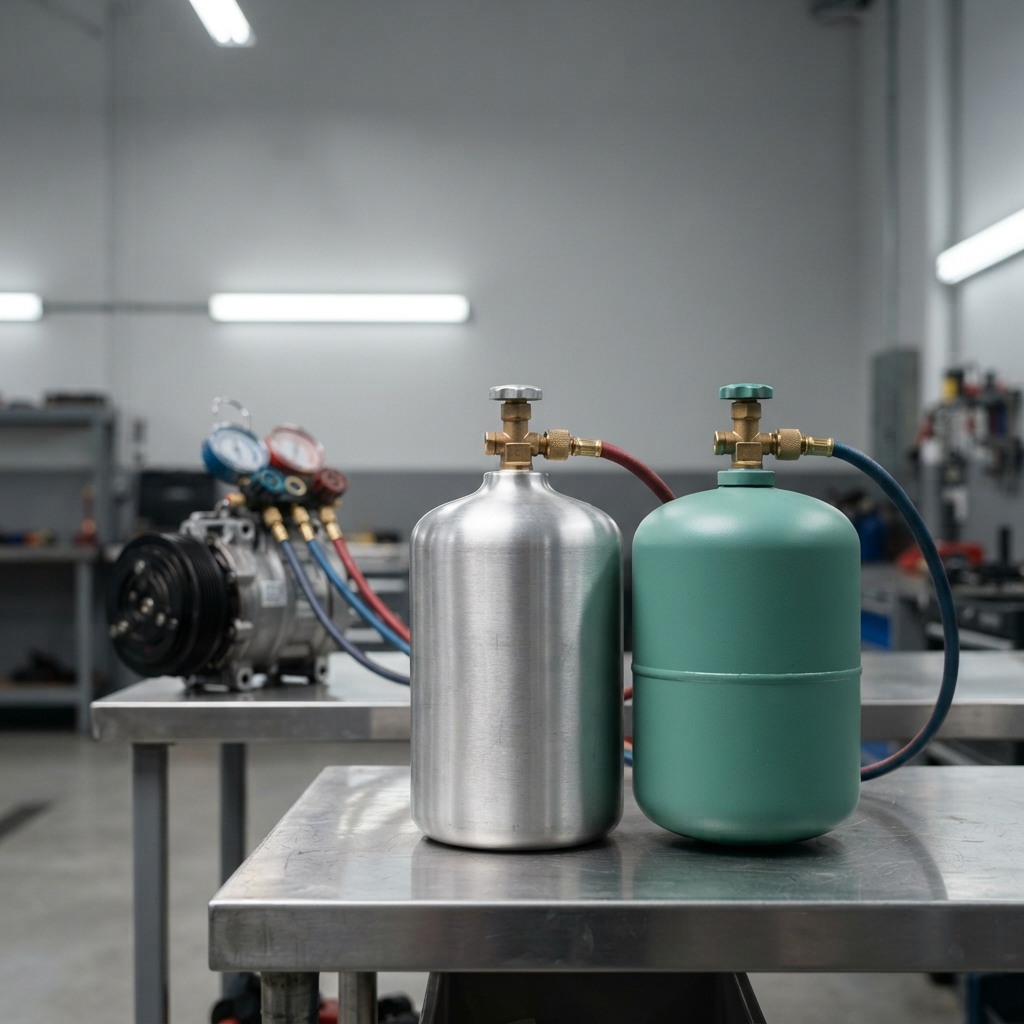
| Service equipment | R134a recovery, recycling and recharge set | Dedicated R1234yf machine, fittings and leak detection |
| Retrofit from the other fluid | Reference fluid for the older fleet | Not a drop-in; component, tool and labelling changes apply |
| EU new-vehicle status | Excluded from new passenger-car MACs since 2017 | Compliant with the sub-150 GWP rule |
| US status | Still widely used in service | Listed as acceptable under EPA SNAP, subject to use conditions |
| Aftermarket depth | Broad and mature | Growing, and strongly dependent on vehicle age and region |
What each refrigerant is
R1234yf vs R134a is often framed as new against old, but the two fluids sit closer together than that framing suggests. Both are single-component fluorinated refrigerants used in essentially the same vapour-compression circuit; what separates them is climate impact, safety class and the validation that surrounds each part number.
R134a: the installed base
R134a (1,1,1,2-tetrafluoroethane) replaced R12 in the 1990s and became the default automotive AC refrigerant for roughly two decades. Its advantage for buyers is not technical elegance but depth: compressor families, expansion devices, hoses, seals, driers and service tools are all built around it, and most independent workshops own the equipment to handle it. That installed base is why R134a compressors such as the 10PA17C and 10P15C families remain core aftermarket items even where new vehicles no longer use the fluid.
The weakness is climate impact. R134a is a potent greenhouse gas, and the European Union treats it as such: the Commission's own page on mobile air-conditioning systems states that R134a has a GWP of 1,300, well above the 150 limit that now applies to new passenger cars.
R1234yf: the low-GWP replacement
R1234yf (2,3,3,3-tetrafluoropropene) was developed as a replacement with a GWP far below the regulatory threshold, and R1234yf refrigerant behaves broadly like R134a in the circuit. That similarity is why the industry could convert existing architectures rather than redesign every HVAC module. The qualification matters: an A2L refrigerant is mildly flammable, and that single property changes how the system is designed, serviced, stored and labelled.
For a parts buyer, the practical consequence is that R1234yf is not simply "R134a with a different can". Compressors, seals, service ports, leak detectors, recovery machines and workshop procedures all carry refrigerant-specific requirements, and the vehicle manufacturer's charge data is the only valid reference.
How the two refrigerants compare
Global warming potential and the regulatory trigger
The EU Mobile Air Conditioning Directive (2006/40/EC) is the reason R1234yf exists in volume. It applies to air-conditioning systems fitted to passenger cars (category M1) and light commercial vehicles (category N1, class 1), and it phases in a ban on fluorinated greenhouse gases with a GWP above 150. The European Commission sets out the timetable plainly: from 21 June 2008, new vehicle types could not obtain type approval with such a refrigerant and a leak rate above 40 grams per year for a single-evaporator system, or 60 grams per year for a dual-evaporator system; from 21 June 2009 this applied to all new vehicles; from 1 January 2011 new types had to use a refrigerant with a GWP of 150 or less; and from 1 January 2017 the ban covered every new vehicle placed on the EU market.
The numbers behind that threshold come from the IPCC assessment reports. The US EPA's explanation of global warming potentials lists HFC-134a at 1,430 over a 100-year horizon on the IPCC Fourth Assessment Report basis, which is roughly nine times the EU limit. Any refrigerant GWP in the single digits or low double digits clears the rule comfortably; the R134a figure cannot.
In the United States the mechanism is different. The EPA's Significant New Alternatives Policy (SNAP) program lists HFO-1234yf as acceptable in motor vehicle air conditioning subject to use conditions, which is a use-condition listing rather than a mandate. A US program can therefore still ship R134a systems, but an export program sold into the EU cannot.
Safety classification: A1 versus A2L
The safety side of R1234yf vs R134a is the least negotiable difference. R134a is A1: non-flammable at ambient conditions. R1234yf is A2L: mildly flammable, with a lower flammable limit and a narrow flammable range that only becomes relevant when the refrigerant is released and concentrated. A2L is not a reason to avoid the fluid, but it is a reason to change workshop behaviour.
In practice that means no open flame or grinding near an open circuit, dedicated leak detection rather than a combustible-gas probe, ventilation when charging in a confined bay, and strict separation of tools. For a distributor, it also means staff training and customer labelling are part of the product, not an afterthought.
System design and compressor implications
Because the two fluids have different thermophysical properties, the system around them is not identical. Charge weight, expansion-device calibration, internal heat exchanger design, hose permeation and control strategy are all set by the vehicle manufacturer for the fluid it chose. That is why a compressor's displacement and control type must be matched to the application, not selected from a generic catalogue page.
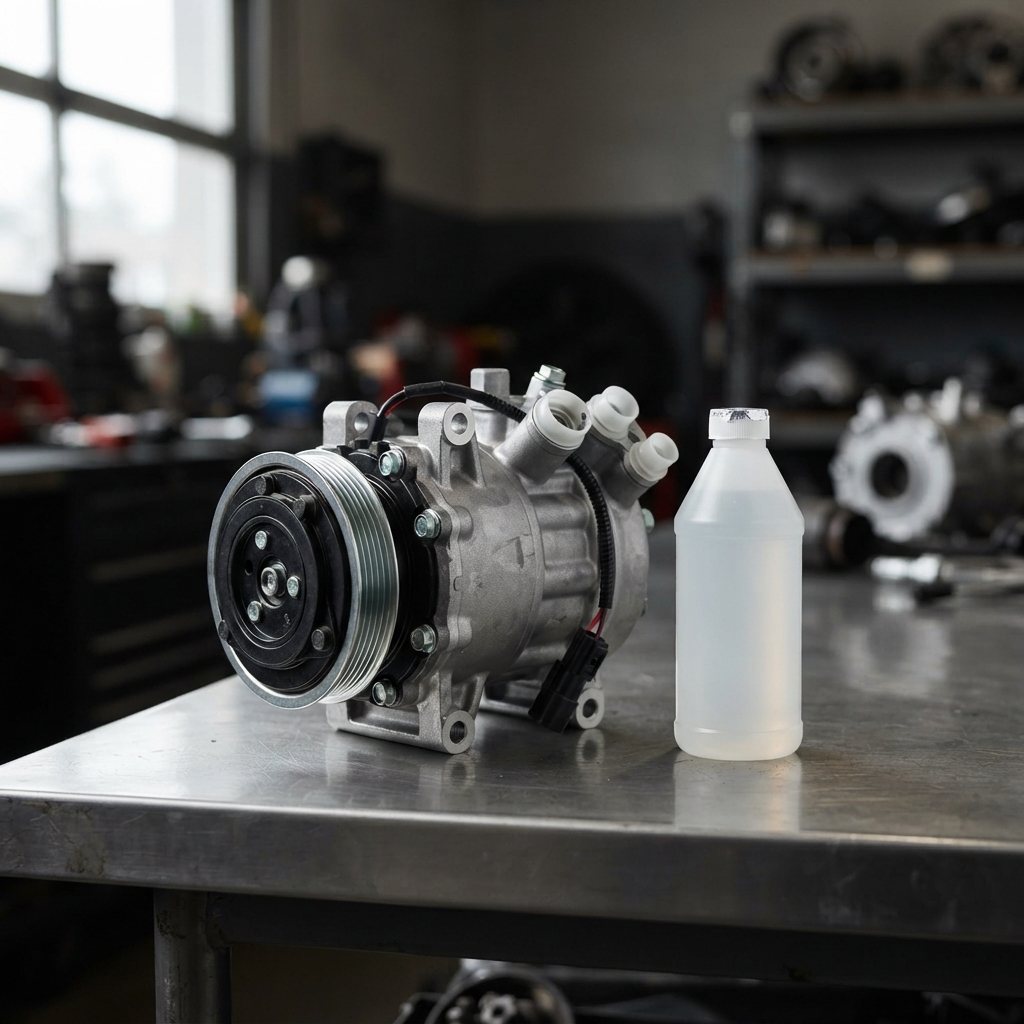
At the compressor level, three things change first: the lubricant specification, the shaft seal and O-ring materials, and the clutch or control-valve calibration on variable-displacement units. A compressor validated on R134a is not automatically approved for R1234yf even when the mounting pattern and pulley are identical.
Lubricant and material compatibility
Both refrigerants require a lubricant that is fully miscible and stable in the circuit, and both lubricants are strongly hygroscopic — they absorb moisture from the air, which is why a receiver-drier is replaced whenever the circuit is opened and why an open compressor should never sit uncapped in a humid workshop.
The safe rule for buyers is simple: never infer the oil from the refrigerant name. Use the lubricant the compressor manufacturer specifies for that part number and that refrigerant, keep it sealed until use, and never top up one oil type with another. Mixed lubricants are one of the few failure modes that will destroy a compressor inside a season and leave the warranty argument unwinnable.
Service equipment and fittings
R1234yf systems use different service fittings from R134a, precisely so that the wrong machine cannot be connected. Recovery, recycling and recharge equipment must be rated for the refrigerant, and leak detection must be appropriate for A2L fluids. SAE's J-standard service requirements exist to keep those interfaces consistent, and the US EPA's motor vehicle air conditioner servicing rules set out the recovery and handling duties that come with any refrigerant change in a workshop.
For a wholesale program, this is a commercial risk as much as a technical one: a customer who buys an R1234yf compressor but owns only R134a service equipment will be back with a complaint that has nothing to do with the part.
Cost, availability and supply chain
On cost and availability, R1234yf vs R134a still favours the older fluid. R134a benefits from scale: it is produced in large volumes, stocked by every refrigerant distributor, and priced predictably enough to quote into a landed-cost model. R1234yf volumes are smaller and more regionally uneven, so availability and lead time deserve a specific question in any RFQ rather than an assumption carried over from R134a.
Compressor pricing follows the same logic. The fluid itself is a modest share of a compressor's cost, but the validation, seals, service fittings and labelling that surround an R1234yf program are not. Two quotes for "the same" compressor in the two refrigerants are rarely comparable line for line.
The regulatory picture in the EU and the US
The EU position is a hard constraint: no new passenger car or light commercial vehicle may be placed on the market with a MAC refrigerant above 150 GWP. That rule, not customer preference, is what makes R1234yf the default for European new-vehicle programs, and it applies to imported vehicles as well as those built in Europe.
The US position is a listing regime. The EPA SNAP fact sheet for HFO-1234yf describes it as an acceptable substitute for ozone-depleting substances in motor vehicle air conditioning, subject to use conditions. Those conditions typically cover service equipment, labelling and handling, and they are worth reading before a US-bound private-label program is finalised. State-level rules can add further requirements, so a national listing is a floor rather than a ceiling.
Outside those two markets, the picture is mixed: some countries follow the EU GWP threshold, others regulate only the refrigerant's handling, and many have no MAC-specific rule at all. A distributor selling into several regions should carry the destination requirement on the SKU record, not in a salesperson's memory.
What the refrigerant choice means for compressor sourcing
Once the refrigerant is fixed, the compressor RFQ becomes much easier to write. The table below lists the fields that should be frozen before a supplier quotes, because each one can silently change the part.
| Field to freeze | Why it changes the part |
|---|---|
| Refrigerant and application | Sets seal material, lubricant, validation evidence and labelling |
| Displacement (cc) and control type | Fixed, internal-control variable or external-control variable; determines capacity and wiring |
| Pulley diameter and groove count | Determines belt speed and clutch engagement; a 112 mm PV4 pulley is not interchangeable with a different diameter |
| Rated voltage | 12 V and 24 V units serve different vehicle classes and must not be mixed in a catalogue |
| Mounting and manifold ports | Bolt pattern, port angle and port size decide whether the unit fits at all |
| Lubricant charge and type | Must match the refrigerant and the compressor maker's specification |
| Quality system and test evidence | Helium leak test, performance test and durability records should be named in the approval |
| Packaging and labelling | Refrigerant marking is a safety and compliance item, not a marketing choice |
Notice that "R134a compressor" is not a specification. It describes a compatibility class, not a part. Two compressors can both be sold as R134a units and differ in displacement, pulley, clutch voltage, port geometry and control strategy.
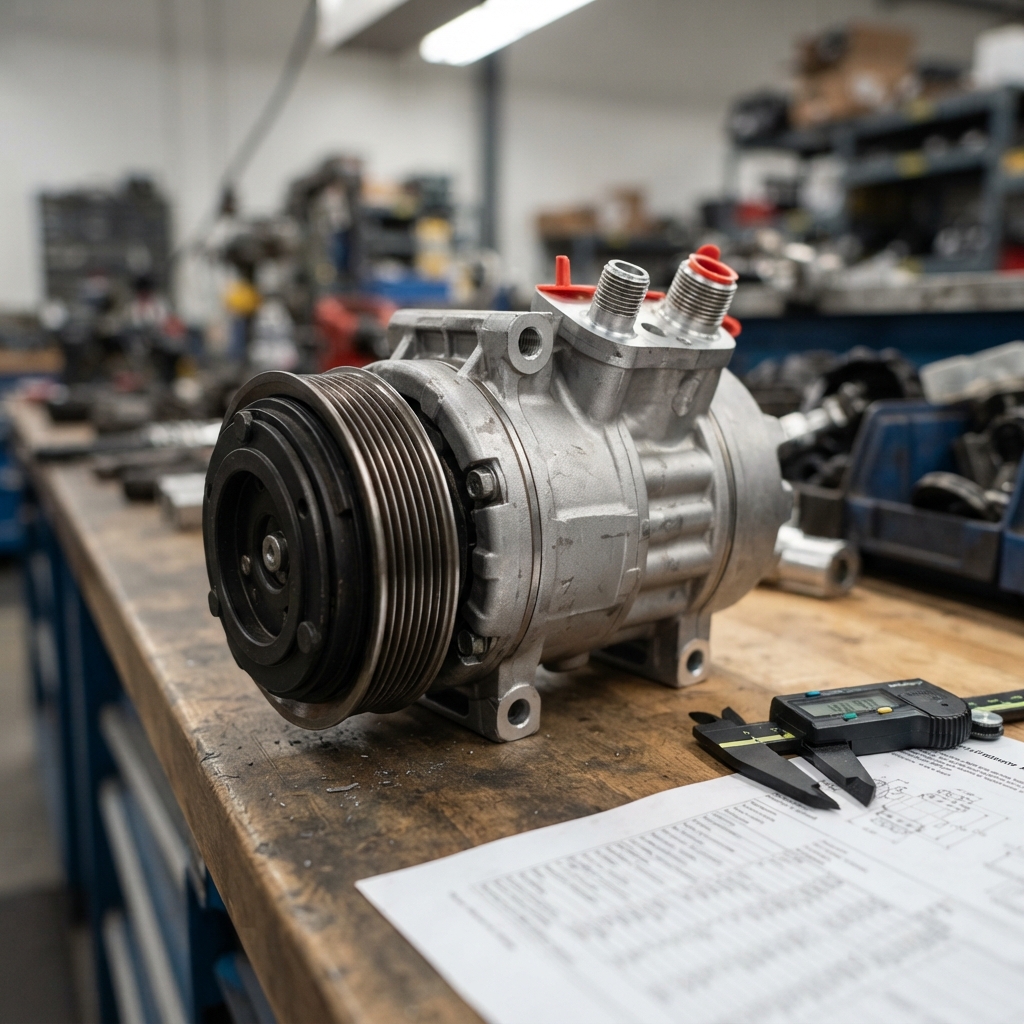
Can you retrofit an R134a system to R1234yf?
Technically, in some applications, yes — and commercially, usually no. A retrofit R134a to R1234yf is an engineering project, not a recharge. The EPA's SNAP listing for R1234yf in motor vehicle air conditioning is subject to use conditions, and those conditions assume the system has been assessed for the new fluid rather than simply evacuated and refilled.
The items that change in a genuine retrofit are consistent: lubricant and possibly the compressor, seals and O-rings, hoses with adequate permeation performance, the receiver-drier, the expansion device or its calibration, service ports, leak-detection method, and the under-hood label. Each of those is a place where a shortcut becomes a warranty claim six months later.
| Retrofit scenario | Reasonable position |
|---|---|
| OEM or fleet program with engineering support | Possible, with a documented component assessment and revised labels |
| Aftermarket range sold as "compatible with both" | Do not claim it. A single SKU cannot carry two refrigerant validations |
| Repair shop converting a customer vehicle to save money | Not advisable; the equipment and component changes usually exceed the saving |
| Mixed-bay workshop without dedicated equipment | Do not handle R1234yf at all until the equipment and training exist |
R1234yf vs R134a: best-fit scenarios
The comparison only becomes useful when it is attached to a program type. These are the five cases that cover most sourcing decisions:
- European new-vehicle program: R1234yf, with compressor validation, A2L labelling and dedicated service tooling designed in from the start.
- Aftermarket range for vehicles built before roughly 2015: R134a remains the volume fluid; depth of coverage matters more than novelty.
- Export distributor with mixed vehicle ages: both fluids, separated at catalogue level, with the refrigerant printed on the box and in the fitment data.
- Heavy-duty, off-road and stationary applications: often still R134a, because the installed base is long-lived and the service network is built around it; confirm the destination rule before assuming.
- Private-label program: choose one refrigerant per SKU and put the decision in writing; dual-fluid claims are the fastest route to a returns problem.
Decision checklist before you approve a refrigerant or compressor
- Confirm the destination market and its GWP rule, not just the customer's preference.
- Confirm the vehicle application and the refrigerant the system was engineered for.
- Freeze displacement, control type, pulley diameter and groove count, voltage and port geometry.
- Ask for the lubricant specification and the charge quantity in writing.
- Ask which leak, performance and durability tests were performed on that part number, and on which refrigerant.
- Confirm the service equipment and training the customer will need before the first sale.
- Check the label, the packaging and the catalog record all name the same refrigerant.
- Decide the retrofit position before a customer asks, so the answer is consistent.
Common mistakes in R1234yf vs R134a sourcing
- Treating the refrigerants as interchangeable. They are close in behaviour and different in validation, tooling and law.
- Assuming the R134a lubricant carries over. The oil must be approved for the refrigerant and the compressor.
- Selling one SKU as dual-compatible. A part validated on one fluid is not validated on the other.
- Ignoring the service network. If the buyer cannot recover the charge, the part will be blamed for the outcome.
- Quoting from a catalogue title. "R134a compressor" hides displacement, pulley and voltage differences that decide fitment.
- Leaving the retrofit question unanswered. Customers will improvise, and improvisation is what warranties are made of.
Compressors for R134a and low-GWP programs from Bailin
Bailin (Guangzhou Berlin Auto Parts Manufacturing Co., Ltd.) has built piston-type automotive A/C compressors in Guangzhou since 2006, with a plant of more than 10,000 square metres and an annual compressor capacity stated at 450,000 units. The range covers variable and fixed displacement platforms from 80cc to 320cc, which is the span most aftermarket programs need when they carry both an R134a core range and a newer low-GWP line.
Two examples show how specific the fitment data has to be. The 10PA17C compressor for the Toyota HiAce RZH10 is listed as a 12 V unit for R134a, with a 112 mm pulley, PV4 groove, aluminium and copper construction, a shipping weight of 8 kg and ISO/TS16949 certification on the product record. The 10P15C 12 V compressor for the Jacto Uniport is a different 10P15C platform with its own factory number, BL.81.144, and the same ISO/TS16949 record. Same broad family name, different part — which is exactly why the RFQ fields above matter.
If you are building a range that has to serve both refrigerants, the useful starting point is the application list and the compressor platform, not the refrigerant name alone. Our team can work from a vehicle list, an OE number or a sample, and the compressor catalogue shows the current platforms.
Frequently asked questions
Is R1234yf vs R134a a fair comparison?
Yes, as long as it is a comparison of systems rather than fluids. The refrigerants behave similarly in the circuit; the differences that matter are GWP, safety class, lubricant approval, service equipment and the validation behind each compressor.
Is R1234yf better than R134a?
Better for climate impact and for compliance with the EU's 150 GWP limit; not automatically better for a given vehicle. The right fluid is the one the system was engineered and validated for. R1234yf carries A2L handling requirements that R134a does not.
Can I use R134a in an R1234yf system?
No. The system is designed around a specific refrigerant, and substituting it invalidates the charge data, the lubricant specification and the safety assessment. It also defeats the regulatory reason the vehicle was built with R1234yf.
Can I use R1234yf in an older R134a system?
Only as an engineered retrofit with component assessment, lubricant change, new seals and drier, compatible service ports and revised labelling. It is not a recharge procedure, and it is rarely economic for a single vehicle.
Why does R1234yf need different service equipment?
Because it is A2L and because cross-contamination between refrigerants ruins both charges. Dedicated recovery machines, fittings and leak detectors keep the fluids separate and keep the workshop safe.
Does the compressor change between the two refrigerants?
Often, yes — at minimum in lubricant, seals and validation. A compressor approved for R134a is not automatically approved for R1234yf even when the mounting and pulley are identical.
Is R134a banned everywhere?
No. The EU bans refrigerants above 150 GWP in new passenger-car and light-commercial MACs; other markets regulate differently. The US lists R1234yf as acceptable under SNAP but does not mandate it for all vehicles.
What GWP values should I quote to a customer?
Quote the value from the standard your customer's market uses, and name the source. The EU cites 1,300 for R134a; the IPCC Fourth Assessment Report lists 1,430. Both are far above the 150 limit, which is the point that matters.
Does the refrigerant affect warranty on a replacement compressor?
Yes. A compressor installed with the wrong refrigerant or an unapproved lubricant is normally outside warranty, and the failure analysis will usually show it. Keep the refrigerant and oil on the invoice.
Conclusion
R1234yf vs R134a is decided by the vehicle system and the destination market, then executed through the compressor specification. R1234yf clears the EU's 150 GWP threshold and brings A2L handling duties; R134a remains the backbone of the existing fleet and the aftermarket that serves it. Buyers who freeze the refrigerant, displacement, pulley, voltage, port geometry and lubricant before quoting avoid most of the expensive mistakes in this category.
If you are building or refreshing a compressor range for either fluid, send the application list or OE numbers to our team through the contact page, and we will match the platform and the fitment data before anything is quoted. For a broader view of how OEM and aftermarket programs differ, the OEM versus aftermarket compressor comparison and the variable versus fixed displacement guide cover the next decisions.