A dual electric radiator cooling fan is not automatically better than one larger fan. The correct architecture is the one that supplies required airflow through the actual heat exchangers, at the required vehicle operating points, within packaging, electrical, acoustic, durability, and control constraints. Buyers should compare complete fan-and-shroud performance rather than motor count alone.
This ZUA Auto Parts resource helps distributors organize the evidence needed before quotation; confirm the exact application, interfaces, tests, and supplied scope for every requested part.
This guide helps distributors, sourcing teams, and private-label brands understand the selection evidence behind dual and single automotive cooling-fan assemblies. It does not prescribe universal airflow, current, temperature, or noise limits; those values must come from the target vehicle and customer specification.
Quick comparison: dual fan or single fan?
| Decision factor | Dual-fan opportunity | Single-fan opportunity |
|---|---|---|
| Core coverage | Can distribute airflow across a wide pack | Can suit a compact or centrally loaded pack |
| Packaging | Two smaller diameters may clear obstacles | Fewer motors and connectors |
| Control stages | Fans may be staged or independently controlled | One variable-speed motor can provide modulation |
| Redundancy | Some airflow may remain after one path fails | Simpler fault tree and harness |
| Noise character | Lower individual speeds may help in some states | Avoids interaction between two rotating sources |
| Service | Architecture depends on replaceable-unit design | Potentially fewer components to diagnose |
These are engineering possibilities, not guarantees. Blade design, motor efficiency, shroud sealing, controls, heat-exchanger resistance, and installation can reverse a simple expectation.
Set a baseline assembly before testing alternatives. Record its hardware, software, seal condition, voltage, heat-exchanger stack, and vehicle configuration. A dual electric radiator cooling fan comparison is credible only when the reference and candidate use equivalent boundary conditions and instrumentation.
Keep the raw results.
Begin with the vehicle heat-rejection problem
The cooling module may serve the engine radiator, A/C condenser, charge-air cooler, power electronics, transmission cooler, or other heat exchangers. Define the worst relevant combinations: idle with A/C on, low-speed towing, high ambient operation, after-run cooling, regeneration, high electrical load, or another application-specific condition.
Airflow demand depends on heat load and system resistance. A free-air fan number cannot show how much air moves through stacked cores, grilles, shutters, seals, and engine-bay restrictions.
Compare system curves, not catalogue maxima
A fan has a pressure-flow characteristic; the vehicle has a resistance curve. Their intersection determines the operating point. Ask for performance data under clearly defined voltage, density, temperature, shroud, restriction, and measurement conditions. Compare candidates at the pressure range that represents the vehicle.
For a dual electric radiator cooling fan, the assembly curve must represent both fans and the complete shroud in the intended control state. Adding two isolated free-air values does not describe interaction or recirculation.
Inspect how the shroud uses the core area
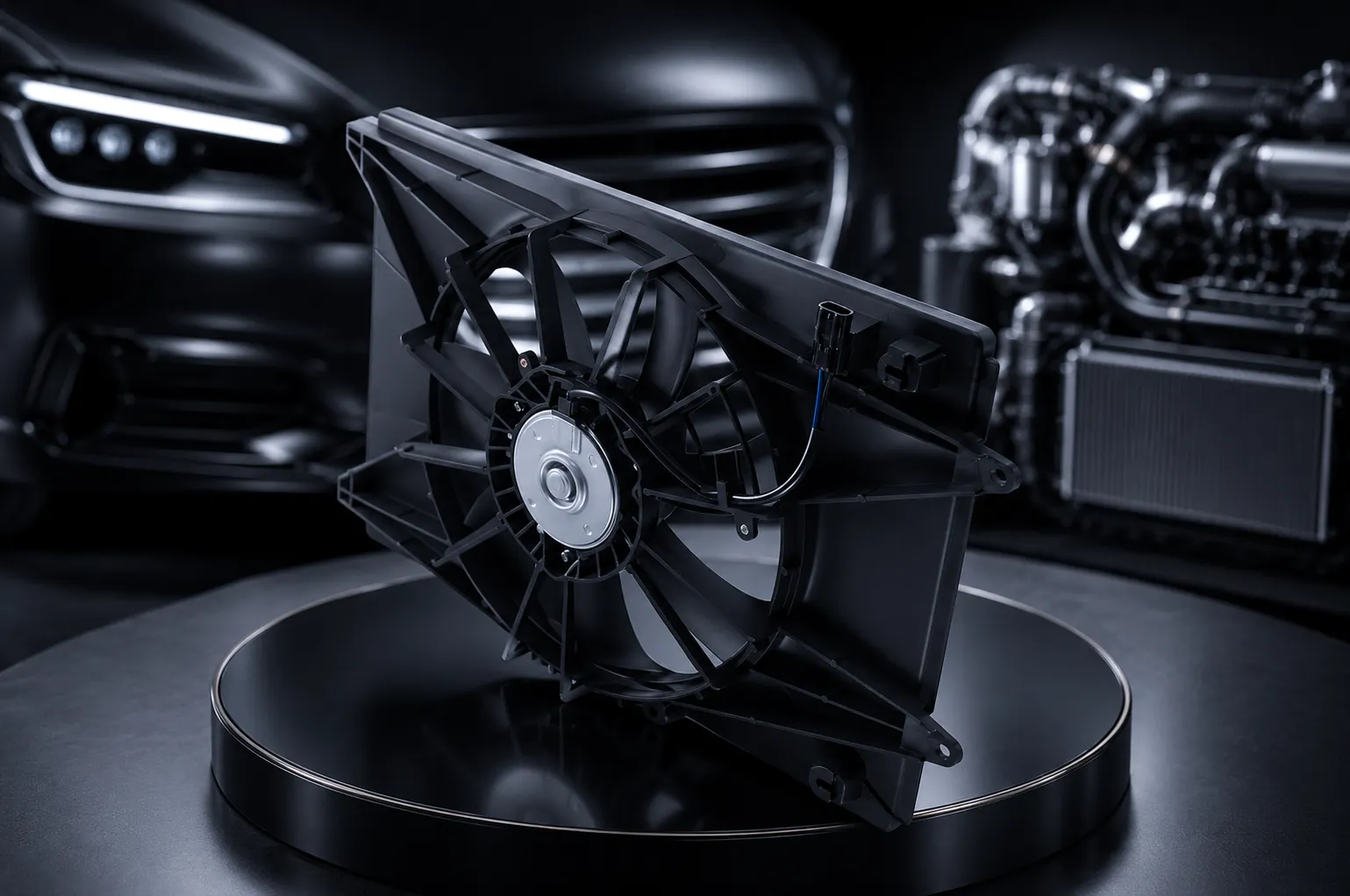
The shroud should guide air through useful heat-exchanger area and limit recirculation around the edges. Review seal surfaces, stand-off distance, ring geometry, bypass flaps, dead zones, motor supports, structural ribs, mounting points, and clearance to cores and nearby parts.
Two smaller fan rings can improve coverage on a wide rectangular module, while one larger ring may serve a compact module efficiently. Use airflow mapping or thermal results to verify distribution rather than judging by visible coverage.
Understand series, parallel, staged, and variable-speed control
Dual assemblies can use separate relays, series/parallel circuits, resistor stages, electronic modules, pulse-width control, LIN communication, or vehicle-specific strategies. One fan may operate first, both may run together, or each may follow a different command. A single fan can also offer several stages or continuous modulation.
Confirm connector, pinout, voltage, polarity, current profile, communication, diagnostics, fail-safe behavior, control-module location, and vehicle logic. Mechanical fit does not prove electrical compatibility.
Budget current for start, steady operation, and faults
Review inrush or controlled start, steady current across operating points, harness and connector temperature, relay or module capacity, voltage drop, ground path, fuse coordination, stalled-motor protection, blocked-rotor response, and low-voltage behavior. Test conditions and limits should follow the application.
Two motors can reduce individual motor load but add connectors, branches, and control elements. One motor can simplify the circuit but may carry a larger single load. Evaluate the complete electrical path.
Do not assume two fans equal redundancy
Redundancy depends on failure independence and remaining cooling capacity. Both fans may share a fuse, relay, controller, ground, connector, command, or obstructed airflow path. A failed motor can also block part of the shroud and increase recirculation.
Define the vehicle response to one failed fan: warning, power limitation, A/C disable, service request, or continued operation under restricted conditions. Verify the strategy rather than advertising “backup” from motor count.
Compare noise by operating state
Assess overall sound, tonal content, blade-pass features, motor electromagnetic noise, structure-borne vibration, beating between fans, transitions, startup, shutdown, and control modulation. Measure at representative airflow resistance and installation conditions.
A dual electric radiator cooling fan may run two sources at lower speed in one state, yet interactions can create noticeable tones. A single fan may need higher speed, but blade and shroud optimization can change the result. Vehicle-level perception decides.
Check packaging in three dimensions
Confirm overall envelope, depth, ring positions, motor protrusion, connector access, harness routing, fasteners, locating features, core clearance, engine movement, hood and latch clearance, service removal path, and neighboring hoses or lines. Compare scanned geometry or controlled drawings where possible.
Thermal expansion, vibration, assembly tolerance, and powertrain movement can close a static gap. Use the vehicle’s clearance requirement rather than a photograph.
Validate environmental and mechanical durability
The program may need thermal cycling, vibration, mechanical shock, water, dust, salt or corrosion exposure, chemical contact, stone or debris risk, connector sealing, blocked rotor, endurance, imbalance, blade containment, and after-test performance. The applicable set comes from installation and customer requirements.
Inspect blades, rings, shroud welds or joints, motor mounts, bearings, brushes where used, electronic modules, balancing controls, fasteners, and material marking. Link test samples to the production design revision.
Use vehicle tests to close the decision
Bench data supports comparison, but vehicle validation confirms coolant and refrigerant temperatures, A/C pressure behavior, airflow distribution, electrical load, control transitions, noise, recirculation, and heat soak in the real module. Record ambient, vehicle speed, load, HVAC command, shutters, grille, sealing, and software state.
Test candidate assemblies under equivalent conditions. If a result changes after the grille, seal, condenser, radiator, software, or refrigerant charge changes, update the system conclusion.
Match replacement parts to original architecture
Aftermarket buyers should confirm OE references, vehicle qualifiers, module dimensions, mounts, shroud, connector, pinout, control strategy, motor direction, blade orientation, and diagnostic compatibility. A fan that spins in open air may still move air the wrong way through the core or trigger vehicle faults.
ZUA lists cooling fans within its engine-cooling product range. Buyers should confirm the responsible production route, target application, validation evidence, and change-control responsibilities for each program.
Choose the architecture with a decision matrix
Weight thermal margin, airflow distribution, package, electrical load, control compatibility, acoustic performance, durability, serviceability, supply risk, cost, and validation evidence. State assumptions and required operating points. A matrix makes tradeoffs visible, but it cannot repair missing data.
Do not award extra points simply because a candidate has two motors. The dual electric radiator cooling fan wins only when the complete evidence better satisfies the target system.
Review supplier evidence and change control
Request controlled drawings, BOM, motor and blade identification, material specifications, process flow, balance controls, electrical and airflow data, durability reports, traceability, inspection plan, failed-part handling, and change notification. Confirm whether the supplier manufactures, assembles, or sources the unit and which party owns validation.
The IATF 16949 overview gives automotive quality-system context. Product-level evidence is still required for the exact assembly and revision.
Frequently asked questions
Is a dual cooling fan always more powerful?
No. Useful airflow depends on fan curves, shroud, restriction, voltage, control state, and the installed cooling module.
Can two fan airflow ratings be added together?
Not reliably unless the rating represents the complete assembly under the same system conditions. Interaction and restriction matter.
Does a dual fan provide backup if one motor fails?
Only if the electrical and control paths are sufficiently independent and the remaining fan provides the required reduced-state cooling.
Why is the shroud important?
It controls core coverage, sealing, recirculation, mounting, bypass behavior, and structural support, directly affecting installed performance.
Can a single fan have variable speed?
Yes. Single and dual assemblies may use staged or electronic variable-speed control depending on the vehicle.
What must match electrically?
Confirm voltage, connector, pinout, polarity, current, start behavior, control signal, diagnostics, protection, and vehicle software strategy.
Does ZUA supply cooling-fan assemblies?
ZUA lists cooling fans in its broader product portfolio. Buyers should verify application, responsible production route, evidence, and commercial terms.
How can buyers request a fan comparison?
Send OE references, vehicle configuration, module drawings, connector details, control strategy, operating points, forecast, and validation needs through the ZUA contact page.
Select a dual electric radiator cooling fan for the system
A suitable dual electric radiator cooling fan must prove installed airflow, core coverage, control compatibility, electrical integrity, packaging, durability, noise, and vehicle thermal performance. Compare it with a single-fan option at the same system conditions, then select the architecture supported by evidence.