

An automotive AC expansion valve is a small part with an outsized ability to be ordered wrong. It sits between the condenser and the evaporator, it is often hidden behind a panel, and several variants can look almost identical on a bench while behaving differently once refrigerant starts moving. Most wrong-part returns do not begin at the factory. They begin at the moment somebody matched a photograph instead of an identity.
This guide is for importers, distributors, private-label brands, and service networks buying thermostatic and block expansion valves for passenger cars and light commercial vehicles. Rather than listing specifications to copy, it sets out a way to confirm identity: which fields have to agree, what the markings on the body actually tell you, and how the shipment record keeps a correct choice from becoming a wrong delivery.
Identity work is dull right up to the point it saves a container.
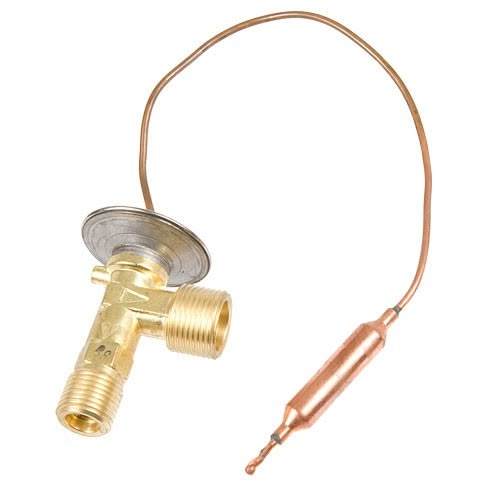
Why an expansion valve is so easy to buy wrong
Three reasons do most of the damage. The part is function-critical but physically small, so a buyer's attention goes to the compressor and the condenser first. The fitment depends on details that a photo cannot show: port orientation, thread form, sealing method, and the way the valve is mounted. And the catalogue has to compress all of that into a short line of text, which means small differences produce the same description.
Add a language step and the problem grows. A designation that reads clearly in one catalogue may be a translation of a supplier's internal family name in another. Unless somebody reconciles the two, the buyer is comparing a product with a word. None of that is an argument against running an automotive AC expansion valve programme. It is an argument for doing the identity work in writing, where it can be checked twice.
The five identity fields that must agree
Before price enters the conversation, five fields should agree across the quotation, the drawing, the sample, and the shipment. When they do not, the difference is the finding.
| Field | What it pins down | Where it usually breaks |
|---|---|---|
| Application | Vehicle, engine, and system qualifiers | A model year split nobody recorded |
| Geometry | Port orientation, thread or block form, mounting | Direction shown only in a drawing view |
| Sealing | O-ring, gasket, or face seal detail | Seal left out of the quote |
| Regulation | Thermostatic or block behaviour and its setting | Family name used instead of the setting |
| Marking | Body and label identification | Internal code with no cross-reference |
Two of these fields deserve a second look because they are the ones buyers skip. Sealing decides whether a correct valve leaks, and marking decides whether anybody can prove which valve was fitted six months later.
What the markings on the body tell you
A body marking is an identifier, not a specification. It can confirm that a supplier, a family, and a production period sit behind the part in your hand, and it gives quality and service teams something to trace. What it cannot do is prove that the valve suits a particular vehicle, because the marking does not carry the application list.
So treat the marking as a link in a chain: marking to part number, part number to application list, application list to the item quoted. If the chain has a missing link — a code with no cross-reference, or a cross-reference that only exists in a sales email — the identity is not closed, however convincing the label looks.
How a catalogue line turns into a wrong part
Catalogue errors are rarely dramatic. A port angle gets rounded. A year range loses its final digit. A superseded reference stays in place because nobody wanted to remove it. Each of those is trivial on its own and enough to send a different valve.
Buyers who import can add one habit that catches most of them: read the catalogue line as a specification rather than as a title, and mark every field the line does not state. The unstated fields are where the uncertainty lives; they are also, usefully, the list of things to ask about in writing.
Keep the charge and the setting attached to the part
Expansion valves regulate refrigerant flow by responding to conditions at the evaporator outlet. Two valves can share a body and differ in the way that response is set, which is exactly why the description has to travel with the part instead of staying in a catalogue entry.
Whatever the supplier documents about the valve's behaviour, that statement belongs beside the part number in your own file, not in a separate folder. When a workshop asks why a replacement behaves differently from the unit it replaced, the answer should be readable from the record rather than reconstructed from memory. Written down once, the note answers the same question for every future order of the same reference.
There is a commercial point buried in this. A buyer who can explain the behaviour of the part they supply is treated as a technical source rather than as a warehouse with a catalogue, and that reputation is what brings the second order.
Confirm identity at three moments
Quotation, sample, and shipment are the three points where identity can still be corrected cheaply.
At quotation, ask for the application list and the drawing revision in the same reply as the price. At sample, compare the sample's markings and geometry with the drawing rather than with the photograph used to market it. At shipment, check the carton label and the packing list against the same field list before the goods are put away, because a mismatch found on the dock can still be resolved with the supplier while the container is fresh.
Each of those three moments costs less than the one after it. Correcting an automotive AC expansion valve identity at quotation is a sentence in an email; correcting it after a workshop has fitted the part is a credit note and a conversation.
Make the carton label part of the specification
Warehouse mistakes are identity mistakes that happen late. A carton carrying only an internal code forces the receiving team to interpret, and interpretation is how a mixed or aged valve reaches a job card.
Ask for the customer part number, the supplier reference, the quantity, the production period, and the application family on the label, in a layout you have seen before it is printed. Then check one carton on arrival as a habit rather than as an exception. The five minutes it takes is cheaper than one field claim.
Build the return file before you need it
When an automotive AC expansion valve comes back, the useful evidence is the set of documents that travelled with it: the quotation, the drawing revision, the application list, the sample record, the label photograph, and the workshop's description of the fault. A pile of unlabelled returns tells a quality team almost nothing, and a supplier cannot investigate what cannot be identified.
Setting the file up once, with the same fields in the same order, turns every future complaint into a shorter conversation. ZUA Auto Parts lists expansion devices and related flow-control parts within its expansion devices range, and the wider automotive parts catalogue shows how the category relates to compressors, condensers, and driers.
Where supplier evidence fits
Company information helps a buyer judge whether a supplier works in a controlled way. ZUA describes its production footprint and quality activity on the company page, and the ISO 14001 environmental management standard is a useful reference for the kind of system-level documentation an exporter is often asked to hold.
Keep that material in its place. It supports confidence in the supplier; it does not certify the identity of one valve. The item-level record — drawing, application list, marking, and inspection — is still the thing that decides the order.
Questions buyers ask about automotive AC expansion valves
How do I tell two similar expansion valves apart?
By geometry, sealing, regulation, and marking, in that order. Port orientation and thread form usually settle the question before the internal behaviour is discussed.
Is a body marking enough to identify a valve?
No. It identifies a family and a production period. The application list is what connects that marking to the vehicle in front of the workshop.
Why does the same part number appear with different descriptions?
Catalogues compress information differently, and translations drift. Reconcile the two descriptions against a drawing and an application list rather than against the wording.
Should the seal be quoted with the valve?
Yes, or the quotation should state clearly that it is not included. A correct valve with the wrong or missing seal is still a leak waiting to be reported.
What causes most expansion valve returns?
Fitment and sealing mismatches, followed by expectations set by a description that did not match the part's behaviour. Identification work removes the first two.
Can a photograph confirm a replacement valve?
It can confirm a general shape. It cannot confirm a thread, an angle, a seal, or a setting, which are the fields that decide whether the part fits and works.
How should valves be packed?
Protected from impact and moisture, separated so that the charge bulb and capillary are not kinked, and labelled so the receiving warehouse can identify the version without opening every box.
What belongs in an automotive AC expansion valve enquiry?
Vehicle and engine details, current reference, port and sealing detail, quantity, market, packaging expectations, and the evidence you intend to review before approving the part.
Does ZUA supply expansion valves and related flow-control parts?
ZUA lists expansion devices and valves alongside its compressor, condenser, evaporator, and drier categories. Confirm the responsible production route and the item-level record for the exact reference you need.
Where does price belong in the decision?
After identity. A cheaper valve that has to be returned, re-shipped, and explained to a workshop has already cost more than the difference.
Identity first, then price
A buyer who confirms five identity fields, reads the marking as a link rather than a proof, and keeps the shipping label inside the specification ends up ordering fewer wrong parts and arguing about fewer claims. That is a slow advantage in the first season and a large one by the third.
To put an automotive AC expansion valve programme together — mixed references, private label, or a second source — send the application list, current part references, and expected quantities through the ZUA contact page. Starting from the identity fields makes the quotation comparable and the sample check short.