

An automotive heater core manufacturer is usually judged on a specification sheet: core size, inlet and outlet diameter, material, and a pressure rating. That sheet says very little about where the part will fail in service. A heater core sits at the end of the coolant circuit, where flow is low, temperature swings are large, and the core is clamped inside a plastic case that expands at a different rate. A useful supplier review starts from the failure modes and works backward to the evidence.
This article is written for importers, distributors, private-label brands, and service networks comparing heater cores for passenger cars and light commercial vehicles. It assumes the part is already defined by the vehicle application; the question here is how to judge the supplier behind it. ZUA Auto Parts presents heater cores within a wider climate-control and cooling portfolio, and the same discipline applies to every category: identify the interface, describe the failure, request the record, and only then compare price.
Nothing below replaces the vehicle manufacturer requirement or a validated test plan. It is a practical way to ask better questions before a sample is approved and a container is booked.
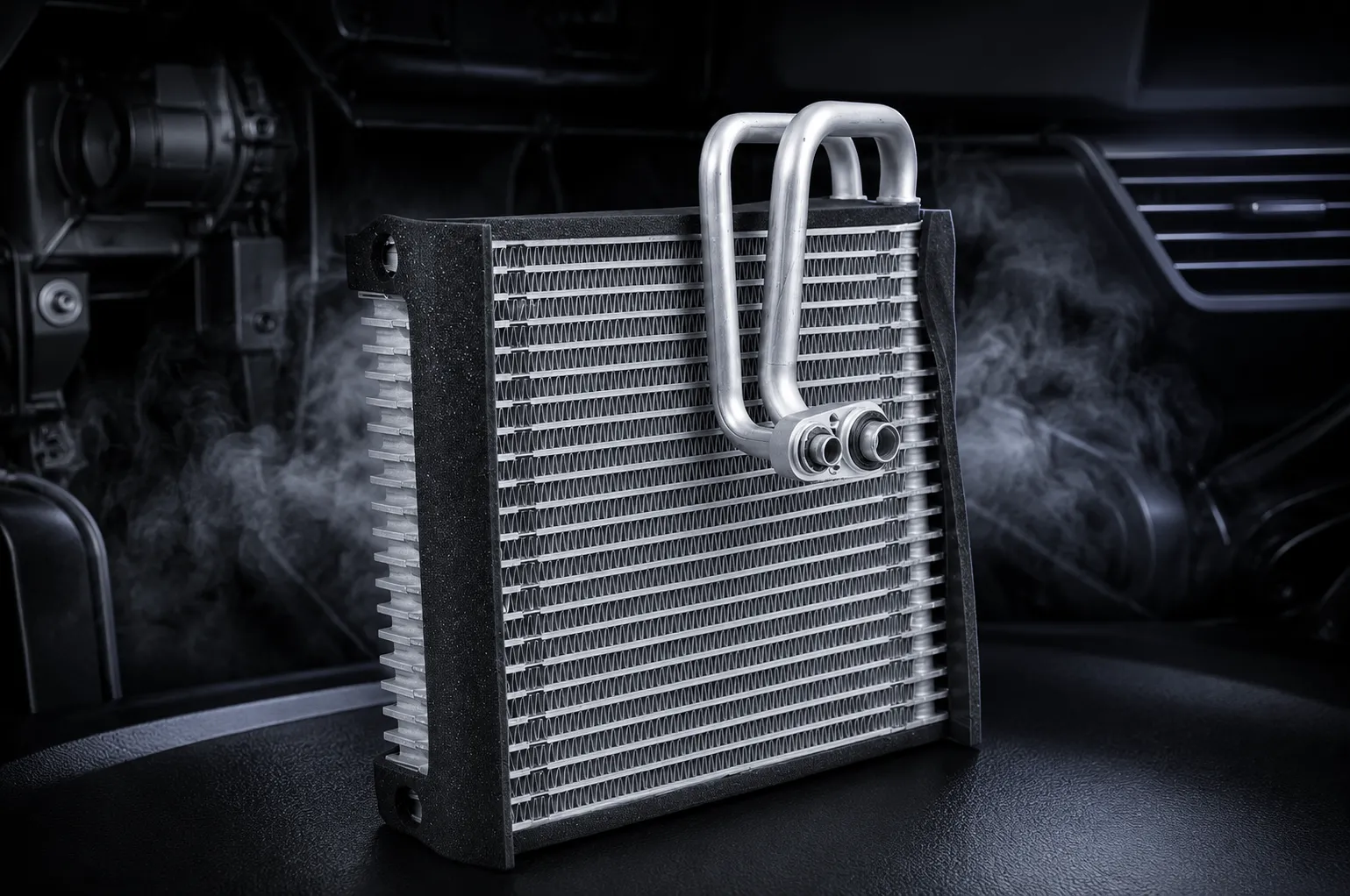
Begin where heater cores actually fail
Service returns rarely say "the core failed". They say the windscreen fogs, the coolant level drops, the cabin smells sweet, or the passenger footwell is wet. Each of those symptoms points back to a small number of physical causes. A buyer who knows those causes can question an automotive heater core manufacturer about the matching evidence instead of collecting general certificates.
Five failure modes cover most of the field picture: a leaking tube-to-header joint, corrosion that thins the tube wall over years of service, damage at the inlet or outlet nipple during installation, internal blockage from debris left in the core, and mechanical stress where the core is pressed against its case or mounting pads. The relative risk changes with coolant chemistry, vehicle duty cycle, installation practice, and the case design, so treat the list as a starting point for questions rather than a fixed ranking.
Failure mode one: tube-to-header joint fatigue
Every heating cycle pushes the core through a small expansion and contraction. The joint between the tubes and the header carries that movement. If the braze coverage is uneven, if the header metal is thin at the transition, or if the core is restrained by the surrounding case, the joint can crack long before the tubes themselves are worn out.
Ask the automotive heater core manufacturer how brazing is controlled for this part family. Useful answers name the furnace profile, the fixturing that holds the core during the cycle, the alloy or cladding combination, and the way brazing quality is verified. Look for sectioned samples, joint inspection criteria, and a stated repair rule, because a repaired core at the header is not the same product as an as-brazed core.
A pressure or leak test alone does not prove joint durability. It proves the part was sealed on the day it was tested. Durability evidence comes from pressure cycling, thermal cycling, or burst testing that pushes the joint toward its limit, with the result tied to a defined acceptance source.
Failure mode two: corrosion under real coolant chemistry
Heater cores are thin-walled by design, which makes them efficient and also makes them sensitive to the coolant around them. The wrong coolant, a diluted mix, or a system that has never been serviced can move the corrosion mechanism inside the part. A supplier cannot control what a driver pours into the reservoir, but it does control the material spec and the cleanliness of the surfaces it ships.
Request the tube and fin material designation, the cladding or coating approach, and any corrosion test the supplier performs. Ask how the test sample was prepared, whether it was cleaned to a defined condition, and whether the result is reported for this core or for a generic coupon. A coupon result can be informative, but it is not the same as a result from the actual geometry that will be installed in the vehicle.
Then connect the material decision to the market. Regions with hard water, with frequent top-ups, or with a strong aftermarket culture of mixing coolant types place different demands on the part. That context belongs in the sourcing file next to the drawing, not only in the sales conversation.
Failure mode three: inlet and outlet nipple strain
A heater core is often damaged by the person installing it. The nipples pass through the firewall or the case, and the hose must be pushed on, clamped, and sometimes levered into place. A nipple that is too thin, over-annealed, or joined to the header with a narrow braze fillet can bend or crack during that work.
Check the wall thickness of the connection, the length of the engagement area, and how the nipple is formed. Ask the supplier to describe the torque or pull condition the joint is expected to survive and how the incoming inspection verifies the connection. A diameter callout in a catalogue does not describe the joint at all.
Packaging belongs to this failure mode rather than to logistics alone. A core that arrives with a nipple bent by a carton divider will often be installed anyway, and the resulting leak will be blamed on the part. Separators, sleeves, and a stated carton orientation are cheap compared with a field claim.
Failure mode four: debris left inside the core
Particles, flux residues, machining chips, or brazing spatter that remain inside the core tend to travel with the coolant and settle in the narrowest passage available. In a heater circuit that may be the core itself or the valve that controls it. The symptom appears later as poor heat, uneven temperature across the core face, or a restriction that no amount of flushing resolves.
Ask what cleanliness requirement applies, how the internal volume is checked, and what limit applies to the flush or rinse sample. Ask who performs the check, with what method, and how the result is recorded for the production lot. If the answer is "visually clean", the buyer has no measurable condition to compare between one shipment and the next.
This is also a question about the plant rather than the part. Cutting, brazing, and assembly areas that share equipment with oily or dusty processes will hand contamination to the core unless the flow is separated. A short walk along the process route tells a buyer more about debris risk than a page of procedure text.
Failure mode five: case and mounting stress
The core does not float inside the vehicle. Tanks, end plates, and mounting brackets locate it, and foam or rubber pads take up the tolerance between the core and the case. If those pads are too thin, too hard, or missing on one side, the core becomes a structural member and is loaded every time the case moves.
Review the mounting interface as part of the heater core review. Ask which surfaces are intended to carry load, which are only for sealing, and how much movement the design expects. Then check the sample against that intent: bracket position, pad thickness, tank clearance, and the freedom of the core to expand lengthwise.
A buyer who shares the case drawing and the installation sequence with the supplier is more likely to receive a part that survives the vehicle. A buyer who sends only a core photo is asking the supplier to guess where the load will come from.
Map each failure mode to a test and an acceptance source
The table below turns the discussion into a working document. Fill it in with the supplier during the technical review and keep it beside the approved sample. Where a cell stays empty, that is an open action rather than a passed item.
| Failure mode | Evidence to request | What must be stated |
|---|---|---|
| Tube-to-header joint | Brazing control, section sample, pressure or thermal cycling result | Acceptance source, sample identity, cycle conditions |
| Corrosion | Material specification, cladding or coating, corrosion test report | Specimen preparation, test fluid, duration, evaluation rule |
| Nipple strain | Wall thickness, forming method, pull or torque condition | Limit, method, inspection frequency |
| Internal debris | Cleanliness requirement, rinse or flush check, process separation | Particle limit, sampling plan, record owner |
| Mounting stress | Bracket and pad definition, clearance check, installation note | Load path, movement allowance, assembly instruction |
What an automotive heater core manufacturer should show before sampling
Before a sample is built, the supplier should be able to describe the part in its own system. That includes the application list, the drawing revision, the material and finish, the connection geometry, the mounting interface, the label or marking, and the packaging design. Ask to see the release file rather than a product photo, and check that the same identifiers appear in the quotation, the sample record, and the inspection documents.
ZUA Auto Parts lists heater cores and related climate-control parts across its mobile air conditioning and climate comfort range, with cooling components alongside them in the engine cooling systems range. Buyers should confirm the responsible production route for the specific core and the evidence that belongs to it, because a catalogue entry is a starting point rather than a validation.
Company-level evidence then supports that product-level review. ZUA describes its compressor focus, laboratory activity, production controls, and quality management approach on the company page. The ISO 9001 quality management overview is useful context for how documented information and corrective action are meant to work. It is reasonable to use that material to judge whether an automotive heater core manufacturer works in a controlled way, and still insist on part-specific results for the core being purchased.
Package the core so the last inspection still matters
Heater cores are thin, light, and easy to bend. Everything the buyer verified in the plant can be lost between the packing table and the warehouse shelf. Ask for the intended carton layout, the number of pieces per layer, the separators between cores, and the way the nipples are protected. Then check whether the carton itself is strong enough for the stacking assumption in the shipping plan.
Labeling deserves the same attention. A carton that carries the customer part number, the supplier reference, the quantity, and the production period can be received and traced without opening every box. A carton that carries only an internal code forces the warehouse to interpret the shipment, and interpretation is where mixed or aged stock enters inventory.
Questions buyers ask before approving a heater core
Does a pressure test prove the core will not leak in service?
No. A pressure test confirms the part was sealed at the time of testing. Durability evidence comes from cycling or burst testing tied to a defined acceptance source.
Should a heater core be repaired if the header joint fails inspection?
Repair rules belong in the quality agreement. If a joint is reworked, the buyer needs to know who approved it, how it was re-brazed or sealed, and whether the change still meets the released condition.
What coolant information should the supplier provide?
Ask for the material specification, any coating or cladding detail, and the corrosion test used for the part, including specimen preparation and evaluation rules.
How is internal cleanliness verified?
Look for a stated particle or residue limit with a defined method and sampling plan. A visual check with no limit cannot be compared between production lots.
Why does the mounting interface matter to a core supplier?
A core constrained by its case behaves differently from one that can expand freely. Sharing the case drawing and installation sequence removes guesswork about where load will be applied.
Can a buyer approve a heater core from a catalogue photo?
No. The photo may confirm the general form, but the application list, connection geometry, mounting detail, material, and revision must come from controlled documents.
What is the most useful sample evidence?
A sample record that identifies the drawing revision, the material, the inspection results, the test conditions, and the person who approved the part is more useful than a sample alone.
How should heater cores be packed for long sea freight?
Use separators and orientation controls that protect the nipples and the core face, and confirm the carton strength against the stacking and handling assumptions of the route.
Does ZUA supply heater cores and related cooling parts?
ZUA lists heater cores and related climate-control items alongside cooling components in its broader portfolio. Buyers should confirm the production route and part-specific evidence for each item.
What should be included in a heater core inquiry?
Send the vehicle application, current part reference, connection sizes, mounting detail, quantity by phase, market, packaging expectation, and the evidence you intend to review.
Turn failure modes into a short approval record
A disciplined automotive heater core manufacturer review ends with a one-page record rather than a folder of brochures. It names the failure modes the buyer is worried about, the evidence that addresses each one, the open actions, and the person responsible for closing them. That record travels with the program and makes the second order much faster than the first.
When an application is ready to discuss, send the vehicle details, current reference, quantities, and packaging requirement through the ZUA contact page so the technical review can start from the same definition of the part. A short, specific brief usually produces a more useful answer than a request for the lowest price on a heater core.