

Nobody buys a cooling system. What moves through a purchase order is a radiator, a fan assembly, a water pump, a thermostat, a hose set, a sensor, and a bracket, often drawn from several catalogues and sometimes from several factories. Every one of those items can clear its own incoming inspection while the finished vehicle still runs hot, because temperature control belongs to the assembly rather than to any single part. Which is why an OEM engine cooling components conversation is worth starting from a boundary drawing instead of a price list.
The notes below are for importers, distributors, private-label brands, and service networks building a cooling range for passenger cars and light commercial vehicles. They cover where supplier responsibility starts and stops, which interfaces need a named owner, what belongs in a frozen definition before sampling, and what evidence makes two quotations comparable when the scopes behind them differ.
There is a commercial reason to settle this early. A boundary agreed at the inquiry stage tends to prevent arguments later on — about a weeping joint, air slipping past a shroud, or a fan that spins happily without cooling anything.
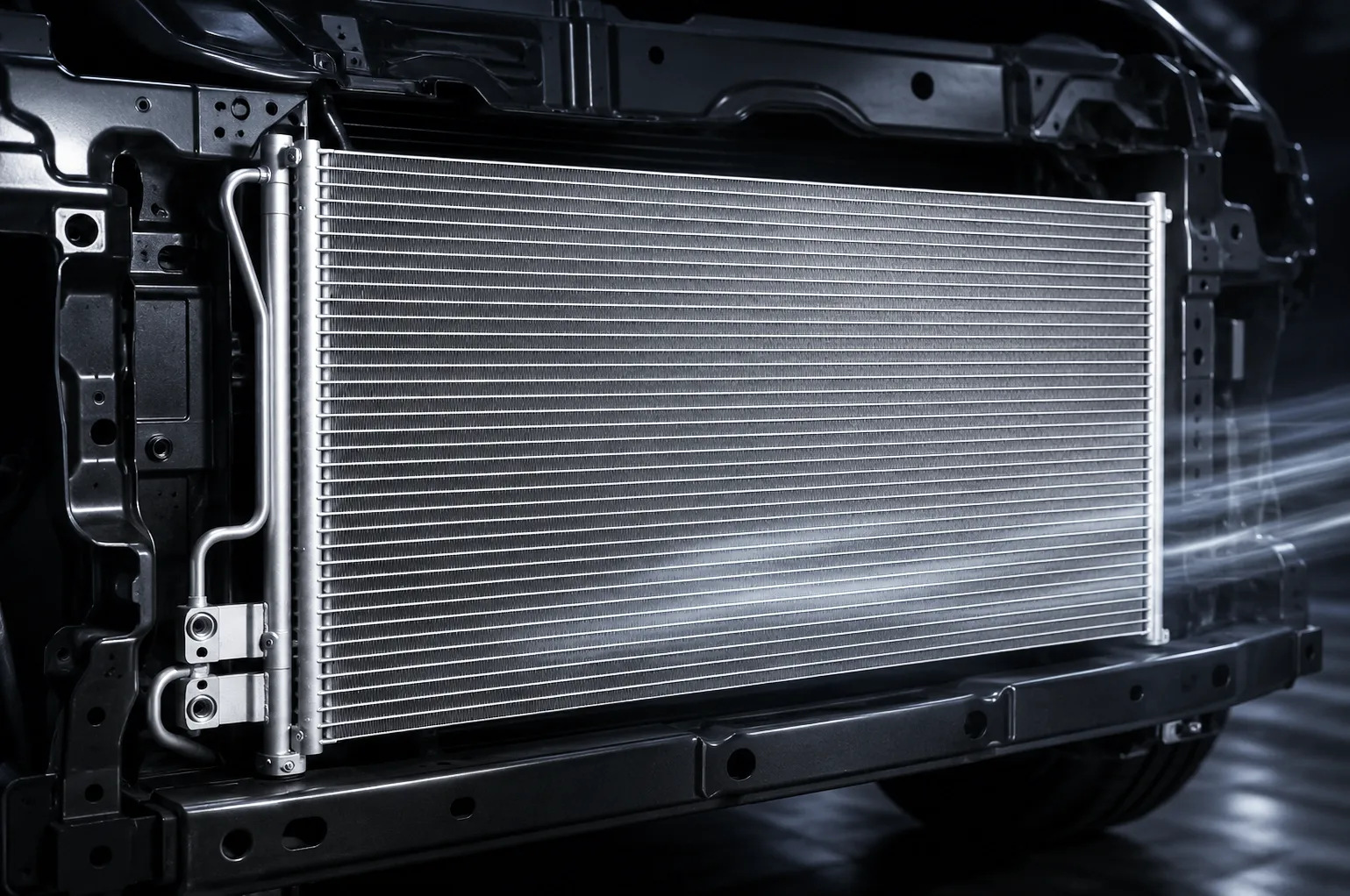
Why a cooling system quotation needs a boundary
Heat rejection is a team result. The pump sets flow. The thermostat decides when that flow is allowed into the radiator, and the bypass decides where it goes when it is not. The radiator has to shed the heat, the fan has to move air across the core while the vehicle is barely moving, the shroud has to make sure that air comes through the core rather than around it, and the hoses add resistance and stored volume in between. Change one of them and the rest behave differently.
So a supplier quoting only the radiator cannot fairly be held to the behaviour of a fan that pulls air around the core. A supplier quoting a complete module can be held to the assembled result — but only once the reference vehicle, the test condition, and the acceptance limit are written into the agreement. Without those three, module responsibility is just a phrase on a quotation.
Keep the statement short. One paragraph in front of the technical annex is enough: parts in scope, parts excluded, the interfaces the buyer will define, the ones the supplier may propose, and the party that signs off the installed result.
The seven interfaces that decide system behavior
In practice, most cooling complaints arrive as an interface problem that was never written down, not as a component that failed alone. The table below names the interfaces worth listing in a quotation. Rows can be added or removed to suit the vehicle. Leaving one unassigned is what turns into somebody's surprise.
| Interface | What must be defined | Typical failure if it is vague |
|---|---|---|
| Pump to circuit | Flow, pressure, inlet condition, bleed path | Poor circulation, noise, local overheating |
| Thermostat to bypass | Opening behavior, bypass geometry, warm-up target | Slow warm-up or unstable temperature |
| Radiator to airflow | Core face, fin density, sealing to the shroud | Air bypassing the core and reduced heat rejection |
| Fan to shroud | Blade position, tip clearance, rotation direction | Reversed or recirculated airflow |
| Fan to control | Signal type, voltage, duty cycle, fault behavior | Fan runs but at the wrong speed |
| Hose to connection | Diameter, bead form, clamp position, routing | Weeping joints and chafed hose sections |
| Sensor to control | Location, thread, sealing, response range | Late fan command or misleading diagnostics |
Each row should finish as a document. A drawing, a control specification, a test condition, or a written installation note survives a change of staff. A decision taken in a meeting does not.
Give every interface one accountable owner
Contribution and ownership are different things. Plenty of teams can touch an interface, yet exactly one party should own the final definition and the evidence that proves it. Skip that step and the first build becomes a hunt for whoever was supposed to check a clearance.
| Question | Owner to name in the agreement |
|---|---|
| Who defines the installed test condition? | Buyer engineering or the nominated validation partner |
| Who approves a component-level change? | Supplier quality with buyer approval where fitment changes |
| Who owns the shroud and sealing design? | Named as buyer-defined or supplier-proposed, never both |
| Who issues the reference vehicle and build data? | Buyer, with a revision number and date |
| Who closes a field complaint? | One named technical contact with access to the full assembly file |
It reads like paperwork until the first disagreement, at which point it is the difference between answering in two days and arguing for two months.
Freeze interfaces, not only part numbers
A bill of materials tells you which items are in the box. An interface list tells you how they meet. Both matter, yet most buying decisions are still made from the bill of materials alone, which is a large part of why programs run into fitment trouble before they ever reach performance trouble.
Start with the connections: hose diameters and bead forms, mounting hole patterns, bracket positions, connector keys, thread forms, and the clearances that have to remain once the assembly is bolted together. Only then fix the performance expectations that cross those connections — coolant flow at a defined condition, fan airflow with the shroud fitted, warm-up time measured from a stated starting temperature.
Once buyer and supplier work from a single interface list, an OEM engine cooling components quotation becomes far easier to read. Two offers can sit at the same price while covering quite different scopes, and the list makes that visible before anyone has to win an argument.
Plan the first build as one system
The value of an interface list shows up at the first assembled vehicle. Build it with the parts and fixtures that production actually intends to use rather than with whatever samples were closest to hand. Write down the torques, the clamp positions, the bleed sequence, and the routing as installed, then hold that record against the released definition.
Do the thermal check with the radiator, shroud, grille, and fan control in place. A free-air airflow figure is fine for comparing components and quietly misleading as system approval. Take temperature readings at several points over time, and note ambient conditions, load, fan command, and thermostat state beside each one.
When the numbers miss the target, change one defined item at a time. Following the interface list keeps cause and effect connected; swapping three parts together only produces a story afterwards.
Control change across a multi-part bill of materials
Nothing in a cooling assembly stays still for long. A blade supplier changes. A hose compound is reformulated. A radiator tank moves plant. A fan controller picks up a new calibration. A bracket is revised for another vehicle variant. Each change looks small on its own, and together they shift the installed result.
Decide in advance what counts as reportable, both for each item and for the assembly as a whole. Material, geometry, connector, control strategy, sub-supplier, production site, tooling, and packaging are the triggers that matter most in an OEM engine cooling components program. For every trigger, name who gets notified, what evidence travels with the notice, and how far ahead of shipment that notice is due.
Leave the previous revision somewhere service and warranty can reach it. A complaint about a two-year-old vehicle is difficult to investigate once the approved configuration has been overwritten.
Evidence that makes an OEM engine cooling components quotation comparable
Ask every supplier for the same evidence pack and the comparison stops being rhetorical. It works for a mixed category too: radiator, fan assembly, water pump, thermostat, hose set, and the smaller coolant parts around them.
Identity comes first — supplier part number, customer part number, application list, drawing revision, material specification, and the production route responsible for each item. Then the interfaces: connection geometry, mounting detail, connector or control specification, and the clearances that must survive installation. Performance sits last, and it has to name the tests performed, the conditions used, the acceptance source, and the result for the exact revision being quoted.
ZUA Auto Parts lists cooling fans, water pumps, and related components in its engine cooling systems range, with a wider automotive parts catalogue covering climate and cooling categories. Buyers should confirm which items ZUA manufactures directly, which are assembled or sourced through approved partners, and who owns design approval and validation for each one.
Company documents round out the picture without replacing the part record. The ZUA company profile sets out the compressor focus, the production footprint, and the quality activity, while the ISO 9001 quality management overview explains the system-level expectations that sit behind documented information and improvement. Neither will tell a buyer whether one fan assembly moves enough air through one radiator.
Questions buyers ask about engine cooling system sourcing
Should a cooling range be purchased as components or as a module?
Whichever way the buyer wants accountability to land. A module leaves one owner for the assembled result. Separate components can work out cheaper, though the interfaces still need somebody to coordinate them.
Can a radiator be approved without an airflow test?
Dimensional and pressure evidence may be enough for component approval. Installed cooling performance is another matter, since it depends on airflow through the core, and that is worth confirming with the shroud and fan fitted.
Why does fan direction matter so much?
Because a fan turning the wrong way still moves air, so a basic function check shows nothing wrong. Heat rejection drops, and the radiator usually gets the blame.
What belongs in an interface list?
Connection geometry, mounting features, electrical connectors or control signals, thread forms, clearances, and the performance expectations that cross each connection.
How should a change to one component be reported?
The agreement names the trigger, the notification timing, the evidence required, and the person who approves the change before it reaches production.
Is a certificate enough to qualify a cooling supplier?
No. Certification speaks to the management system. Product-specific fitment, performance, traceability, and change-control evidence for the items quoted still have to come from somewhere.
What is the most common cause of an overheating complaint after a repair?
Air trapped in the circuit, the wrong thermostat, a reversed fan, or a hose routed so that it kinks. The part itself is often innocent.
How should mixed cooling shipments be packed?
Keep carton identification aligned with the part list, protect fragile items such as sensors and thin cores, and add a pallet map so the receiving warehouse can check the shipment without opening every box.
Does ZUA supply OEM engine cooling components?
ZUA lists cooling fans, pumps, and related components alongside its climate-control range. Confirm the responsible production route, the capacity, and the evidence for the specific item before quoting to your own customers.
What should accompany a cooling system inquiry?
Vehicle and engine data, current part references, the interface list, quantities by phase, target market, packaging expectations, and the evidence you intend to review.
Keep the boundary visible from inquiry to release
A cooling program stays healthy while the boundary document, the interface list, and the evidence pack live together and stay current. That is what lets a buyer compare offers, approve a sample, receive a shipment, and answer a claim without leaning on memory or on whichever engineer happens to pick up the phone.
ZUA Auto Parts can look at an application, a mixed cooling scope, and a packaging plan before quotation. Send the vehicle data, part references, and expected quantities through the ZUA contact page, and the discussion starts from a defined OEM engine cooling components boundary instead of a list of part names.