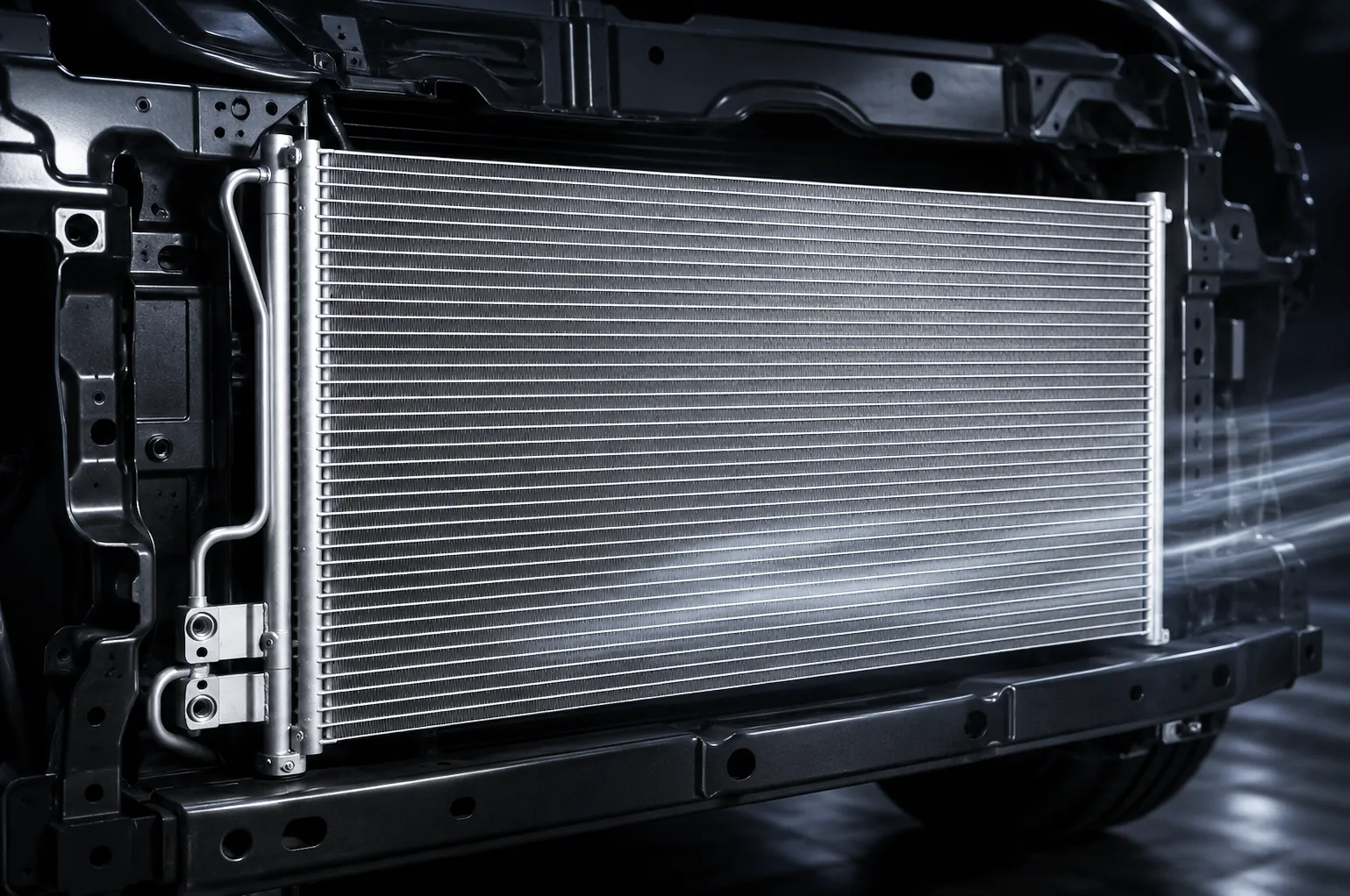
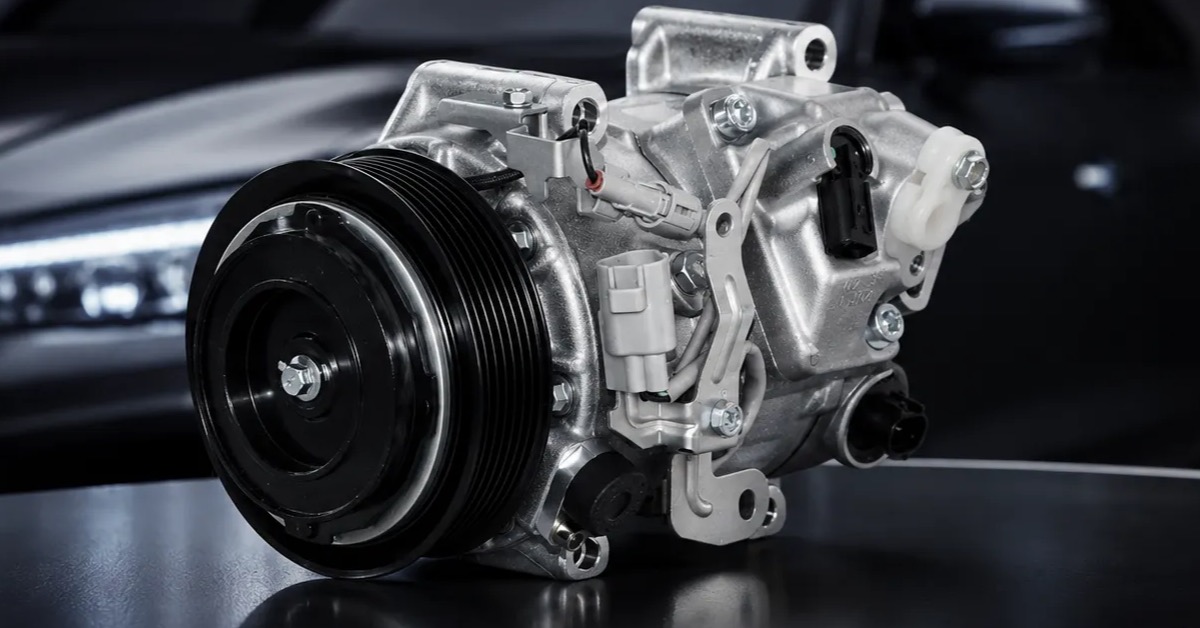
An AC condenser supplier China search should start with the vehicle installation and refrigerant duty, not a similar-looking core or a low unit price. A condenser is a heat exchanger, a pressure boundary, a set of vehicle interfaces, and a part that must survive handling before it reaches the front of the vehicle. A small change in port position, fin protection, or internal passage design can create installation problems or alter system performance.
This guide is for importers, aftermarket brands, distributors, fleet-parts teams, and vehicle-program buyers. It shows how to turn application evidence into a controlled RFQ, assess the supplier's production route, verify a representative sample, and preserve the approved configuration through pilot production, shipment, and warranty review.
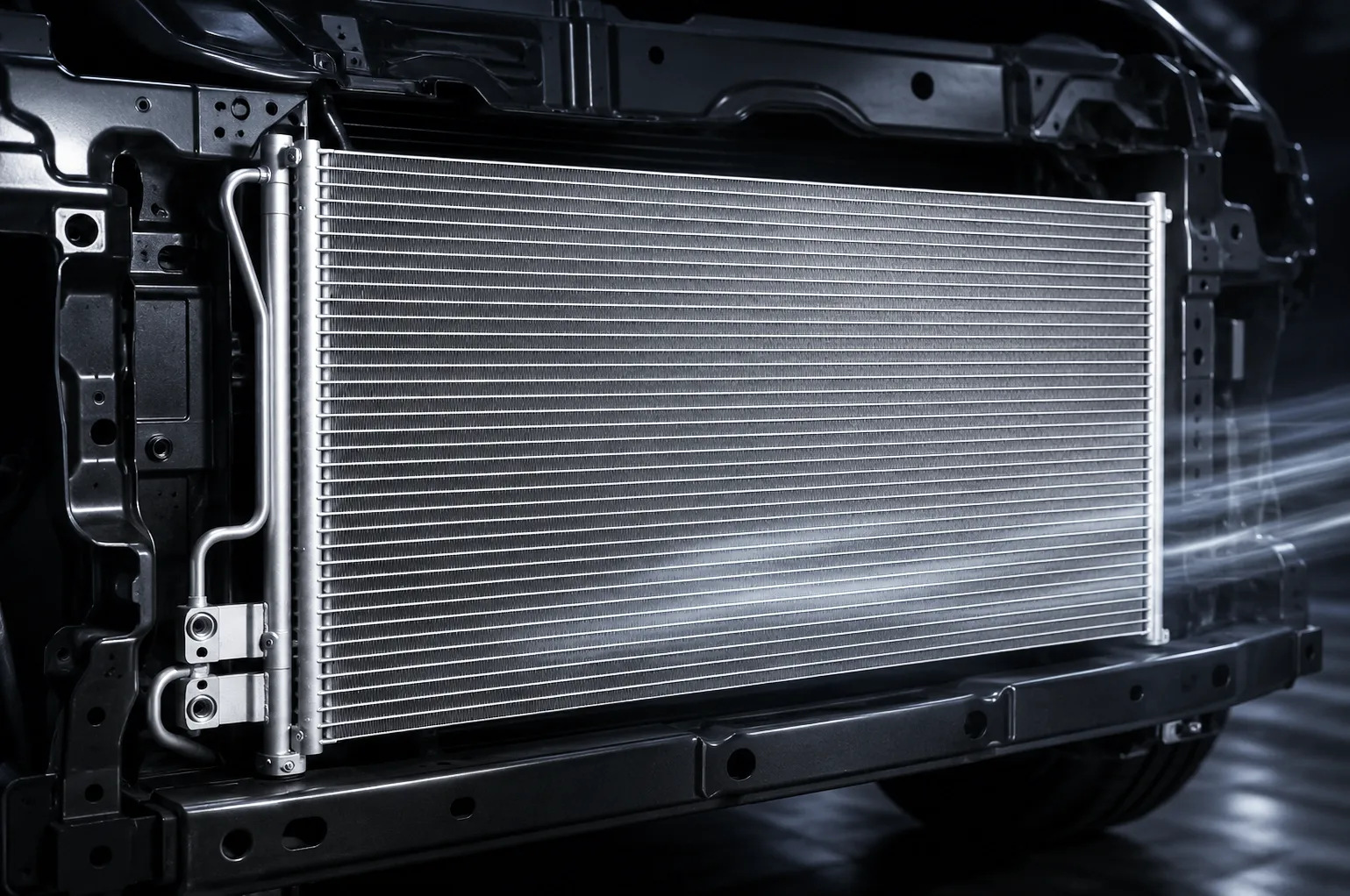
Define the condenser application before requesting a quote
Record the vehicle year, make, model, engine, market, body, production break, original part number, and known supersessions. Add the refrigerant, compressor family, condenser position in the stack, fan arrangement, and whether the unit includes an integrated receiver drier, desiccant cartridge, subcooling section, pressure switch port, or mounting hardware.
Use the removed condenser when available. Photograph the face, rear, ports, brackets, labels, side plates, service fittings, and any attached drier. Measure overall height, width, thickness, port centerlines, bracket datums, and the relationship to nearby heat exchangers. A catalog photograph rarely shows the features that decide whether a part fits.
Define the sellable boundary in the RFQ. State whether the carton includes seals, caps, drier components, pressure sensors, brackets, clips, or installation instructions. Two suppliers should not be allowed to quote different kits under the same OE reference.
| Application field | Why it matters | Evidence to request |
|---|---|---|
| Vehicle identity | Separates similar condensers across engines and model years | Application list, OE references, production breaks |
| System configuration | Controls refrigerant path, pressure, airflow, and drier function | System sketch, refrigerant, compressor and fan data |
| Mechanical envelope | Prevents clashes with the radiator, fan, bumper, and crash structure | Drawing, 3D data, fixture or vehicle trial-fit |
| Port and bracket identity | Controls sealing, hose routing, and mounting load | Port drawing, datum measurements, photographs |
| Kit boundary | Keeps quotation, packing, and service expectations aligned | Bill of materials, label, pack image, seal list |
Match the core design to the system duty
Ask the supplier to describe the proposed construction: tube and fin, parallel flow, serpentine, headers, side plates, receiver-drier integration, and the material or coating system. The construction should be connected to the vehicle's refrigerant, expected pressure, airflow, temperature, corrosion exposure, and packaging constraints.
Do not compare only the number of rows or the overall thickness. Flow distribution, tube geometry, fin pitch, louver design, pass arrangement, and internal volume can change heat rejection, pressure drop, refrigerant charge behavior, and sensitivity to debris. If a supplier proposes a different core, require a comparison that explains what remains equivalent and what needs validation.
For an AC condenser supplier China program, the buyer should know whether the quoted unit is an exact replacement, an engineered equivalent, or a new application. Those are different release paths. An equivalent claim needs drawings, material information, performance evidence, and approval boundaries rather than a verbal assurance.
Freeze ports, brackets, and the stack-up with datums
Condenser fitment is a relationship between many features. Check port type, thread or pad geometry, seal groove, port angle, centerline, bracket hole pattern, side-plate profile, fan shroud clearance, and the distance to the radiator or intercooler. Record the datum scheme used for inspection so that supplier and buyer measure the same feature.
Use a route or stack-up fixture where the condenser works with other front-end modules. Trial-fit the part with the actual hoses, seals, brackets, clips, fan, and adjacent heat exchangers. Confirm that the hose is not forced into a twist, the service port remains accessible, and the condenser can be installed without bending fins or loading a port.
Photograph the installed condition and keep the images with the drawing revision. A clean standalone sample can hide an interference that appears only when the full cooling and climate-control stack is assembled.
Audit brazing, forming, and cleanliness controls
Walk the production route from tube and fin receipt through forming, assembly, brazing, leak screening, cleaning, coating, drying, capping, and packing. Ask which operations are performed in-house and which are subcontracted. Outsourcing is manageable only when the owner of specifications, process approval, change notification, and defect containment is clear.
Review fixture condition, braze temperature or energy control, filler-material identification, joint coverage, distortion checks, and rework rules. A visually neat joint is not enough; the process must prevent under-brazing, excessive filler, blocked passages, fin damage, and contamination of sealing surfaces.
Follow one lot through the line. Check line clearance, part identity, work instructions, tool maintenance, calibration, nonconformance segregation, and lot traceability. Ask for actual first-off records and corrective actions from the same condenser family. A presentation prepared for an audit is less useful than records linked to a shipped unit.
Separate leak screening from thermal performance
Leak testing confirms the pressure boundary under defined conditions. It does not prove heat rejection, pressure drop, corrosion life, vibration survival, or post-shipment integrity. Ask the supplier to separate production leak screening from qualification testing and to explain the purpose of every test.
A leak record should identify the medium, pressure or vacuum, stabilization time, fixture, temperature, acceptance limit, calibration status, operator or station, and lot link. Define how a failed unit is contained, whether retest is allowed, and how a repaired or reworked core is identified. "100 percent tested" is not a complete method description.
Thermal evidence should state airflow, inlet conditions, refrigerant, pressure or temperature points, fan or bench arrangement, measurement uncertainty, and stabilization rules. Compare the results at operating points that matter to the vehicle. A peak result from an unrelated bench condition should not be treated as application approval.
The official SAE J639 overview covers mobile A/C systems using belt-driven and electric compressors and frames design, assembly, and test across the system lifetime. Buyers should use the current applicable standard and customer requirements to define the completed system evidence.
Check corrosion, pressure, and environmental exposure
Condenser exposure depends on its front-end location, road debris, salt, moisture, cleaning chemicals, and contact with other modules. Request the material and surface-treatment declaration, including tubes, fins, headers, side plates, brackets, and any coating or conversion process. Confirm that the evidence applies to the released construction.
Agree the pressure, burst, cycling, vibration, corrosion, and thermal-aging sequence with the customer program. Define the preconditioning, fixtures, test fluid, inspection points, and pass criteria. Do not infer approval from a generic laboratory certificate that does not identify the core, joint process, or revision.
After environmental testing, inspect the ports, joints, headers, fin-to-tube areas, brackets, and sealing faces. Record any leak, distortion, coating loss, galvanic interaction, fin blockage, or loss of performance. The post-test condition matters as much as the initial pass.
Use a sample and pilot lot to test repeatability
Issue a written sample request containing the application record, drawing, critical characteristics, test plan, packaging concept, and due date. On arrival, preserve the carton, labels, caps, seals, and lot identity. Inspect the sellable kit before installation and record any deviation rather than correcting it silently.
After sample approval, run a pilot lot. Compare multiple units for dimensions, port position, bracket location, fin condition, mass where relevant, leak results, labels, and pack condition. Select pilot units for representative pressure and thermal checks. Review the production records for the same lot, not only a development report.
Conditional approval should name the open item, owner, evidence required, and deadline. A shipping date should not close a technical question by default. The release authority must be clear to purchasing, quality, engineering, and the supplier.
Validate packaging for fins, ports, and mixed shipments
Fins are easy to damage and difficult to repair without changing airflow. Packaging should protect the face, corners, ports, brackets, drier, and side plates while restraining the unit against movement. Define separators, edge protection, caps, bagging, inner quantity, carton orientation, pallet pattern, and mixed-SKU identification.
Test the actual pack through the intended handling route or an agreed simulation. Inspect for crushed fins, bent ports, displaced brackets, loose caps, rubbed coatings, moisture, corrosion, and unreadable labels. A change in carton size or quantity changes the load path and should trigger packaging review.
Align unit, carton, and pallet labels with the controlled SKU, application, lot identity, and revision where used. Warehouse staff should be able to receive the correct condenser without opening every carton or relying on a photograph.
Review capacity, continuity, and supplier changes
Capacity is not just the number of brazing stations. Review constraint operations, fin and tube supply, braze-cell loading, leak-test throughput, yield, rework, trained operators, planned maintenance, coating capacity, and peak-season demand. Ask how the supplier would recover after a furnace, fixture, test station, or critical material disruption.
Set forecast windows, minimum order quantities, frozen periods, safety-stock ownership, and escalation triggers. Identify long-lead tooling and parts. A continuity plan should state what is protected by stock, what depends on shared equipment, and how a second source or alternate route would be approved.
Require notice and review for changes to core geometry, tube or fin material, braze alloy, coating, drier content, fixture, machine, factory, subcontractor, leak method, thermal test, label, or packaging. Define the validation package, affected inventory, first changed lot, and buyer approval point.
Turn field claims into useful supplier feedback
A condenser-related complaint may involve a leak, impact damage, fin blockage, corrosion, an incorrect part, a reused seal, a hose connection, an overcharge, or a system fault elsewhere. The claim form should capture vehicle, part number, lot, mileage, installation date, refrigerant, service history, leak location and method, pressure readings, photographs, and returned-part condition.
Preserve the returned unit before cutting it open or washing it. Trend confirmed causes by joint, port, bracket, core family, SKU, lot, packaging route, and installer context. Feed recurring patterns into drawings, work instructions, packaging, inspection fixtures, application data, and corrective actions.
Agree on containment and response timing before launch. Buyers and suppliers should know who authorizes returns, who performs analysis, which evidence is mandatory, and how urgent field risks are communicated.
Build a precise ZUA condenser inquiry
ZUA lists automotive A/C condensers within its climate-control product range. Related guidance covers condenser quality testing, catalog fitment data, bulk-order packaging, and private-label launch control. These references help organize the RFQ, but application coverage and production responsibility still need confirmation for the quoted SKU.
For buyers evaluating an AC condenser supplier China option, send the vehicle list, OE references, removed-part photos, dimensions, port and bracket details, refrigerant, system stack, annual volume, sample quantity, destination, labels, validation needs, and warranty expectations. Ask for the marked application matrix, drawing, construction summary, material declaration, process route, leak and thermal test plan, traceability example, pack proposal, change rule, lead time, and open assumptions.
Use the ZUA contact page to begin the RFQ. Treat the first response as technical clarification and evidence planning, not automatic approval of every cross-reference.
Questions buyers ask about an AC condenser supplier China
What should I send with a condenser RFQ?
Send the vehicle and market, OE number, removed-part photographs, dimensions, port and bracket data, refrigerant, system stack, quantity, destination, kit contents, and validation needs.
Is a similar-looking condenser interchangeable?
Not necessarily. Verify the core construction, ports, brackets, dimensions, flow path, drier content, refrigerant duty, performance evidence, and vehicle trial fit before approval.
Why are fin count and thickness not enough?
Heat rejection and pressure drop also depend on tube geometry, pass arrangement, louver design, airflow, refrigerant distribution, and the test conditions behind the result.
Which brazing records should a buyer review?
Review material identity, fixture and line setup, temperature or energy control, first-off approval, joint inspection, distortion checks, rework rules, and lot traceability.
Does 100 percent leak testing prove condenser quality?
No. It addresses leakage under a defined production condition. Thermal performance, corrosion, vibration, pressure cycling, packaging, and fitment need separate evidence.
What should the thermal test report contain?
It should state airflow, refrigerant, inlet conditions, pressure or temperature points, fan or bench arrangement, stabilization, measurement uncertainty, acceptance criteria, and the tested revision.
When should a pilot lot be required?
Use one when the supplier, core design, tooling, factory, process, packaging, or application creates meaningful repeatability or release risk.
How should condenser packaging be approved?
Check face and corner protection, port caps, bracket restraint, moisture control, carton strength, pallet orientation, mixed-SKU labels, and the condition after handling or shipment simulation.
Which supplier changes need buyer approval?
Require review for core geometry, material, braze alloy, coating, drier content, process, equipment, factory, subcontractor, test method, label, packaging, and affected inventory.
How can two condenser suppliers be compared fairly?
Give both the same application boundary and score fitment, construction, process control, leak and thermal evidence, capacity, traceability, packaging, change management, warranty response, and price.
Choose an AC condenser supplier China with a repeatable release
The right AC condenser supplier China connects the vehicle record to the core construction, ports and brackets, braze process, leak and thermal evidence, corrosion controls, pilot lot, packaging, lot history, and change decisions. That linked record is what lets a buyer expand from one fitted sample to reliable supply.
ZUA Auto Parts can review the application and commercial boundary before quotation. Keep assumptions visible, approve one controlled drawing and kit, and require every production and change record to point back to the released configuration.