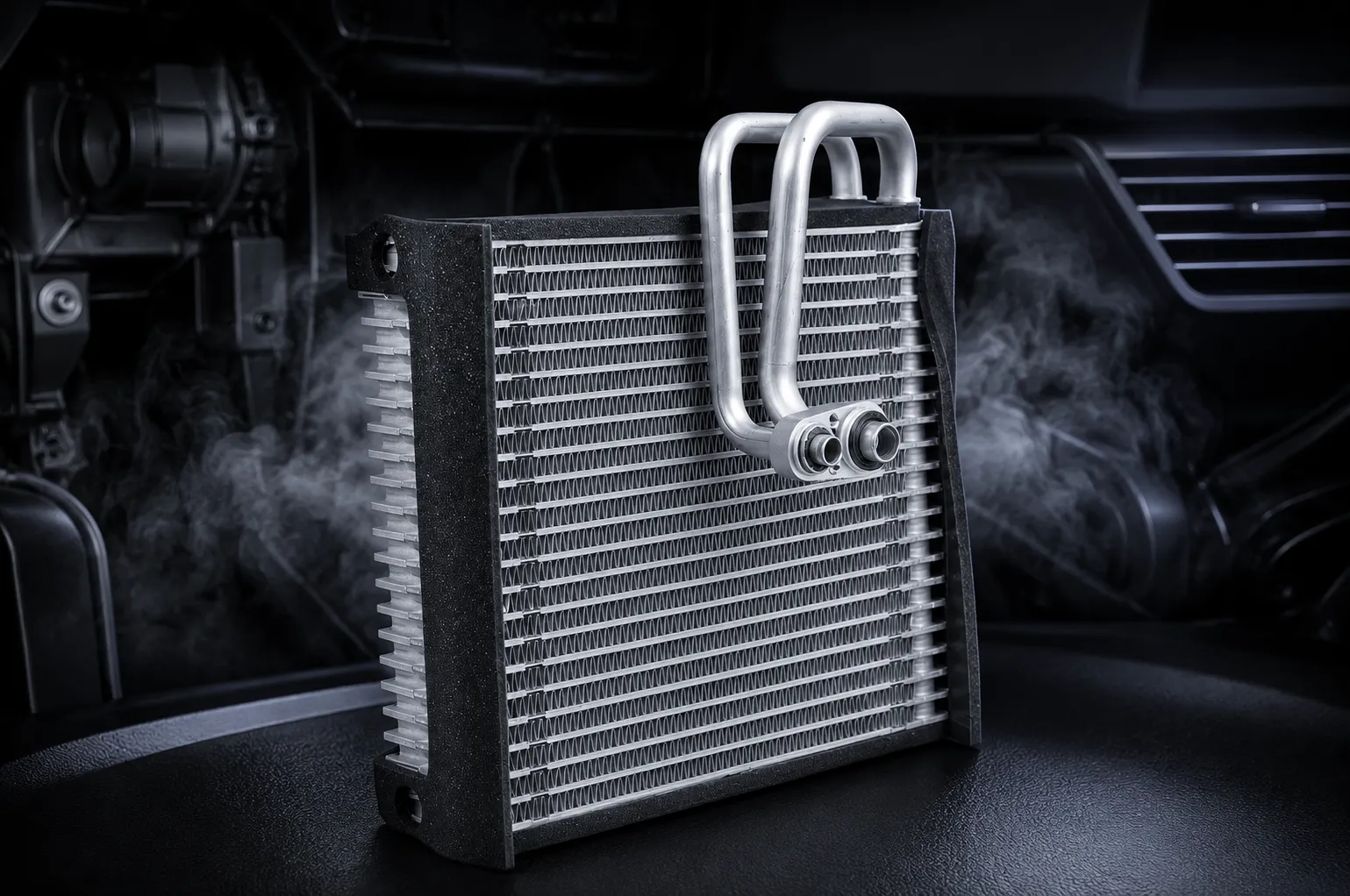
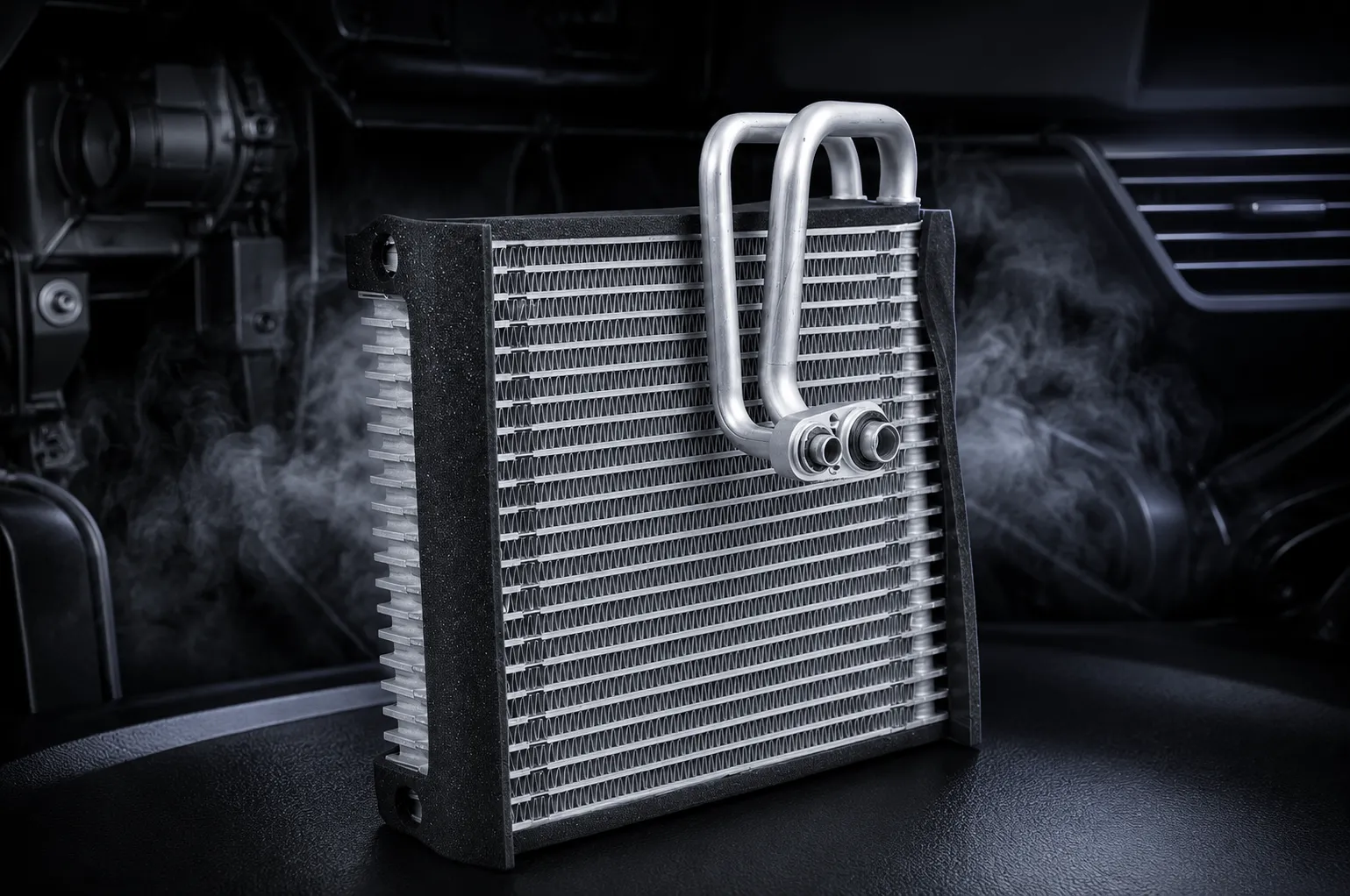
An aftermarket car AC evaporator should be evaluated as a wet heat exchanger inside an airflow module, not only as an aluminum core that fits the case. Drain-pan geometry, tube position, fin condition, surface cleanliness, airflow distribution, sealing foam, corrosion resistance, installation hygiene, and vehicle drainage all influence cooling, water carryover, odor, and service life.
ZUA Auto Parts uses this buyer-focused framework to turn the topic into a clearer product inquiry, while application, construction, and evidence must still be confirmed for each SKU.
This guide follows the evaporator from dry storage through cabin use and post-shutdown moisture. It is written for distributors, private-label brands, sourcing teams, and service networks that need fewer repeat repairs and more useful complaint evidence.
Follow one drop of condensate
Moist air passes across a cold evaporator and water forms on fin and tube surfaces. That water must move toward the designed collection area, enter the HVAC case drain path, and exit the vehicle without being carried into ducts or trapped against surfaces. Vehicle pitch, blower speed, fin geometry, seals, and drain condition can change the path.
Map the intended route on the actual HVAC module. A core drawing alone cannot show whether water encounters foam, ribs, gaps, or a blocked outlet after assembly.
Separate five complaint families
| Complaint | Possible evidence path | Do not assume |
|---|---|---|
| Weak cooling | Airflow, refrigerant, heat transfer, controls | Core capacity is the only cause |
| Water in cabin | Drain, case seal, carryover, installation | The evaporator leaks refrigerant |
| Odor | Moisture retention, contamination, filters, ducts | Odor proves defective coating |
| Icing | Airflow, sensing, charge, valve, control | Fin spacing alone caused it |
| Refrigerant loss | Core, joints, ports, service damage | Condensate is refrigerant evidence |
Confirm fitment inside the HVAC case
Compare overall envelope, tube and port positions, flange, seals, foam, case contact points, sensor pockets, brackets, drain relationship, and expansion-device interface. Check whether protective materials must be removed or transferred. A slightly displaced outlet can stress pipes or prevent the case from closing evenly.
For an aftermarket car AC evaporator, use vehicle qualifiers and production boundaries, not only an OE cross-reference. HVAC options and regional configurations may change the module.
Inspect fins as airflow surfaces
Review fin density, alignment, louver condition, depth, core thickness, face area, bypass gaps, and damage. Bent fins can create local restriction, redirect water, or change airflow distribution. Cosmetic standards should distinguish harmless visual variation from functional deformation.
Measure restriction and heat-transfer performance under controlled airflow and refrigerant conditions appropriate to the application. A visual comparison cannot confirm performance equivalence.
Test drainage in installed orientation
Place the core in a representative HVAC case or fixture with production-intent seals. Supply controlled airflow and moisture or condensate, then observe collection, migration, carryover, pooling, and drain exit across required orientations and blower states. Record water input, air condition, duration, pitch, and inspection method.
Include shutdown and restart. Water that drains during operation may remain in pockets after the blower stops.
Identify what can retain moisture
Potential retention sites include fin intersections, damaged areas, foam contact, case ledges, debris, blocked drains, poorly seated seals, and surface contamination. Retained moisture does not automatically cause odor, but it can support unwanted deposits when nutrients and environmental conditions are present.
The aftermarket car AC evaporator review should distinguish core design, HVAC module design, cabin filter condition, service contamination, and vehicle use. Each owner needs the correct action.
Control cleanliness from production to installation
Define internal and external cleanliness requirements. Protect refrigerant ports with retained caps and protect fins from dust, oil, packaging fibers, and handling residues. Inspect brazing flux or other production residue under the approved process requirement.
During service, keep the opened HVAC case, ducts, drain, tools, seals, and replacement core clean. A clean new part installed into a contaminated wet case may inherit the complaint.
Review corrosion as a local environment problem
Condensate chemistry, airborne pollutants, road or coastal environment, cleaning chemicals, galvanic contacts, residue, coatings, braze quality, and water retention can affect corrosion. Select validation exposures from the target market and installation. Universal test hours or salt concentrations should not be invented.
After testing, inspect joints, tubes, fins, headers, ports, surface condition, leakage, and performance. Record whether corrosion is cosmetic, progressive, or connected to loss of integrity.
Trace airflow before diagnosing icing
Check cabin filter, blower output, door positions, case sealing, fin blockage, sensor placement, refrigerant charge, expansion valve behavior, compressor control, and evaporator temperature distribution. Icing can be a system interaction rather than a single-component fault.
Use temperature mapping and time histories under defined conditions. A photograph of ice after the event does not show where the condition began.
Separate condensate water from refrigerant leakage
Water around the HVAC case may come from normal condensation with a blocked or misrouted drain, case leakage, vehicle body water entry, or carryover. Refrigerant leakage requires an appropriate controlled detection method at the core, joints, or connections.
Preserve dye, oil, residue, pressure history, and installation evidence. Cleaning before inspection can erase the leak path.
Run an odor complaint investigation without shortcuts
Record when the odor occurs: first start, after shutdown, heater operation, wet weather, recirculation, or all conditions. Document cabin filter, drain flow, case cleanliness, vehicle use, cleaning products, microbial treatment history, and whether the symptom changes with the compressor off.
Inspect the entire air path. Do not promise that replacing the evaporator will solve an odor whose source has not been located.
Protect the core during installation
Do not bend ports to force alignment, crush fins, leave foam displaced, omit sensors, reuse damaged seals, or close the case over trapped wiring. Follow the vehicle procedure for HVAC module removal, expansion-device installation, evacuation, charge, oil balance, and leak checks.
Photograph critical steps for difficult applications. The record helps an aftermarket car AC evaporator supplier distinguish fitment, service, and product issues.
Approve packaging for thin fins and long tubes
The pack should isolate fins, ports, tubes, and brackets from carton loads and movement. Check caps, bags, inserts, orientation, label, stacking, vibration, drop, and humidity exposure using the actual distribution route. Inspect airflow surfaces and leak integrity after testing where required.
ZUA lists evaporators on its automotive A/C evaporator page. Buyers should confirm the responsible production route, application evidence, validation owner, packaging controls, and after-sales process for the quoted part.
Use returns to improve both product and service data
Code claims by weak cooling, drain issue, water carryover, odor, icing, leakage, fitment, port damage, packaging damage, or unknown. Add vehicle, build boundary, climate, installer, lot, and time in service. Look for repeatable patterns before changing design or catalog coverage.
The IATF 16949 overview gives automotive quality-management context. Product-specific evidence and transparent limitations remain necessary.
Observe parked soak and the next restart
Many moisture and odor complaints appear after the vehicle is parked, not during a stabilized laboratory point. Define an observation sequence that includes cooling operation, shutdown, parked soak, environmental exposure, door opening, restart, blower-only operation, compressor engagement, and drainage inspection. Record time, ambient temperature and humidity, vehicle pitch, recirculation state, filter condition, and odor timing.
Inspect whether water continues to drain, remains in the case, moves toward ducts, or contacts foam and debris. When practical, use non-destructive views of the case and drain before disassembly. A technician who opens the module immediately can change the moisture pattern.
Compare a reference vehicle or known-good module under the same sequence. The aftermarket car AC evaporator should be assessed within the complete wet system, including the case and service condition. Repeat observations are more informative than a single subjective smell rating, especially when the symptom depends on climate or parking duration.
Record who performs the assessment and use consistent descriptors. When assessors disagree, preserve both observations and rely on physical moisture, drainage, airflow, and contamination evidence to guide the next test.
Frequently asked questions
Can a new evaporator cause water inside the cabin?
Water entry can involve drainage, case sealing, airflow carryover, installation, or vehicle body paths. The route must be inspected.
Does evaporator odor always mean corrosion?
No. Moisture retention, debris, cabin filters, ducts, cleaning chemicals, and other contaminants can contribute.
Why should drainage be tested in a case?
The HVAC case, seals, pitch, airflow, and drain path determine where condensate moves after leaving the core surface.
Can bent fins be repaired before installation?
Follow an approved disposition. Repair may alter coating or geometry, and severe damage can affect airflow or drainage.
What information helps an icing diagnosis?
Record temperatures, pressures, airflow, filter, door states, sensors, charge, controls, ambient conditions, and event timing.
Should the HVAC case be cleaned during replacement?
Follow the repair procedure and inspect the case, drain, seals, ducts, and filters so contamination is not transferred to the new core.
Does ZUA supply evaporators?
ZUA lists automotive A/C evaporators in its portfolio. Buyers should verify fitment, responsible production route, and model-specific evidence.
How can buyers request evaporator data?
Send vehicle and OE references, sample or drawing, complaint history, target market, forecast, and validation needs through the ZUA contact page.
Evaluate the aftermarket car AC evaporator through its wet life
A dependable aftermarket car AC evaporator must fit the HVAC case, transfer heat, distribute airflow, drain condensate, resist its environment, remain clean, survive packaging, and support evidence-based complaint analysis. Following that wet lifecycle produces better decisions than comparing core dimensions alone.