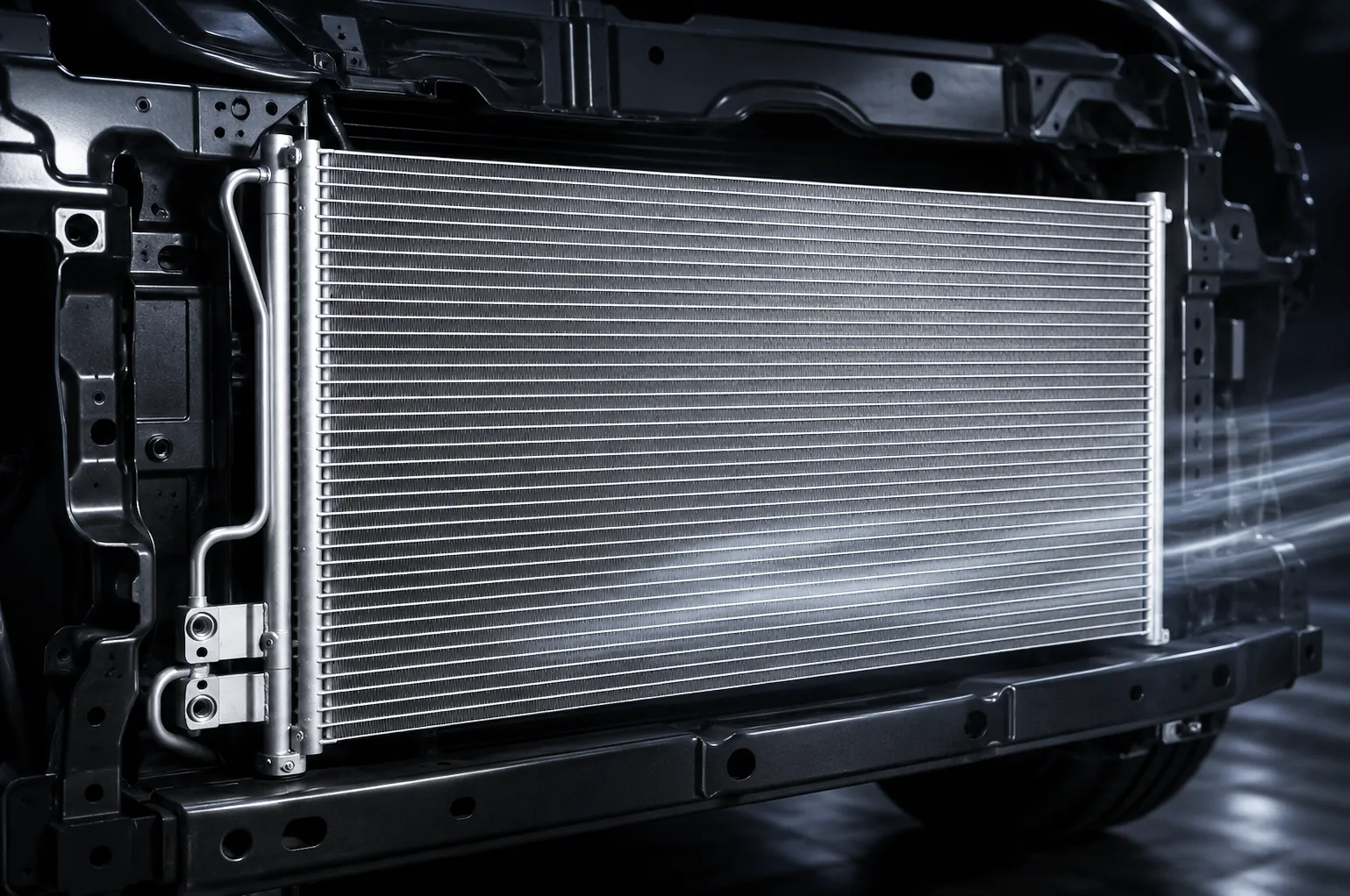
A private label AC condenser program is more than printing a logo on a carton. The distributor must freeze the approved condenser configuration, brand relationship, application data, label artwork, packaging protection, included components, sample record, warranty route, and change-notification rules. If those elements are treated separately, the market may receive the correct core in the wrong box, a correct label on an unapproved revision, or fitment information that does not match the delivered assembly.
For buyers sourcing through ZUA Auto Parts, this framework connects the technical question to a controlled product inquiry; exact fitment and quoted specifications remain SKU-specific.
The practical launch method is a product identity file with release gates. It tells the factory what may be made, the packaging team what may be packed, the catalog team what may be published, and the distributor what evidence supports each claim.
Define the commercial identity before artwork
Write the brand owner, legal entity, selling brand, manufacturing reference, importer or responsible-market party, warranty contact, and countries of sale. Decide whether the program is private label, co-branded, or a distributor presentation of a ZUA product. Avoid implying OE authorization or certification that has not been confirmed.
Give each sellable SKU a controlled internal number. Map it to the manufacturing part number, approved revision, OE references, vehicle range, included drier or hardware, and packaging version. A brand SKU should never be the only traceability key.
The launch pack in seven linked records
| Record | Must be frozen | Owner |
|---|---|---|
| Product identity | Part number, revision, scope, approved images | Product and engineering |
| Fitment data | Vehicle, OE, break points, verification notes | Catalog team |
| Brand artwork | Logo, warnings, language, barcode, legal text | Brand and compliance |
| Packaging | Carton, supports, caps, label position, pallet route | Operations and logistics |
| Quality evidence | Sample status, tests, deviations, retained reference | Quality |
| Claims route | Required photos, return code, response owner | Warranty team |
| Change file | Notification triggers, approval, inventory separation | Program owner |
Choose the product scope customers will receive
State whether the private-label AC condenser includes a receiver, drier cartridge, desiccant, pressure switch boss, sensor, seals, caps, brackets, or mounting hardware. Distinguish transfer parts from supplied parts. The installation instruction must match the actual box contents.
Use controlled photographs from the connector, port, drier, bracket, and label sides. If a product can be supplied in more than one configuration, create separate SKUs or a clear configuration suffix. One broad image should not represent several untracked variants.
Build private label AC condenser fitment data that the brand can defend
Fitment records should include make, model, year, engine, HVAC option, market, OE references, supersessions, port and bracket notes, and a verification status. Record where the information came from and when it was reviewed. “Fits most models” is not a substitute for a controlled application list.
For a private label AC condenser, the brand owner is often the first person a customer blames for a wrong application. Make uncertainty visible in the catalog, and create a route for pre-order confirmation when a vehicle break point is unclear.
Approve artwork as a technical document
Proof every logo, part number, barcode, country-of-origin statement, warning, recycling mark, language, website, and warranty instruction. Check that the printed SKU and scan code resolve to the same product identity in the digital catalog.
Keep artwork revision, proof approval, printer or packaging source, date, and disposal rule for obsolete cartons. A packaging change can affect traceability even when the condenser itself is unchanged.
Protect ports and fins through the route
Define caps, fin clearance, corner supports, carton compression limits, pallet pattern, mixed-SKU controls, and unpacking orientation. Do not let blades, ports, or thin fins carry transit loads. Add a route or handling trial that represents the actual distribution chain.
After the trial, inspect fin damage, port condition, bracket geometry, cap retention, labels, carton crush, and unit identity. Record acceptance criteria before the first shipment rather than negotiating damage after delivery.
Prepare multilingual and market-specific catalog fields
Global distributors often publish the same condenser in several languages and markets. Keep the controlled part number, OE references, units, vehicle names, and safety or service wording consistent while localizing natural search phrasing. Do not translate a fitment claim into a stronger promise. Store market exclusions, refrigerant differences, and local responsible-party information as structured fields.
Review localized pages after every product or artwork change. A translated title may be updated while a PDF, image label, or fitment table still shows an obsolete revision. For a private label AC condenser, the brand owner should identify which language and market versions are approved, who reviews them, and how obsolete listings are retired.
Use a sample board instead of an informal approval
Keep one signed reference sample with product photographs, dimensional checks, label images, packaging configuration, test status, and open deviations. Mark whether the sample is prototype, pre-production, or production-intent. The sales sample and the shipment sample should be traceable to the same approved file.
The program should state who approves fitment, appearance, packaging, and technical evidence. A sample can be visually accepted while still waiting for a required leak, airflow, or vehicle check.
Write claims around evidence, not slogans
Define which claims are allowed: application coverage, material or construction statements, test completion, warranty term, or packaging features. Tie each claim to a drawing, test record, controlled photo, or program document. Avoid “OE quality,” “drop-in,” or “universal” language unless the specific basis is documented.
The ISO 9001 overview provides a general quality-management context for controlled processes and records; it does not prove a particular condenser's performance or certification scope. Keep claims specific to the approved program evidence.
Give the channel a usable warranty intake
Request the brand SKU, vehicle and OE data, installation date, mileage, symptom, photographs of ports and fins, refrigerant or service history where relevant, packaging condition, lot or date code, and the returned-part status. Classify wrong fitment, shipping damage, installation damage, leakage, airflow complaint, missing contents, and insufficient evidence separately.
This record lets the private-label owner identify whether the problem came from product, application data, packing, installation, or communication. It also turns recurring claims into a controlled corrective-action queue.
Review changes before they reach the market
Require notification for core design, port, bracket, drier, material, coating, supplier, manufacturing site, packaging, label, barcode, artwork, fitment data, test method, or warranty-route changes. State whether the change needs a sample, drawing review, catalog update, new artwork, inventory segregation, or customer notice.
Do not let a silent component change remain under an old private-label SKU when it can affect fit, service, performance, or claims evidence.
Prepare the launch handoff for sales and service teams
Give internal teams a compact launch sheet with approved product image, SKU, vehicle coverage, OE references, included components, installation notes, warranty route, and the contact for fitment questions. Add examples of applications that must be verified before ordering. This keeps a private-label AC condenser program consistent across ecommerce listings, quotations, distributor catalogs, and workshop conversations.
Train teams to use the controlled SKU and revision when reporting an issue. A customer may describe a box color, a vehicle symptom, or a distributor number, but the investigation needs the product identity behind that description. Track questions that repeatedly arise after launch and feed them back into fitment data, FAQs, artwork, packaging instructions, or future sample work. The launch pack becomes a living control record rather than a one-time design handoff.
Connect a private-label request to ZUA
ZUA lists automotive condensers in its condenser category and provides a broader product portfolio. Buyers can review company information and send brand, fitment, packaging, sample, and evidence requirements through the contact page.
Ask ZUA to confirm the exact production responsibility, product configuration, artwork workflow, sample stage, testing ownership, packaging route, and change controls for the quoted private-label program. These points should be agreed before a launch date is announced.
Frequently asked questions
Is private labeling only a packaging service?
No. It also requires controlled product identity, fitment, claims, traceability, warranty, and change records.
Should a private-label SKU map to a factory number?
Yes. The mapping supports traceability without exposing or confusing the public-facing brand SKU.
What belongs on a condenser label?
Use the approved part number, brand, barcode, required warnings, origin or legal text, lot or date code, and contact details.
How are artwork changes controlled?
Use numbered proofs, named approvers, effective dates, obsolete-stock rules, and a check that barcode data still matches the product.
What should a launch sample prove?
It should represent the intended product, label, packaging, fitment record, and required technical evidence for its release stage.
Can one carton serve several condenser variants?
Only when the identity, included parts, label, fitment communication, and traceability remain unambiguous.
Which claims need support?
Support application, construction, test, material, quality, warranty, and OE-related claims with controlled evidence.
What does a good warranty intake capture?
Capture brand SKU, vehicle, symptom, installation, photos, lot, package condition, service history, and return classification.
When does a component change require review?
Review any change that can affect fit, service, performance, labeling, packaging, warranty, or traceability.
How can buyers start a private-label inquiry with ZUA?
Send target vehicles, OE references, forecast, brand guidelines, packaging needs, samples, markets, and required evidence.
Release the brand and the part together
A private label AC condenser succeeds when product identity, fitment, artwork, packaging, evidence, warranty, and change control tell the same story. A disciplined launch pack protects the distributor's brand while giving ZUA a precise, reviewable program brief.