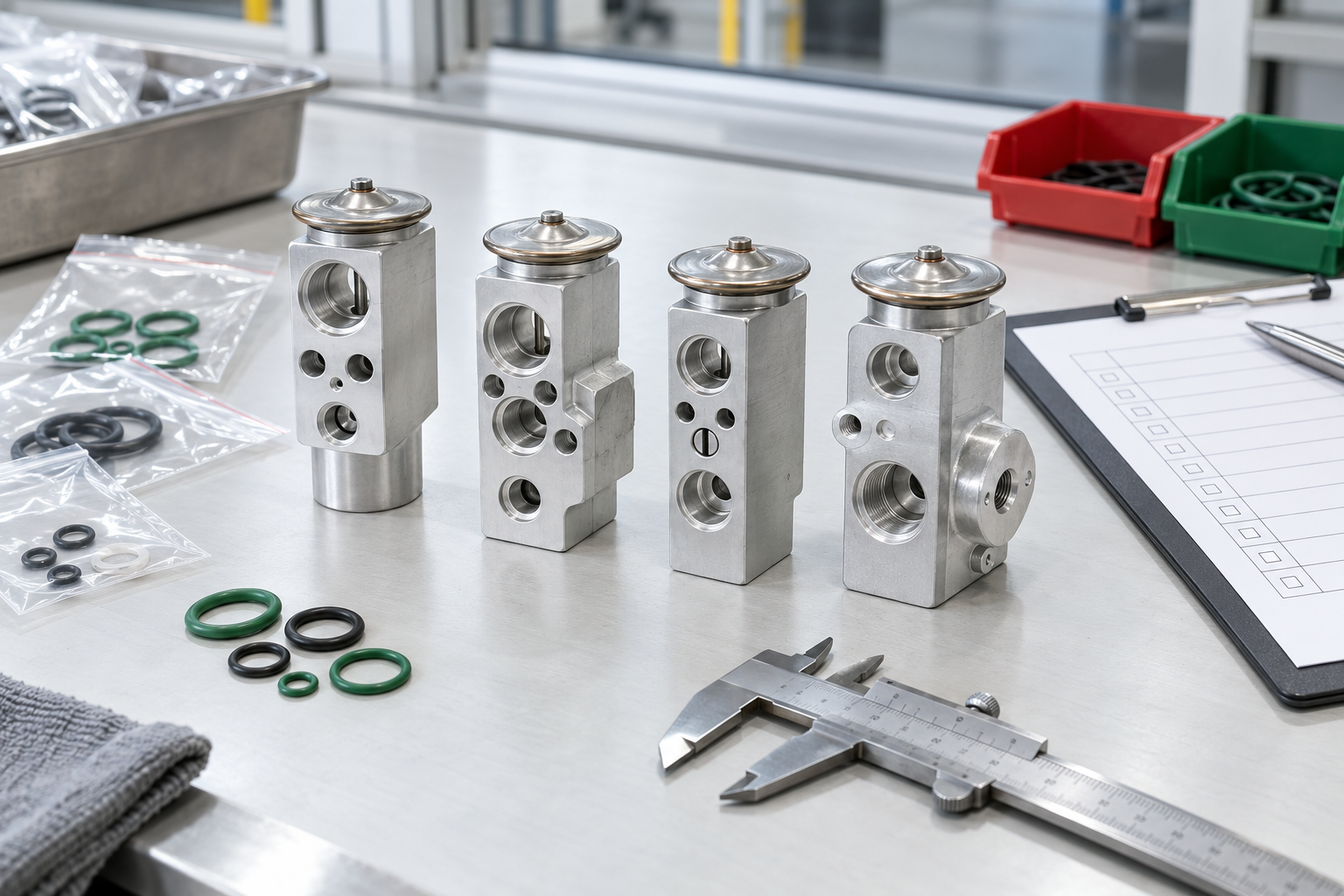
At 9:10 on Wednesday morning, four expansion-valve quotations are open on the buyer's screen. All four carry the requested OE reference, so the award looks easy for perhaps half a minute. Supplier A photographed a similar valve without naming the vehicle. B included seals but left out the port caps. C wrote "100% tested" above a report for another family. D is dearer and, rather inconveniently, offers the only answer the buyer can actually check. That is where this AC expansion valve supplier evaluation begins.
RFQ-24 is a composite case, not a claim about a particular order. Its paperwork, sample checks and purchasing calls are work that a sourcing team can repeat. The four bidders are simply A, B, C and D. Nobody has been chosen in advance; the exercise asks whose quotation still holds up when fit, routine production and after-sale risk become visible.
9:25 a.m.: stop comparing prices and repair the RFQ
RFQ-24 is missing the evaporator code. The buyer can read the car's market, year, powertrain, refrigerant and OE number, so those go on a one-page application record. Steering side is added because the HVAC case may differ. Two phone photographs show the removed valve and both pipe ends. The unreadable code stays marked unknown. A blank is awkward; a guess is worse.
The bottom half of the sheet defines the box. Four seals, two screws and caps are required. There is no separate sensing bulb on this block-valve application. That discovery changes the price comparison immediately: B's offer is not complete. ZUA's expansion valve identification guide provides a useful format for building the same identity record.
Revision 2 reaches all four suppliers at 9:40. Each factory must now price the same box of work. Conflicts belong in the conditional column; an unspoken assumption cannot become the factory's private specification.
The AC expansion valve supplier evaluation scorecard
Before revised prices arrive, the team freezes 100 available points. Application and interfaces carry 20. Metering and response carry another 20. Cleanliness and leak control receive 15, as do process and change control. Traceability and claims, capacity and delivery, and commercial terms each receive 10.
Supplier names are temporarily hidden from the two technical reviewers. A point requires evidence for RFQ-24's proposed revision. A family brochure might explain a method, but it does not prove that this valve passed. Half credit is possible when the method is credible and a production sample remains open. "Normally tested" gets an action, not a score.
There is an extra column titled Consequence. If a missing response curve could stop approval, the sheet says so. If a packaging photograph can follow after the technical decision, that is written too. By then, the sheet distinguishes a nuisance from a stop-order issue.
Monday: four samples, four different jobs
The samples arrive the following week. They are labelled EV-A through EV-D before anyone opens the bags. EV-A goes to dimensional inspection. EV-B will be tried in the HVAC case. EV-C stays untouched as a retention part. EV-D is reserved for response testing and may be cut apart later. This small piece of housekeeping matters. Without it, "the sample passed" can refer to whichever valve happens to be on the bench.
The technician measures port diameter, depth and center position from the same datums used on the reference. Seal lands, axes, flow direction, mounting face, body envelope and screw locations follow. On an externally sensed design, the list would also include capillary length, bulb dimensions, attachment and insulation. The block expansion valve port record keeps these observations from being scattered across emails.
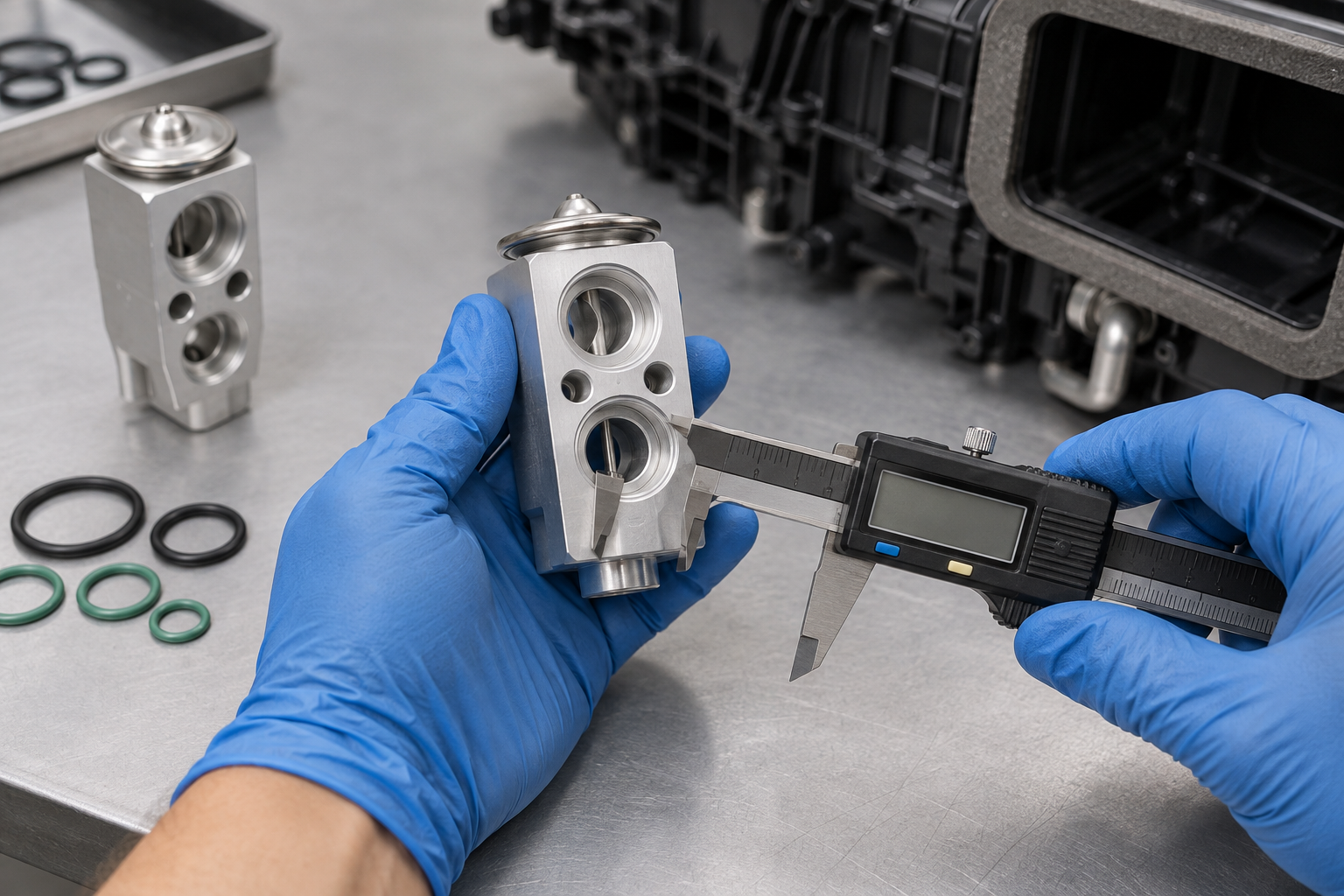
EV-B then goes into the actual case with the proposed seals and screws. One pipe needs the bolt to pull it sideways by roughly two millimetres. The valve can be installed, technically, but the joint begins its life under stress. The reviewer writes "open" rather than pass. A bolt is meant to clamp the joint, not correct port position.
Tuesday: ask what "tested" meant
Supplier C's report is a single flow value. There is no medium, inlet condition, outlet condition or sample revision. D's report names those items and shows a curve with readable axes. Neither document proves vehicle performance by itself, but one can be discussed and repeated. The other is a number detached from an operating point.
The buyer sends six questions: Was the check for external leakage, internal seat leakage, flow, thermal response or something else? What instruments were used? How long did the result stabilize? Which limit applied? Which physical sample was tested? What happens to a failed part? Every reply is filed under the sample identity it describes, not dropped into a general supplier folder.
Those answers only make sense in the circuit that the valve will control. Evaporator load, pressure conditions, compressor control and the sensing arrangement all affect that job. A room-temperature screen may be useful on the production line, yet it is not a vehicle validation. ZUA's expansion valve quality testing guide separates those jobs. The official SAE J639 overview adds system context; RFQ-24's current customer specification still decides acceptance.
“Safety and Design Standards for Motor Vehicle Refrigerant Vapor Compression Systems.”
Thursday: follow one lot through the quiet parts of the plant
The audit does not begin beside the newest machine. It begins with one marked basket. An auditor walks beside it through washing and drying, then assembly, setting, leak screening, inspection, capping and packing. Halfway along, the basket sits uncovered beside the rework station. Nobody can say how long it has been there. That pause tells the buyer more than the polished audit slide.
Cleanliness records for the lot show a method, limit, sampling rule, equipment check, result and disposition. The leak screen names its medium, pressure, stabilization time, fixture and rejection route. Supplier A has both records but cannot link them to EV-A. D can. C repeats that every valve is tested, though its failed-part route is still unclear.
One operation is subcontracted. That is not an automatic deduction. The factory names the legal seller, design owner, body source, power-element source, assembly plant, setting site, test site and final quality owner on one page. The missing question is who approves a setting change at the subcontractor. Until the answer arrives, those process points remain open.
Do not confuse a careful sample with normal production
All four suppliers know the samples are being watched. Routine orders will not receive the same attention. The AC expansion valve supplier evaluation therefore includes a small pilot made by the intended operators, components, fixtures, settings, screens, labels and packaging. It is large enough to reveal variation, not a ceremonial repeat of one hand-finished valve.
The team compares port position, seals, marks, caps, cleanliness, response data, leak records and cartons across the pilot. D loses two points when several caps are found loose after the transport check. A closes the earlier fit problem with a corrected part, but its response evidence remains due Friday.

A sailing date appears on the project plan before the last report arrives. The buyer does not relabel the gap as paperwork. Any conditional release will identify the stock, missing evidence, owner, deadline and action triggered by a poor answer. Otherwise "conditional" will quietly turn into approved somewhere between the factory and the port.
Friday morning: trace one valve backward, then move forward
The auditor chooses a valve from ordinary stock and starts a timer. Within 18 minutes, Supplier D finds its order, drawing revision, critical component lots, setting record, inspection, leak result, carton and shipment. The 18 minutes are not a universal pass limit; they simply record what happened in this exercise.
Now the direction changes. A seal lot is selected, and the supplier identifies the finished valves, warehouse positions and shipments that may contain it. "All similar valves" would be a costly containment boundary. The lot code narrows it to two production batches.
The same example tests change control. Suppose the seal compound changes while earlier stock is still in work in progress. The notice must name the first affected finished lot and locate the old inventory. Next, the buyer asks the same question about an internal part, a setting, a fixture, software, the factory, a subcontractor, the test method, the label and the pack. "We will notify you" has little value until the first changed unit can be named.
Friday afternoon: test capacity with the actual order mix
The largest supplier quotes impressive plant output. RFQ-24 is a less flattering test: 10,000 units split across 80 low-volume variants. It will behave nothing like a run of 10,000 identical valves. Every changeover consumes time, and a hurried setup can also put the wrong revision into a small batch.
The team asks where this family actually waits. The queue forms before setting and leak testing, not machining. Discussion moves to shifts, yield, fixture availability, maintenance, bought-part lead time and recovery after a breakdown. D connects the SKU forecast and frozen period to material release and batch size. A offers more total capacity but has not modelled the mix. "No problem" stays out of the evidence column.
Only now does the price ranking return
The buyer puts currency, Incoterm, MOQ, tooling, sample charges, packaging, payment, lead time, quote validity and warranty treatment on one basis. A second line captures work that each quotation sends back to the importer: sourcing missing seals, adding incoming inspection, repairing catalogue data, relabelling cartons or chasing a slow claim. This part of the AC expansion valve supplier evaluation turns a unit-price discussion into a view of the work that purchase creates.
D still costs more, though the gap is smaller after B's missing kit and C's added inspection are priced. A remains a credible second-source candidate if its response action closes. The award note is three sentences long. It says why D leads, why A stays open and which evidence could change the decision. Six months later, the note will be better than anybody's memory.
One last edit goes into the warranty language. A returned valve travels with the vehicle and HVAC version, its lot, installation and service notes, refrigerant, measured pressures and temperatures, photographs and the untouched part itself. The procedure also names who acknowledges the case, who contains stock, where analysis occurs and what triggers a review of related inventory.
Send ZUA the controlled version of the request
The ZUA climate-control range includes automotive expansion devices and valves. For a branded program, settle the kit, marking, label and carton identity before quotations start; the private-label expansion valve guide sets out that handover.
When requesting an AC expansion valve supplier evaluation from ZUA, put the application sheet, port map, refrigerant, operating boundary, reference sample, SKU forecast, pack definition, destination, test plan and decision date in one controlled revision. Give every line one of three states: confirmed, conditional or unknown. Submit that single record through the ZUA contact page or email it to gzberlin@gmail.com, so its attachments do not end up scattered through unrelated messages.
Ten questions that came up in the RFQ-24 review
Why did the team hide prices during the first scoring pass?
Because a low price can make the same evidence gap feel smaller. The blind pass let two reviewers record what was missing before the commercial ranking returned.
Did the OE reference prove the four valves were interchangeable?
No. The reference found four candidates, nothing more. The defined vehicle still had to agree with the port position, mounting, sensing arrangement, response, refrigerant application and kit contents.
Why did a two-millimetre pipe pull matter?
Tightening the bolt made the joint meet, but it did not correct the geometry. The pipe was already carrying a side load before refrigerant pressure, vibration or a heat cycle entered the picture.
Was Supplier C wrong to say every valve was leak tested?
Not necessarily. The statement was incomplete. The buyer still needed the method, process stage, limit and rejection route, and a leak screen could not answer cleanliness or response questions.
How many samples should another buyer request?
Start with the test plan, then count the parts each check consumes. RFQ-24 kept dimensional, installation, response, destructive and retention work separate; pretending one sample could cover every job would erase the record.
Why did the pilot find something the samples missed?
Sample preparation received extra attention. The pilot used the intended production and packing route, where loose caps appeared across several cartons.
Can setting or calibration be subcontracted?
Yes. The site, specification owner, equipment control, acceptance rule, lot link, failure route, audit responsibility and change notification must remain visible.
What made the traceability exercise useful?
It used a real stock valve and a real component lot. A diagram described the intended system; the timed backward and forward searches showed whether people could use it.
Why was plant-wide capacity rejected as evidence?
RFQ-24's constraint sat at setting and leak testing, and its 80-SKU mix required frequent changeovers. Total factory output did not answer either issue.
Did the highest technical score automatically win?
No. The score made risk visible. The team still compared landed cost, open actions, inspection work, delivery resilience and claim response before recording the award.
The scorecard should still make sense after the meeting
A sound AC expansion valve supplier evaluation ties one vehicle boundary and one valve revision to fit, response, cleanliness, routine production, pilot results, traceability, delivery and claims. Several cells may still be open after the first review. That is normal, provided the sheet says so.
Keep each important unknown beside an owner, a due date and the consequence of a poor answer. The resulting price belongs to a valve the buyer can describe, test, receive and support. A familiar casting and a hopeful cross-reference no longer get to stand in for that work.