How to Choose an Auto AC Hose Supplier for Replacement and OEM Projects
This ZUA Auto Parts resource helps distributors organize the evidence needed before quotation; confirm the exact application, interfaces, tests, and supplied scope for every requested part.
Choosing an auto AC hose supplier is not simply a matter of finding a flexible hose with the correct-looking fittings. An automotive air-conditioning line assembly must fit the vehicle, withstand refrigerant pressure and temperature changes, maintain sealing performance, and follow the intended routing without contacting nearby components. For sourcing managers and product engineers, the real decision is whether a supplier can provide a traceable, testable assembly that matches the required application—not just a visually similar replacement.
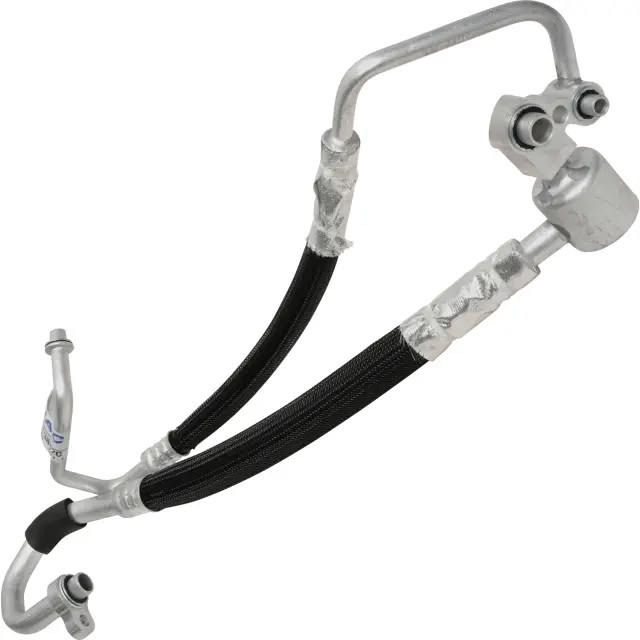
This guide explains what to review when buying automotive refrigerant hose and tube assemblies, how the construction affects selection, and which questions should be answered before requesting a quotation. The product information available here describes a multi-branch assembly with black flexible hoses, formed aluminum tubes, machined connection blocks, crimped sleeves, and an inline cylindrical component. Some details remain application-dependent and must be confirmed against the vehicle or engineering drawing.
What This Type of Assembly Does
An automotive A/C hose and tube assembly routes refrigerant between major air-conditioning components. Depending on the vehicle and system layout, the line may connect the compressor, condenser, evaporator, expansion device, or another refrigerant circuit component. The exact flow path cannot be confirmed from the supplied product view alone, so buyers should not assume that a particular port is an inlet, outlet, suction line, or discharge line without a verified part number or drawing.
The assembly shown appears designed for vehicle-specific routing. It combines rigid bent sections that hold the shape and flexible hose sections that accommodate vibration, movement, and installation variation. Connection blocks provide fixed mounting points, while crimped sleeves secure the hose to its end fittings. This mixed construction is common in automotive packaging, where a completely rigid tube may transmit vibration and a completely flexible line may be difficult to support accurately.
Quick Reference: What to Confirm Before Buying
| Selection area | What to verify | Why it matters |
|---|---|---|
| Vehicle or equipment application | Make, model, year, engine or system variant, and part number | Similar assemblies may have different bends, ports, or routing |
| Port and sealing design | Connection block geometry, bolt pattern, port size, and O-ring arrangement | A small mismatch can cause installation or leakage problems |
| Hose and tube construction | Flexible hose type, external braid, tube material, and formed transitions | Construction affects flexibility, durability, and packaging |
| Inline component | Whether the cylinder is a muffler, pulsation damper, or another device | Its function may affect system behavior and replacement compatibility |
| Inspection and documentation | Leak-test method, dimensional inspection, and drawing or sample approval | Documentation reduces fitment and warranty risk |
Understanding the Main Construction Features
Flexible refrigerant hoses
The two black sections have an external textile-braid appearance. Flexible hose is used where the assembly must absorb vibration or pass around crowded engine-bay components. It also simplifies installation compared with a fully hard-lined design. However, appearance alone does not establish the hose construction, refrigerant compatibility, pressure rating, temperature range, or burst performance. Those values should come from the supplier’s technical documentation for the specific hose used.
Buyers should also consider bend radius and hose orientation. A line that fits on a workbench may be forced into a sharp bend during installation. That can place stress on the crimp, restrict flow, or create abrasion against adjacent components. If the replacement assembly is vehicle-specific, the supplier should review the installed routing rather than only copying the overall length.
Formed aluminum tubes
The rigid sections appear to be aluminum or an aluminum alloy, with curved sections shaped to follow the intended route. Aluminum is commonly selected for automotive refrigerant tubing because it combines low weight with useful formability. Still, the exact material grade, wall thickness, and protective treatment are not identified in the supplied information and should be specified if they are important to the application.
Tube forming quality deserves close attention. A bend that is slightly out of position can create interference with the compressor, radiator, body structure, or fan shroud. Poorly controlled forming may also produce flattening or surface damage. Coordinate measuring equipment is listed among the supplier’s inspection resources, which may support dimensional verification, but buyers should ask whether inspection is performed on this particular assembly and what dimensions are controlled.
Connection blocks, sleeves, and seals
The machined or formed aluminum connection blocks appear to have circular ports and fixed mounting points. These interfaces are often sealed with O-rings and secured with bolts or similar automotive fasteners. Port geometry is therefore just as important as hose length. A line can have the right overall shape and still be unusable if the block thickness, bolt spacing, port orientation, or seal groove differs from the original.
Crimped metal sleeves attach the flexible hose to the fittings. Crimp quality is a critical manufacturing step. A supplier should be able to explain how crimp dimensions are controlled and how assemblies are checked after hose attachment. Do not rely on a clean external appearance as proof of crimp integrity.
Inline cylindrical component
A cylindrical component is visible on one hose. It may be a muffler, pulsation damper, or another refrigerant-line component, but its exact purpose is not confirmed. This is an important point for sourcing teams: replacing or omitting an inline component can change noise, pulsation, flow, or system performance. Its identity should be confirmed through the vehicle drawing, original part number, or supplier engineering review before a production order is placed.
What a Capable Automotive Hose Manufacturer Should Provide
A suitable automotive hose manufacturer should be able to move from application data to a controlled assembly process. Typical operations for this product category include tube cutting and bending, hose cutting, fitting attachment, crimping, component installation, and final assembly inspection. Leak testing is also relevant to refrigerant-line production. The supplied company information confirms access to helium leak-detection capability, although it does not establish that every assembly uses helium testing or that a particular leak-rate value applies.
The manufacturer described in the supplied information specializes in automotive A/C compressors and related components. It reportedly operates a facility exceeding 10,000 square meters with more than 200 employees and maintains an IATF 16949-certified quality-management system. Listed inspection resources include helium leak detectors, coordinate measuring equipment, vibration testing equipment, and salt-spray testing equipment. These capabilities are useful indicators during supplier qualification, but they should be connected to a documented control plan for the hose assembly being purchased.
For custom work, ask for a drawing review, sample approval process, and confirmation of revision control. A supplier that supports product development, OEM/ODM projects, trial orders, and small-volume purchasing may be suitable for both early validation and aftermarket programs. The practical question is how those services are managed: who approves geometry changes, how samples are identified, and how production units are checked against the approved version?
Choosing Between Replacement, Aftermarket, and OEM/ODM Supply
For a direct replacement, part-number compatibility is usually the first filter. Provide the original assembly, vehicle information, photographs of the installed route, and any dimensional drawing available. If the application is uncertain, send the original component for comparison rather than asking the supplier to infer every feature from a photograph.
For aftermarket distribution, packaging and identification become more important. Each assembly should be linked to the correct application information, with port orientation and visible differences recorded. A product that fits one engine variant may not fit another vehicle using the same general air-conditioning architecture.
For OEM or ODM development, the buyer should define the interface requirements before discussing optimization. The supplier may be able to adjust hose routing, hard-line bends, mounting points, or connection blocks, but changes must be evaluated against clearance, vibration, sealing, and service access. Small-volume purchasing and trial orders can help validate the design, but a prototype should not automatically be treated as production-equivalent.
Common Purchasing Mistakes
- Ordering by appearance alone: Two assemblies can look similar while using different port angles or inline components.
- Ignoring the sealing interface: O-ring size, groove design, bolt spacing, and port depth all affect installation.
- Leaving the refrigerant specification unstated: Compatibility should be confirmed for the intended vehicle and system.
- Assuming all testing is included: Ask which leak, dimensional, vibration, or corrosion checks apply to the quoted product.
- Overlooking routing: Check bend radius, bracket location, abrasion risk, and clearance from hot or moving parts.
- Failing to freeze the revision: A small change to a tube bend or connection block can affect fitment.
Practical Buyer Advice
When contacting a supplier, send the application part number, vehicle or equipment details, photographs, overall dimensions, connection details, and expected purchasing volume. State whether you need a direct replacement, a sample for development, or a customized OEM/ODM assembly. Ask the supplier to identify which specifications are confirmed and which require engineering approval.
Request a quotation that separates the product description from assumptions. It should be clear whether the offer includes the flexible hoses, formed tubes, connection blocks, crimp sleeves, O-rings, brackets, and inline component. If the supplied information does not identify the exact materials, pressure limits, temperature limits, or test criteria, those items should be resolved before approval rather than silently inferred.
FAQ
Can this type of assembly replace any automotive A/C hose?
No. Compatibility depends on the vehicle, system layout, connection geometry, routing, and component specification. Confirm the exact part number or approve a matched drawing and sample.
Is the inline cylinder definitely a muffler?
Not from the supplied product view. It may be a muffler, pulsation damper, or another refrigerant-line component. Its function should be confirmed before substitution.
What testing should be discussed with the supplier?
Discuss leak testing, dimensional inspection, crimp control, and any application-specific vibration or corrosion requirements. Helium leak-detection capability is reported for the supplier, but the test method and acceptance criteria for this assembly must be confirmed.
Can small quantities be ordered?
The supplied information indicates support for trial orders and small-volume purchasing. Quantity, tooling requirements, sample timing, and commercial terms still need to be confirmed directly.
Next Step: Build a Specification Before Requesting a Quote
The best sourcing decision starts with a controlled specification, not a generic request for an “A/C hose.” Identify the application, interfaces, routing, inline components, required documentation, and inspection expectations. Then ask the auto AC hose supplier to review the design and state clearly what can be supplied as a standard replacement and what requires customization.
For projects involving replacement lines, aftermarket distribution, or OEM/ODM development, a supplier with automotive A/C component experience, product-development support, and relevant inspection resources can be a useful starting point. The final choice should rest on verified fit, controlled assembly quality, and documented test requirements for the exact hose assembly—not on catalog photographs alone.