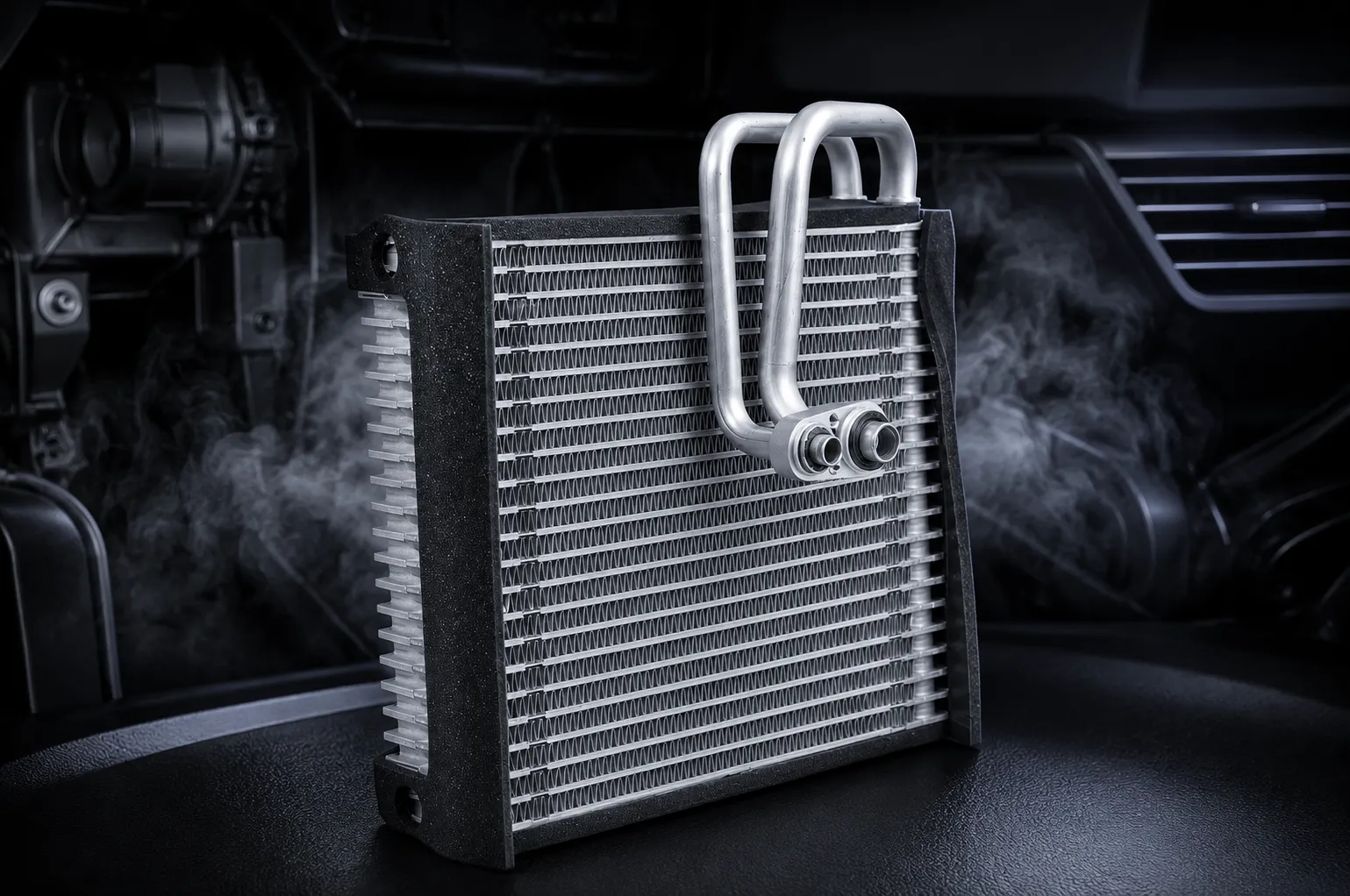
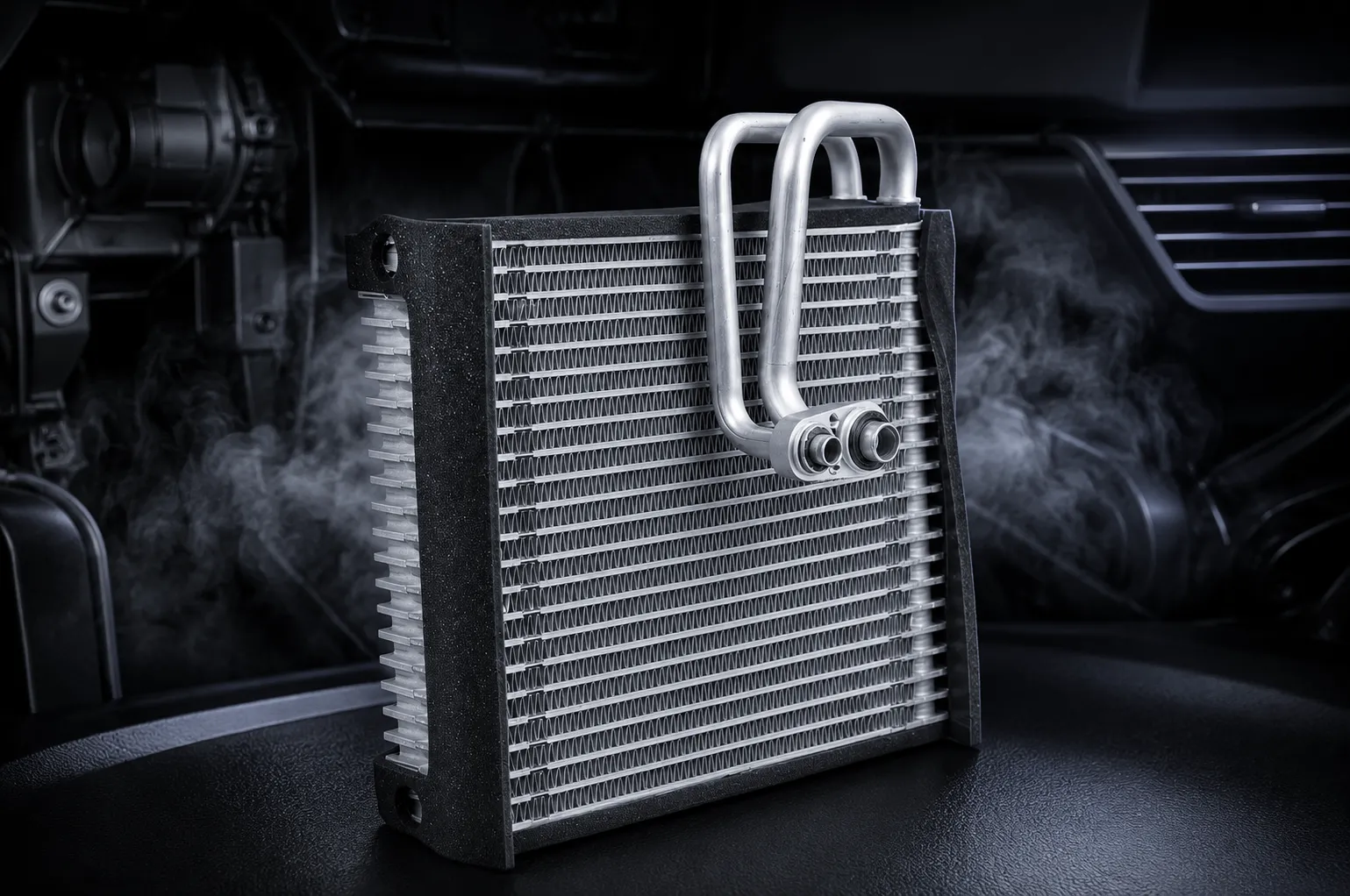
A car heater core supplier China search should end with a controlled product and evidence file, not only a low unit price. A heater core is a compact heat exchanger with tubes, fins, headers, tanks, inlet and outlet connections, seals, and sometimes brackets or a foam frame. A part can look right in a photograph and still have the wrong port spacing, tube layout, coolant path, fin density, or mounting position for the HVAC case.
This guide is written for importers, aftermarket brands, distributors, fleet parts programs, and repair networks. It shows how to qualify a supplier before a sample becomes a catalog item and how to keep the approved version stable as volumes, packaging, and vehicle coverage expand.
Start with the vehicle and HVAC case record
The first mistake in a car heater core supplier China project is asking for a heater core by a broad vehicle name. The same model can have different engines, climate systems, body styles, markets, or production breaks. Ask the buyer or application team for year, make, model, engine, body, market, left or right-hand drive where relevant, HVAC case version, original part number, and the removed core.
Photograph the removed unit beside a ruler and capture both port ends, the fin face, the side rails, the mounting tabs, the foam or seal, and every stamped or printed identifier. A catalog cross-reference is useful, but it should not replace physical evidence. Keep the vehicle record, OE reference, drawing revision, and sample photographs in one controlled folder.
| Application field | Why it matters | Evidence to request |
|---|---|---|
| Vehicle and market | Controls case geometry, coolant routing, and fitment breaks | VIN or application list, model year, engine and market |
| Port interface | Determines hose reach, seal, orientation, and service access | Port center distance, diameter, angle, and seal type |
| Case interface | Prevents rattles, bypass airflow, and installation force | Envelope, rails, tabs, foam, brackets, and insertion direction |
| Coolant duty | Affects material, corrosion exposure, flow and thermal balance | Coolant specification, pressure, temperature and flow conditions |
Define the sellable heater core configuration
Suppliers may quote a bare core, a core with foam seals, a core with brackets, or a complete installation kit. These are different sellable units. Write the boundary into the request for quotation and the purchase order. State whether hoses, O-rings, clips, brackets, insulation, and protective caps are included. A replacement core that needs a transferred seal may be cheaper but may also create more installation risk.
Freeze the approved sample by part number, revision, mass, dimensions, port identity, material declaration, and packaging version. If the supplier proposes an equivalent material or a different fin pack, treat it as a change request. Do not let the phrase “same as original” silently replace a drawing or sample.
Use a simple configuration table in the RFQ. It should identify the vehicle application, core-only or kit boundary, port style, mounting hardware, packaging quantity, label format, and any private-label artwork. This prevents a purchasing team from comparing a finished service kit with an unsealed core.
Compare the heat exchanger construction, not just the face size
Two cores can share width and height while producing different heat transfer, pressure drop, durability, or fit. Record the tube type, tube height and width, tube count, fin pitch, fin louver or wave pattern, header construction, tank material, brazing or mechanical joining method, side plates, and surface treatment. The goal is not to force one construction across every application. The goal is to know what was approved and why.
Aluminum construction is common, but alloy, wall thickness, brazing quality, and coating still matter. Ask how the supplier controls tube forming, fin insertion, header fit, furnace or controlled-atmosphere brazing, and post-process cleaning. A tidy appearance cannot show whether a joint has adequate bonding or whether internal debris remains in the coolant path.
For each application, compare the required coolant flow, air-side restriction, heat output, and pressure drop at agreed test conditions. Request the test fixture and measurement method. A supplier may have a strong platform design while still needing a different port or mounting variant for your vehicle.
Make leak control a release gate
Leak evidence deserves more detail than “100 percent tested.” Ask whether the test is air pressure decay, submerged air, helium, or another method; identify the pressure, stabilization time, temperature, fixture sealing, and acceptance limit. The method should cover tube joints, header seams, tanks, brazed ports, and any attached fittings.
Separate production screening from validation. A production leak check catches open defects on the line. A validation plan should also challenge samples after thermal cycling, vibration, pressure cycling, or the customer-defined durability sequence. Define what happens to a failed unit, how retest is controlled, and how test results are linked to lot identity.
Keep a small set of destructive or sectioned samples when the program requires it. The purpose is to verify joint quality and process assumptions, not to destroy ordinary stock without a reason. Record the sample number, process lot, result, and disposition.
Check corrosion and coolant compatibility
Heater cores live in a wet, warm environment and depend on the vehicle cooling system being maintained. A qualification file should identify the intended coolant family, concentration range, water quality assumptions, inhibitor compatibility, and any material restrictions. Do not accept a generic statement that a core is “anti-corrosion” without knowing the test fluid and exposure.
Inspect tube and header surfaces for consistent joining, burrs, blocked passages, and contamination. Ask how open ports are protected during storage and shipment. A cap that falls off in a carton can allow dust or moisture into a part that later becomes difficult to flush.
When the vehicle maker or customer has a defined environmental standard, map the heater-core plan to that requirement. The official ISO 16750-1 overview is useful background for organizing environmental stresses on vehicle equipment, but it does not replace the customer-specific coolant, pressure, vibration, or thermal test plan.
Verify fitment in the actual HVAC case
Bench dimensions are necessary and still incomplete. A core can meet length and width targets yet fail because a port collides with the case, a tab is clocked incorrectly, foam leaves a bypass path, or insertion force damages a fin edge. Trial-fit the approved sample in the intended HVAC case or a controlled replica. Record insertion direction, fastener engagement, seal compression, port alignment, clearance, and removal access.
Ask the supplier for a fitment control plan. It should show the critical dimensions, gauge or fixture, sampling frequency, reaction plan, and change owner. For a high-volume catalog, retain a golden sample or a digital measurement record with the correct revision and storage conditions.
Where several references share a core family, make the differences explicit. A shared tube pack with a different header or port arrangement should have a separate SKU and label. Similar photos are not permission to merge fitments.
Review production capability and change control
A credible supplier can explain which steps are performed in-house, which are outsourced, and who owns the final release. Ask for the manufacturing route from incoming material through forming, fin assembly, joining, pressure test, cleaning, inspection, packing, and shipment. The supplier does not need to claim every operation is internal; it does need to make responsibility visible.
Request a change-notification rule for alloy, tube, fin tooling, header, brazing line, seal, factory, subcontractor, test method, label, and packaging. A change that looks commercial can affect fit, flow, corrosion, leak rate, or service claims. Agree on when a sample, drawing update, validation report, or customer approval is required.
For a car heater core supplier China comparison, score evidence rather than presentation quality. A short, complete test record with lot identity is more useful than a long certificate folder that never identifies the quoted configuration.
Build a receiving and packaging plan
Fins are easy to crush, ports are easy to bend, and a foam seal can be torn by a sharp carton edge. Specify port caps, separators, fin protection, orientation, inner packaging, master-carton quantity, pallet pattern, and moisture controls. The pack should protect the product without becoming so large that transport damage increases through empty space.
At receiving, inspect carton condition, count, label, port caps, fin faces, brackets, seals, and visible contamination. Define a sampling plan for dimensions and leak or pressure evidence. Keep suspect stock in a marked quarantine location and preserve the carton when a transport or packaging failure may be involved.
Unit, carton, and pallet labels should share the same controlled SKU and lot identifier. Mixed-SKU pallets need a visible map. For private-label programs, approve artwork and barcode content before mass printing; an attractive label with the wrong application code is a costly error.
Turn warranty data into supplier decisions
Do not classify every no-heat complaint as a heater-core failure. The vehicle may have trapped air, a restricted hose, a stuck valve, a blocked passage, a thermostat issue, or a blend-door problem. A useful claim record captures vehicle application, coolant condition, installation date, symptom, inlet and outlet temperatures, flow evidence where available, pressure, leak location, fin or port damage, part label, lot, and photographs.
Use a shared cause vocabulary: application mismatch, installation damage, transport damage, coolant contamination, vehicle system fault, leak at joint, blocked passage, poor fit, and confirmed product defect. Trend the causes by supplier, SKU, lot, and warehouse. This gives purchasing a fair view of supplier performance and gives engineering a clear route for corrective action.
Prepare a precise ZUA sourcing inquiry
ZUA presents heater cores for vehicle cabin-heating and HVAC replacement applications, with a broader climate comfort and mobile A/C parts range that includes related components. Buyers should still confirm the exact production or sourcing route, quoted configuration, test ownership, and warranty boundary for each SKU.
Send ZUA the vehicle list, OE references, removed-part photographs, case dimensions, port details, core-only or kit boundary, annual forecast, launch quantity, destination, label, packaging, validation, and claim requirements. The ZUA company profile can support company-level due diligence, while the contact page is the practical route for a structured inquiry.
A useful RFQ asks for the drawing, material and construction summary, leak-test method, fitment evidence, packaging plan, lot traceability, change-notification rule, lead time, minimum order, and sample schedule. Ask the supplier to mark unknowns instead of filling them with assumptions. That makes the first quotation easier to compare and the later approval easier to defend.
Questions buyers ask about a car heater core supplier China
What information should I send first?
Send the vehicle application, market, engine, original part number, clear photographs, case dimensions, port measurements, and whether the quote is for a bare core or a complete kit.
Is a matching overall size enough to confirm fitment?
No. Port position, mounting tabs, foam, insertion direction, clearance, and case sealing can still make a core unsuitable.
Which leak-test details should appear in a supplier file?
Record the method, pressure, stabilization time, fixture, temperature, acceptance limit, sample or 100 percent scope, and lot or serial link.
Should aluminum alloy be specified in the purchase order?
Yes, when it is a controlled characteristic for the application. Also record wall thickness, joining process, surface treatment, and approved alternatives.
How can a distributor compare two heater-core quotations?
Compare the same sellable boundary, fitment evidence, construction, testing, packaging, documentation, lead time, minimum quantity, and warranty route before comparing unit price.
What packaging protects a heater core in ocean freight?
Use capped ports, fin protection, separators, a stable master carton, controlled pallet stacking, and moisture protection matched to the route and storage time.
Can one core family cover several vehicle references?
Sometimes, but each reference needs documented fitment evidence. Shared dimensions do not prove that ports, tabs, seals, or case clearances are identical.
When should a supplier change require reapproval?
Review changes to tube, fin, header, alloy, tooling, joining line, seal, factory, test method, packaging, or label whenever the change could affect fit, flow, durability, or traceability.
Does ZUA manufacture every heater core it lists?
Do not assume that from a category page. Confirm the responsible route, production location, inspection owner, and warranty terms for the exact quoted SKU.
What is a sensible first order for a new program?
Use a controlled sample, a documented pilot lot, a receiving inspection, and a release review before expanding to a broad catalog or mixed-SKU stocking plan.
Choose a car heater core supplier China with evidence you can reuse
The right car heater core supplier China is the one that can connect application data, construction, coolant compatibility, leak control, HVAC-case fit, packaging, lot identity, and warranty response. That connection lets a distributor scale a proven sample without turning every new carton into a fresh experiment.
ZUA Auto Parts can review the requested heater-core boundary and application evidence before quotation. Give the supplier the measurements and operating context early, then make the approved drawing, sample, test record, label, and change rules part of the same purchasing record.