Choosing an automotive AC evaporator supplier requires more than comparing core size and unit price. The evaporator must fit the HVAC housing, connect correctly to the refrigerant circuit, support the specified airflow, maintain pressure integrity, manage condensate, and arrive clean and undamaged. A visually similar heat exchanger may still fail installation or system validation because small differences in tubes, fins, headers, brackets, ports, sensors, or drain relationships matter.
For buyers sourcing through ZUA Auto Parts, this framework connects the technical question to a controlled product inquiry; exact fitment and quoted specifications remain SKU-specific.
This guide gives importers, distributors, aftermarket brands, repair networks, and OEM teams a practical supplier-qualification process. It also identifies commercial items that must be confirmed per project instead of guessed from a catalog.
Automotive AC evaporator supplier evaluation checklist
| Evaluation area | Evidence to request | Main sourcing risk |
|---|---|---|
| Application match | OE reference, vehicle data, controlled drawing | Wrong fit, ports, brackets, or housing interface |
| Core construction | Material and construction specification | Uncontrolled thermal or mechanical behavior |
| Dimensions | Critical-dimension report and gauges | Assembly interference or air bypass |
| Pressure integrity | Leak-test method, criteria, and records | Refrigerant leakage |
| Cleanliness | Cleaning, drying, capping, and handling controls | System contamination |
| Performance | Agreed heat-transfer and airflow test data | Insufficient cooling or high pressure drop |
| Corrosion and durability | Project-specific validation plan | Early field failure |
| Packaging | Approved pack and transport trial | Bent fins, damaged ports, contamination |
| Traceability | Lot identification and containment drill | Slow or incomplete recall containment |
1. Define the evaporator application precisely
Begin with OE or cross-reference numbers, vehicle make and model, production year, engine or HVAC variant, target market, refrigerant, and any known housing differences. Provide drawings, a reference sample, or dimensional data where possible. The supplier should document which information it used to confirm compatibility.
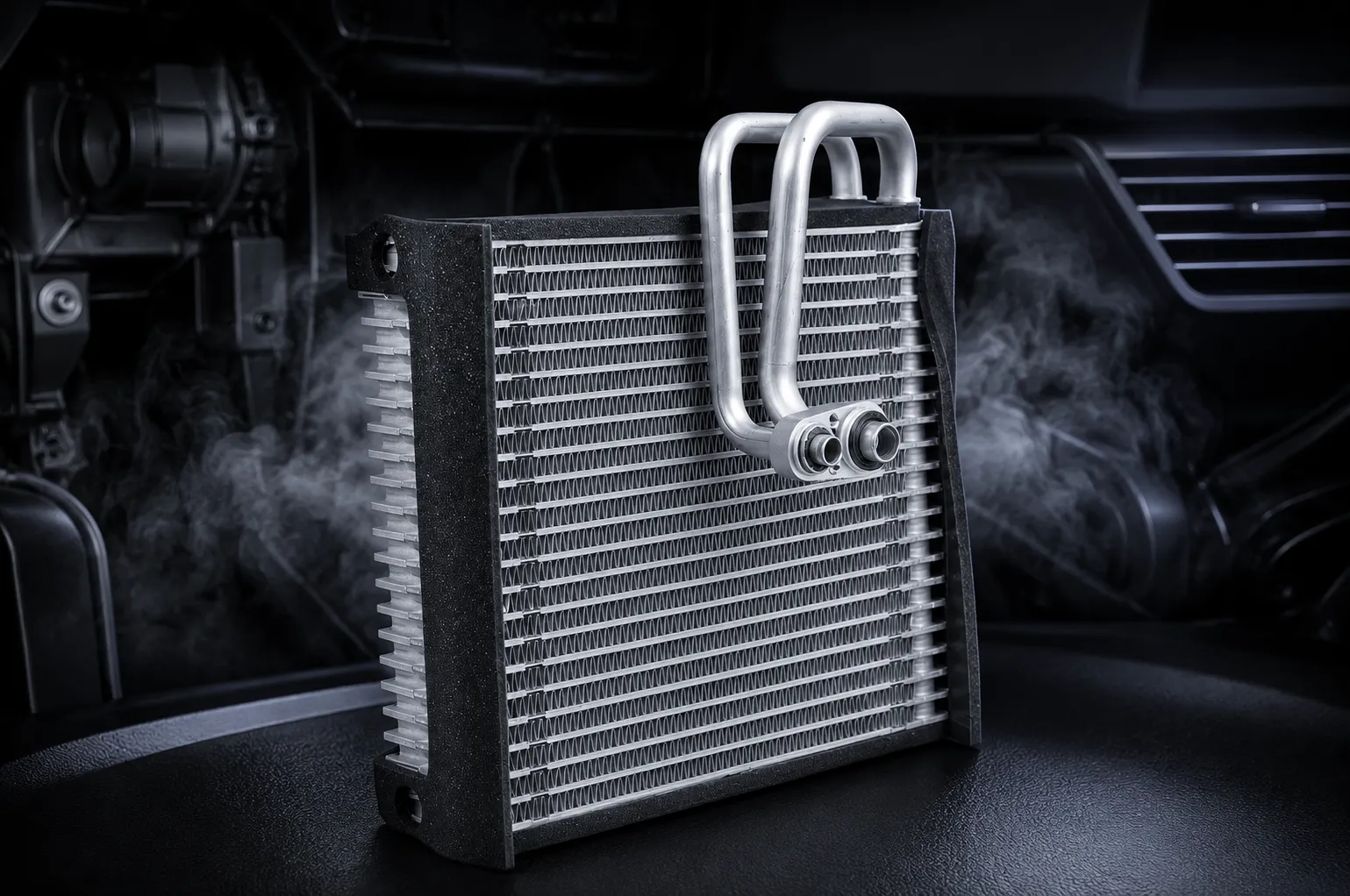
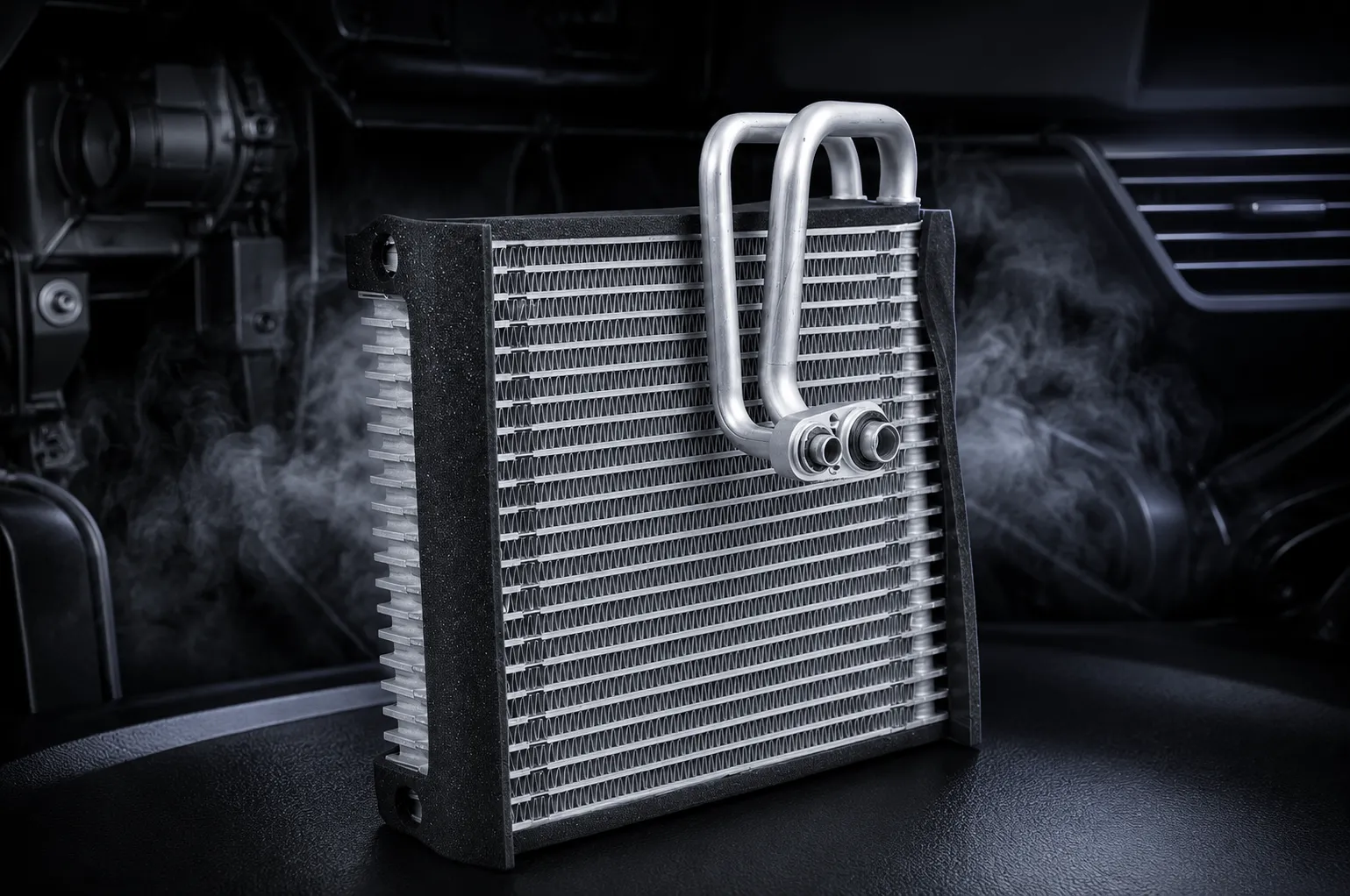
Important checks include overall core dimensions, tube and fin region, inlet and outlet positions, port type and orientation, mounting tabs, sensor or expansion-device interfaces, housing seals, condensate path, and clearance to surrounding parts. If the product includes attached pipes, valves, seals, or brackets, define whether they are part of the approved assembly.
2. Review construction with the automotive AC evaporator supplier
Ask the automotive AC evaporator supplier to explain the core design, tube and fin construction, headers or manifolds, joints, brackets, and surface treatment. Material grades, dimensions, and joining processes should come from a controlled specification. Appearance alone cannot prove alloy, temper, wall thickness, coating, or internal passage design.
Review approved sub-suppliers, incoming-material verification, lot identification, storage, and handling. If some core or joining processes are outsourced, establish where final responsibility and inspection remain. A responsible supplier should identify which features are critical to pressure integrity, heat transfer, fit, and durability.
3. Audit dimensional control and fitment
Small dimensional errors can prevent the evaporator from seating in the HVAC case, distort seals, misalign pipes, or create airflow bypass. Request a critical-characteristic drawing covering external envelope, datum points, brackets, port position, orientation, and interface dimensions. Then review gauges, measurement methods, frequency, calibration, and reaction plans.
For first samples, complete a dimensional layout and controlled fit check. When a reference housing is available, the supplier can use it as a fixture, but the approved drawing should remain the formal product definition. Photograph the installed sample and record any force, interference, seal compression, or routing issue.
4. Verify brazing or joining process control
The exact manufacturing route depends on the evaporator design. Buyers should verify preparation, cleanliness, fixture control, process parameters, equipment maintenance, operator qualification, and post-process inspection for the joining method used. Ask how the supplier detects incomplete joints, distortion, blocked passages, or damage.
Do not accept a general statement such as "vacuum brazed" as complete evidence. Request the process flow, controlled parameters, lot record, inspection plan, and response to abnormalities. If a repair is permitted, its method, limits, reinspection, and traceability should be defined.
5. Review pressure and leak testing
Every evaporator program needs a defined pressure-integrity strategy. The supplier should state the test method, medium, pressure or conditions, duration where relevant, acceptance criterion, equipment, fixture, frequency, and failure response. The correct requirements depend on the product and customer specification.
Ask whether the leak check is performed on every unit and which additional validation tests are sampled or completed during design approval. Review a traceable record for the target part number. Confirm how test equipment is checked and how re-tested or repaired parts are identified.
6. Control internal cleanliness and moisture exposure
The evaporator becomes part of a closed refrigerant circuit, so internal contamination can affect the wider system. Audit cleaning, drying, open-port exposure time, protective caps, storage, rework handling, and packaging. The supplier should prevent debris, moisture, oil mix-ups, and damage during movement between operations.
Ask for the cleanliness requirement and how it is monitored. If the buyer has a residue, particle, or moisture specification, include it in the RFQ. Port caps must fit securely and remain in place through transport without contaminating the sealing surface.
7. Evaluate heat-transfer and airflow performance
Performance depends on core geometry, refrigerant distribution, air-side flow, temperature and humidity conditions, and the complete HVAC system. The test plan should identify inlet conditions, airflow, refrigerant conditions, instrumentation, measurements, and acceptance criteria. Results from another core size or application should not be treated as proof.
Discuss pressure drop on both the refrigerant and air sides where relevant to the project. An evaporator that fits the case but creates excessive restriction or insufficient heat transfer may not meet vehicle-level goals. For OEM or system development, align component testing with HVAC bench and vehicle validation.
8. Address corrosion, vibration, and thermal durability
Evaporators operate with temperature cycling, condensate, vibration, and possible exposure to contaminants. Validation should reflect the target environment and customer requirements. Ask for a risk-based plan covering the materials, joints, brackets, pipes, and surface protection used in the quoted design.
Test names alone are not enough. Review samples, conditions, duration or cycles, acceptance criteria, results, and post-test inspection. When a material, joining parameter, supplier, or geometry changes, engineering should evaluate the need for revalidation.
9. Audit the automotive AC evaporator supplier's packaging
Fine fins, tubes, ports, pipes, and brackets can be damaged before installation. The packaging should prevent movement, crushing, contamination, moisture exposure, and contact that bends fins or sealing surfaces. Check individual protection, dividers, carton strength, pallet pattern, labels, and handling instructions.
Approve packaging alongside the product sample. If private-label artwork is required, confirm artwork approval, barcode data, country-of-origin information, traceability labels, and version control. MOQ, packaging cost, and lead time depend on the selected part and artwork and should be quoted explicitly.
10. Audit the automotive AC evaporator supplier's quality system
The official ISO 9001 overview describes quality management through customer focus, effective processes, and continual improvement. In an automotive AC evaporator supplier audit, look for these ideas in controlled documents, trained operators, calibration, nonconforming-material isolation, traceability, change control, complaint response, and corrective action.
ZUA presents a broader portfolio of compressors and mobile A/C components for OEM/OES, aftermarket, wholesale, distribution, and private-label customers. Buyers should ask which evaporator processes are completed at the proposed site, which are sourced, and what model-specific evidence is available. Review the published evaporator category as a starting point.
Sample approval workflow
- Freeze application data, drawing, materials, and included accessories.
- Confirm sample identity and any deviations.
- Review dimensions, workmanship, cleanliness, port protection, and packaging.
- Review pressure-integrity and agreed performance or validation records.
- Complete HVAC-case fit, bench, or vehicle checks required by the buyer.
- Approve the exact product and packaging revisions in writing.
- Define change-notification and first-production-lot controls.
Commercial questions for the RFQ
- What is the MOQ per evaporator part number and packaging option?
- Are existing models, custom development, or both available?
- What application data are required before compatibility confirmation?
- What samples, drawings, and test records are included?
- What are the sample and production lead times after specification approval?
- Which packaging and private-label options can be controlled?
- How are engineering changes and sub-supplier changes notified?
- What is the documented warranty and return-analysis process?
These questions should receive part-specific answers. Avoid treating an estimate for one core size or packaging format as a commitment for the full range.
Frequently asked questions
Can I choose an automotive evaporator from dimensions alone?
No. Dimensions are essential, but ports, orientation, brackets, housing seals, expansion-device or sensor interfaces, refrigerant, performance, and application data also matter.
Should every evaporator be leak tested?
The supplier should define and document the production test frequency and method for the target part. Buyers should verify the control plan and sample records.
What causes evaporator fitment problems?
Common causes include incorrect vehicle variants, dimensional deviation, port or bracket misalignment, attached-pipe differences, housing changes, and unapproved substitutions.
Why is cleanliness important?
The evaporator is inside the refrigerant circuit. Debris or moisture can affect other components and system reliability, so cleaning, drying, capping, and handling need controls.
How should cooling performance be verified?
Use agreed conditions, instrumentation, airflow, refrigerant-side inputs, measurements, and acceptance criteria tied to the target core and HVAC system.
What should be checked in evaporator packaging?
Verify fin, tube, port, pipe, and bracket protection; contamination control; carton and pallet strength; labels; artwork; and transport handling.
Can an evaporator supplier support private labeling?
Many automotive parts programs can include neutral or private-label packaging, but scope, artwork, MOQ, cost, and timing must be confirmed for the selected product.
How can I request an evaporator quotation from ZUA?
Send OE references, vehicle details, drawings or sample information, annual forecast, packaging, validation, and target market through the ZUA contact page.
Approve the application, process, and evidence together
The right automotive AC evaporator supplier should make the product definition and manufacturing evidence easy to audit. Start with a complete application package, compare suppliers with the same checklist, and release volume only after the sample, validation, process, packaging, and change controls are aligned.