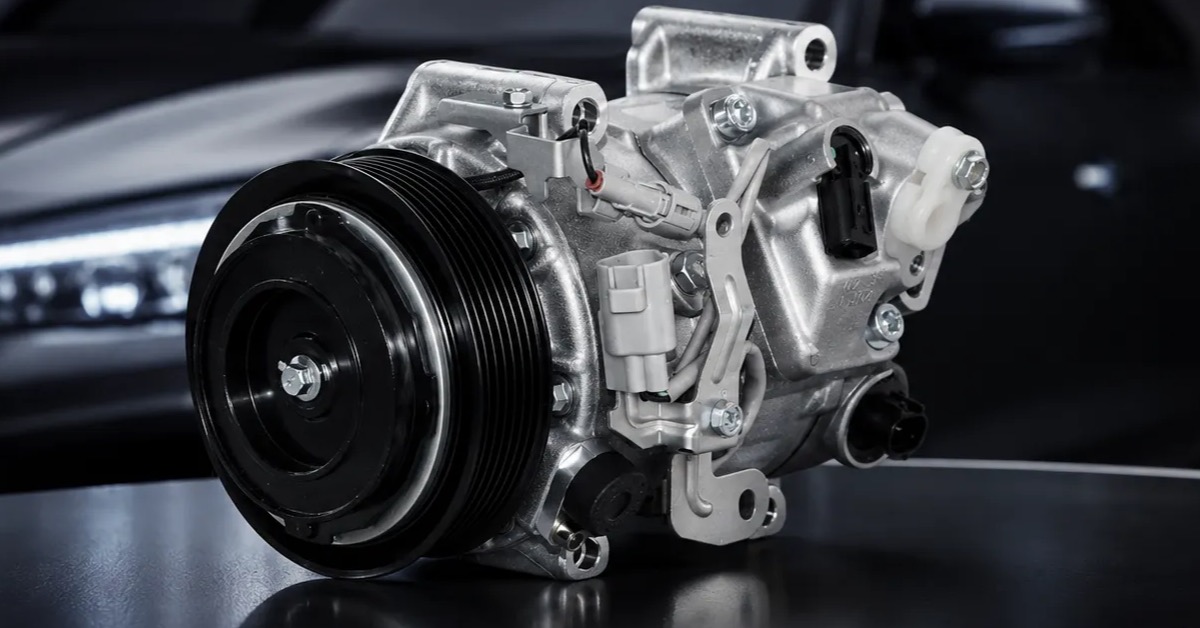
A vehicle specific AC hose assembly needs more than a matching photograph or a copied cross-reference. Reliable fitment data connects the exact vehicle configuration to hose routing, end fittings, port orientation, mounting points, sensors, service valves, heat protection, and supersession history. Buyers should treat the catalog record as controlled product data, because one missing qualifier can turn a physically similar hose into a costly return.
ZUA Auto Parts uses this buyer-focused framework to turn the topic into a clearer product inquiry, while application, construction, and evidence must still be confirmed for each SKU.
This guide is for automotive parts distributors, e-commerce catalog teams, private-label brands, importers, and sourcing engineers managing A/C hose applications across multiple markets.
The fitment record is a technical contract
A catalog listing promises that a specific part will connect, route, mount, seal, clear surrounding components, and support the intended HVAC circuit. That promise involves engineering, sourcing, content, sales, warehouse, and after-sales teams. Give the record an owner, revision, evidence source, and approval state instead of treating it as marketing text.
Separate verified application data from inferred coverage. An interchange may identify a candidate, but it does not prove every engine, production date, body style, steering position, climate package, or regional configuration.
Create a fitment data dictionary
| Field group | Examples | Reason |
|---|---|---|
| Vehicle identity | Make, model, platform, body, year range | Defines catalog hierarchy |
| Configuration | Engine, fuel, drive, transmission, steering side | Separates routing variants |
| HVAC option | Front/rear system, compressor or condenser variant | Identifies circuit architecture |
| Production boundary | Build date, chassis range, market | Controls mid-year changes |
| Assembly role | Suction, discharge, liquid, manifold | Prevents functional confusion |
| Interfaces | Port type, fitting, thread, seal, sensor, valve | Confirms connection compatibility |
| Geometry | Length, clocking, bends, bracket coordinates | Confirms installation path |
| Evidence | Drawing, sample, OE reference, vehicle check | Shows confidence and source |
Define allowed values and units for each field. “Fits sedan” and “long hose” are not governed data. A controlled vocabulary also makes duplicates and contradictions easier to find.
Include negative qualifiers as controlled data. “Not for rear A/C” or “from a stated production boundary” can prevent more returns than a long list of broad positive applications. The vehicle specific AC hose assembly record should preserve why each exclusion exists and who approved it.
Build one golden product record
The golden record should hold the internal part number, supplier number, controlled description, revision, images, dimensions, weight where needed, material specification, fittings, brackets, valves, seals, packaging, markings, cross-references, applications, test evidence, and status. Marketplaces and customer files should be generated from that source.
Do not maintain separate truth in spreadsheets, the website, ERP, and sales presentations. When a correction is approved, publish it through a documented synchronization process and record which channels received the update.
Model the hose as connected interfaces
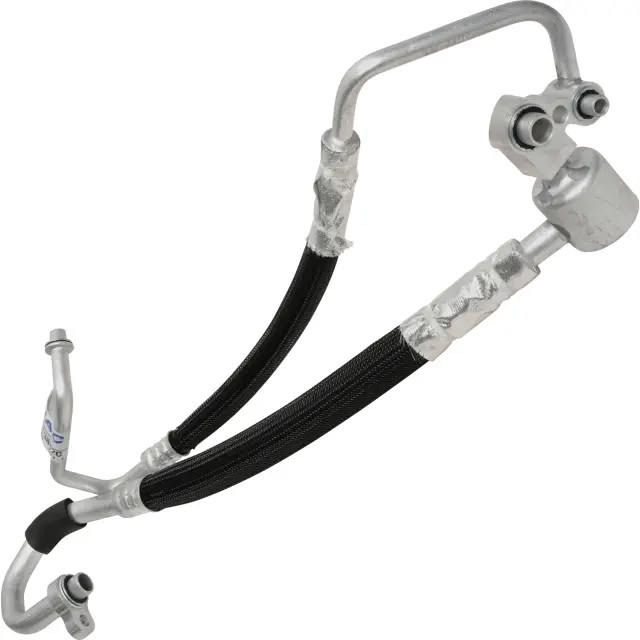
Start at one end and walk the installed route. Record sealing face, diameter, fitting form, orientation, attachment, bracket, flexible section, protective sleeve, crimp, hard pipe, sensor or service port, and opposite connection. Photographs should use consistent reference views and show details that distinguish close variants.
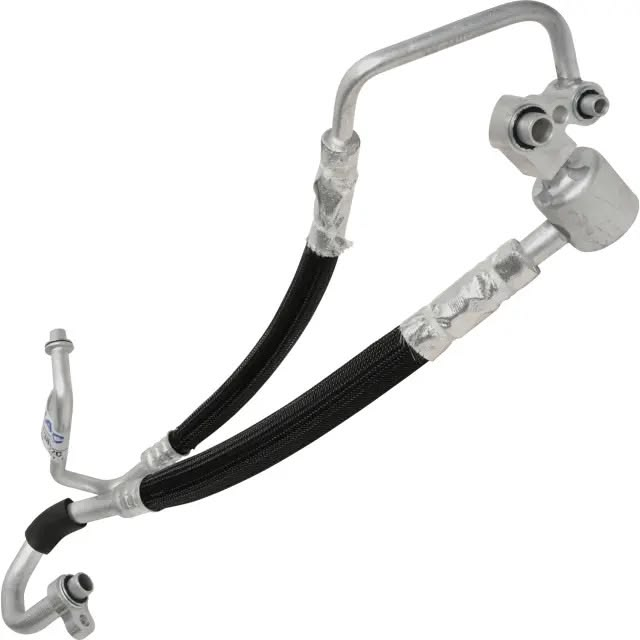
For a vehicle specific AC hose assembly, end-fitting clocking can matter as much as overall length. A hose may connect on the bench yet twist, contact a hot surface, overload a joint, block access, or miss a bracket in the vehicle.
Capture vehicle qualifiers before assigning coverage
Ask which vehicle attributes can change the A/C circuit. Engine family often changes compressor position and routing. Body, wheelbase, rear climate, steering side, market equipment, production date, condenser design, and control package may also matter. Use only qualifiers that have a technical reason.
Over-qualifying creates catalog clutter; under-qualifying creates returns. Review claim and catalog-search data to find where customers cannot distinguish variants.
Use a fitment confidence ladder
Give every application a transparent evidence level. A high-confidence record may combine controlled drawing comparison, OE reference, physical sample, and vehicle installation. A medium-confidence record may have verified interfaces and geometry but lack a complete vehicle check. An unverified candidate should remain internal and not be presented as confirmed fitment.
The level is not a marketing badge. It tells content and sourcing teams which applications need more evidence and prevents an inferred interchange from silently becoming fact.
Validate geometry with repeatable references
Define measurement points for flexible length, hard-line segments, fitting orientation, bend position, bracket coordinates, sleeve position, and service-port direction. Use a drawing, fixture, coordinate-measuring method, or overlay appropriate to the product. Photograph the part on the same reference plane and scale.
A supplier should explain allowable variation and how flexible assemblies are conditioned for measurement. Comparing a coiled new hose to a used installed sample without a common method can create false conclusions.
Confirm sealing and functional requirements
Fitment data does not replace product validation. Confirm material compatibility, permeation requirement, burst or pressure integrity, leakage, cleanliness, crimp control, vibration or impulse durability, temperature exposure, and protective features according to the application and customer specification. Acceptance values must come from controlled requirements.
ZUA lists hose assemblies within its automotive A/C hose range. Buyers should clarify the responsible production route and request model-specific drawings, test evidence, and traceability rather than assuming every listed category is made by the same facility.
Test the catalog with real change scenarios
Mid-year OE supersession
When an OE number changes, determine whether the new part replaces the old for all vehicles, only service stock, or only units after a production boundary. Keep the source and effective date.
One reference, two physical versions
Pause automatic consolidation. Compare connectors, clocking, brackets, valves, routing, and application evidence. Create distinct records when interchange is not demonstrated.
Customer reports difficult installation
Collect VIN, vehicle configuration, old and new part photos in the same orientation, interference point, packaging label, and installation steps. Correct the part or catalog only after the mechanism is understood.
Supplier changes a bracket or sleeve
Require controlled notice, updated drawing and images, validation impact review, inventory identification, and channel update before mixed revisions reach customers.
Publish product content that helps identification
Use a clear assembly role, vehicle qualifiers, OE and aftermarket references with disclaimers, multiple product views, close-ups of fittings and brackets, and measurable attributes. Avoid claims such as “fits all models” when the record contains important exclusions.
Give catalog users a way to report a suspected error. Route corrections through technical review rather than letting customer service change coverage directly after one complaint.
Control supersessions and status
Status may include development, active, restricted, superseded, blocked, or obsolete. A supersession record should state predecessor, successor, direction, effective lot or date, remaining-stock treatment, fitment impact, and approval. Bidirectional equivalence should never be assumed.
When a vehicle specific AC hose assembly changes, preserve historical records so an old claim can be connected to the part actually shipped. Overwriting the prior drawing and image destroys that trace.
Audit data quality with operational measures
Useful measures include application completeness, records with evidence, duplicate rate, unresolved conflict age, catalog return rate, wrong-part reason codes, correction lead time, channel synchronization, and revision traceability. Segment them by product family and market.
A low return rate alone may hide missing sales: customers can abandon a listing when qualifiers or images are unclear. Combine returns with search behavior, customer questions, and coverage gaps.
Sample records during each review rather than checking only totals. Ask a reviewer to reconstruct the vehicle specific AC hose assembly from its approved source, compare the live listing, and identify the warehouse revision. This practical trace exposes synchronization problems that dashboard percentages may miss.
Assign ownership across buyer and supplier
The supplier normally owns controlled product data and change notice for its part. The buyer owns market catalog transformation, channel rules, and final published claims. Both parties should agree how vehicle evidence, samples, drawings, disputes, and corrections are shared. Quality, content, and purchasing should approve different parts of the record.
The IATF 16949 overview provides context for automotive process and change control. The practical test is whether the data trail can explain what was approved and shipped.
Frequently asked questions
Is an OE cross-reference enough to confirm hose fitment?
No. It is a starting point that should be checked against vehicle qualifiers, interfaces, geometry, revision, and credible application evidence.
Which hose dimensions matter most?
Overall and segment lengths, fitting form, end clocking, bend positions, bracket coordinates, protective features, and service-port orientation can all affect installation.
Why do similar hoses need separate listings?
Small differences in routing, brackets, connectors, valves, or production boundaries may make them non-interchangeable.
How should fitment confidence be shown?
Use an internal evidence level with a defined basis. Publish only applications that meet the organization’s approval rule.
What evidence helps investigate a wrong-part return?
Collect VIN and configuration, old and new part labels, aligned photos, fitting and bracket details, interference location, and order record.
Can catalog data be copied from another seller?
That creates uncontrolled risk. Use supplier and OE evidence, verified samples, vehicles, and approved cross-reference sources.
Does ZUA supply automotive A/C hoses?
ZUA lists A/C hose assemblies in its product portfolio. Buyers should confirm fitment, responsible production route, validation, and program terms.
How can buyers request hose application data?
Send vehicle, OE reference, sample images, forecast, target market, and required data fields through the ZUA contact page.
Make vehicle specific AC hose assembly data traceable
A reliable vehicle specific AC hose assembly record connects vehicle qualifiers, physical interfaces, measured geometry, validation evidence, catalog content, supersession, and change history. That disciplined data work reduces wrong-part returns and helps customers identify the correct assembly before installation.