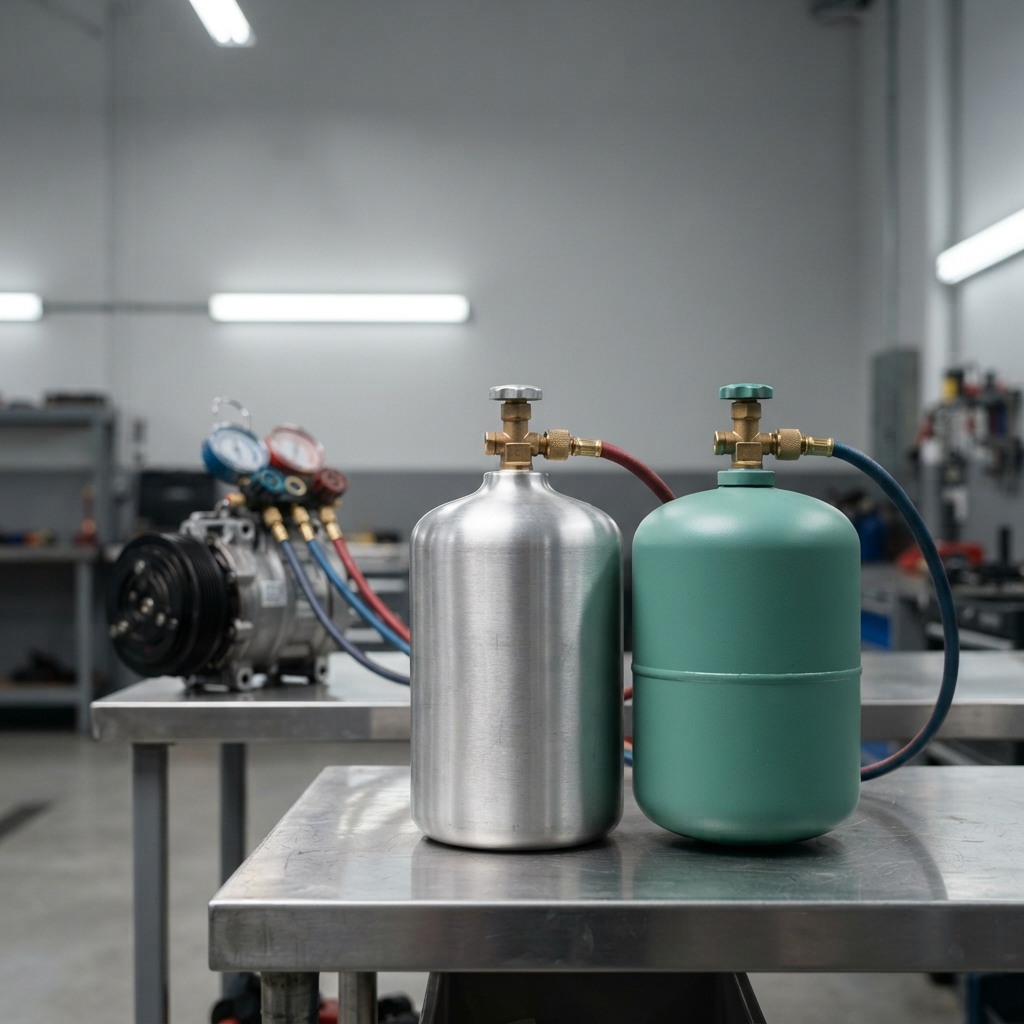
Car AC compressor oil is the lubricant that keeps a compressor alive, and it is not a generic fluid. The oil must match the refrigerant in the circuit, the compressor design and the viscosity grade the manufacturer specifies. Get it wrong and the compressor can run quietly for a few weeks before it seizes, scores its pistons or leaves a varnish layer through the condenser and expansion valve.
This guide explains what car AC compressor oil does, how PAG and POE oils differ, what the viscosity number means, how much oil a system needs, and the service rules that separate a repair that lasts from one that comes back on warranty. It is written for distributors, workshops and sourcing teams who handle compressors in volume rather than one car at a time.
Car AC compressor oil: the short answer
The short answer is that most cars on the road use polyalkylene glycol (PAG) oil with R134a or R1234yf refrigerant, in a viscosity grade specified by the compressor manufacturer, filled to a quantity specified by the vehicle manufacturer. PAG oil is hygroscopic, so it absorbs moisture from open air, and that single property drives most of the handling rules in this article.
| Question | Practical answer |
|---|---|
| Which oil type? | PAG for R134a and R1234yf systems; POE where the compressor or system specifies it |
| Which viscosity? | Whatever the compressor maker specifies; PAG 46, 100 and 150 are common grades, not interchangeable |
| How much? | Set by the vehicle or system specification, adjusted for the oil already in a new compressor and for replaced components |
| Can oils be mixed? | No. Mixing grades or chemistries changes viscosity and can cause poor lubrication or deposits |
| Main handling risk | Moisture. Keep containers sealed and cap an open compressor immediately |
What car AC compressor oil actually does
Inside the compressor, the AC compressor lubricant separates moving surfaces: pistons and cylinder walls, the swash plate or wobble plate, bearings, the shaft seal and, on variable units, the control valve. Without a continuous oil film those surfaces run metal to metal within minutes.
The second job is less obvious. Oil travels with the refrigerant around the whole circuit, so it also lubricates the expansion valve and carries a small amount of sealing and cleaning duty. That is why a system that is low on refrigerant can starve the compressor of oil even when the oil sump was filled correctly at assembly: less mass flow means less oil returning.
The third job is heat transfer, indirectly. Oil that coats evaporator or condenser tubes insulates them. Too much oil, or oil that has broken down into varnish, reduces capacity and shows up as weak cooling that no amount of extra refrigerant fixes.
PAG, POE and PAO: which oil goes with which refrigerant
The oil and the refrigerant are a pair. The refrigerant determines which lubricant chemistries are miscible and stable, and the compressor determines the viscosity. Treating the refrigerant oil as a consumable that any parts store can supply is how systems get destroyed.
| Lubricant | Typical use | Key property | Handling note |
|---|---|---|---|
| PAG (polyalkylene glycol) | R134a and R1234yf automotive systems | Fully synthetic, good miscibility with both refrigerants | Strongly hygroscopic; absorbs moisture from air |
| POE (polyol ester) | Systems and compressors specified for it, including CO2 (R744) designs | Good lubricity and stability at high pressure | Also moisture-sensitive; hygroscopic in storage |
| PAO (polyalphaolefin) | Specific applications where the compressor maker approves it | Good low-temperature behaviour | Not a universal substitute for PAG |
| "Universal" oils | Sold as compatible with everything | Claims compatibility rather than matching a specification | Mixing with PAG is specifically discouraged by parts makers |
PAG oil
PAG is the default R134a compressor oil, and the usual refrigerant oil for R1234yf, because it stays miscible with both refrigerants across the operating range, so oil returns to the compressor instead of pooling in the evaporator. Industry technical literature, including MAHLE's overview of PAG, PAO and POE compressor oils, notes that PAG's main disadvantage is exactly the property that makes it useful in service: it absorbs and binds moisture from ambient air.
That matters commercially. A workshop that leaves a PAG bottle open, or a warehouse that stores compressors with the sealing caps removed, is introducing water into a circuit that has a receiver-drier sized for a much smaller moisture load.
POE oil
POE oil in automotive A/C is used where the system or compressor is specified for it. It offers good lubricity and stability, and it is the usual choice in high-pressure CO2 architectures. POE is also moisture-sensitive, so the storage and handling discipline is similar to PAG even though the chemistry is different.
The practical rule for a parts business is simple: POE goes where POE is called for. It is not an upgrade and not a universal replacement for PAG.
PAO and "universal" oils
PAO oils appear in specific applications where the compressor manufacturer approves them. "Universal" products are a different category: they are marketed on compatibility claims rather than on a specific approval. Parts manufacturers have publicly warned against mixing PAG with universal oils, because the resulting mixture may not hold the viscosity the compressor was validated on. DENSO's technical note on why the right oil matters states the same thing more bluntly: incorrect oils and oil mixtures lead to compressor damage.
For a distributor, the risk is asymmetric. Carrying one universal oil simplifies the shelf and multiplies the failure modes. Carrying the two or three grades your compressor range actually specifies is cheaper over a season.
What the viscosity number means
PAG grades are named by an oil viscosity number, and the number is not a quality ranking. PAG 46 is thinner than PAG 100, which is thinner than PAG 150. The compressor manufacturer chooses the grade for the clearances, loads and operating temperatures of that design.
- Thinner grades flow more easily at low temperature and return to the compressor faster, but carry less load in tight clearances.
- Thicker grades support higher loads and larger clearances, but can be slower to return at low ambient temperature.
- Wrong grade, right chemistry still produces wear: a PAG 46 in a compressor specified for PAG 150 is a lubrication fault even though the oil is "PAG".
This is why the oil specification belongs on the RFQ and on the label, next to the part number. It is also why a compressor sold without a stated oil grade should be treated as an incomplete offer.
How much car AC compressor oil a system needs
Oil charge is a system value, not a compressor value. The vehicle or system specification states the total, and service procedures adjust that total for what is already in the replacement compressor and for components that were replaced.
- Read the specification first. Start from the total oil charge for that vehicle and system, not from a generic rule of thumb.
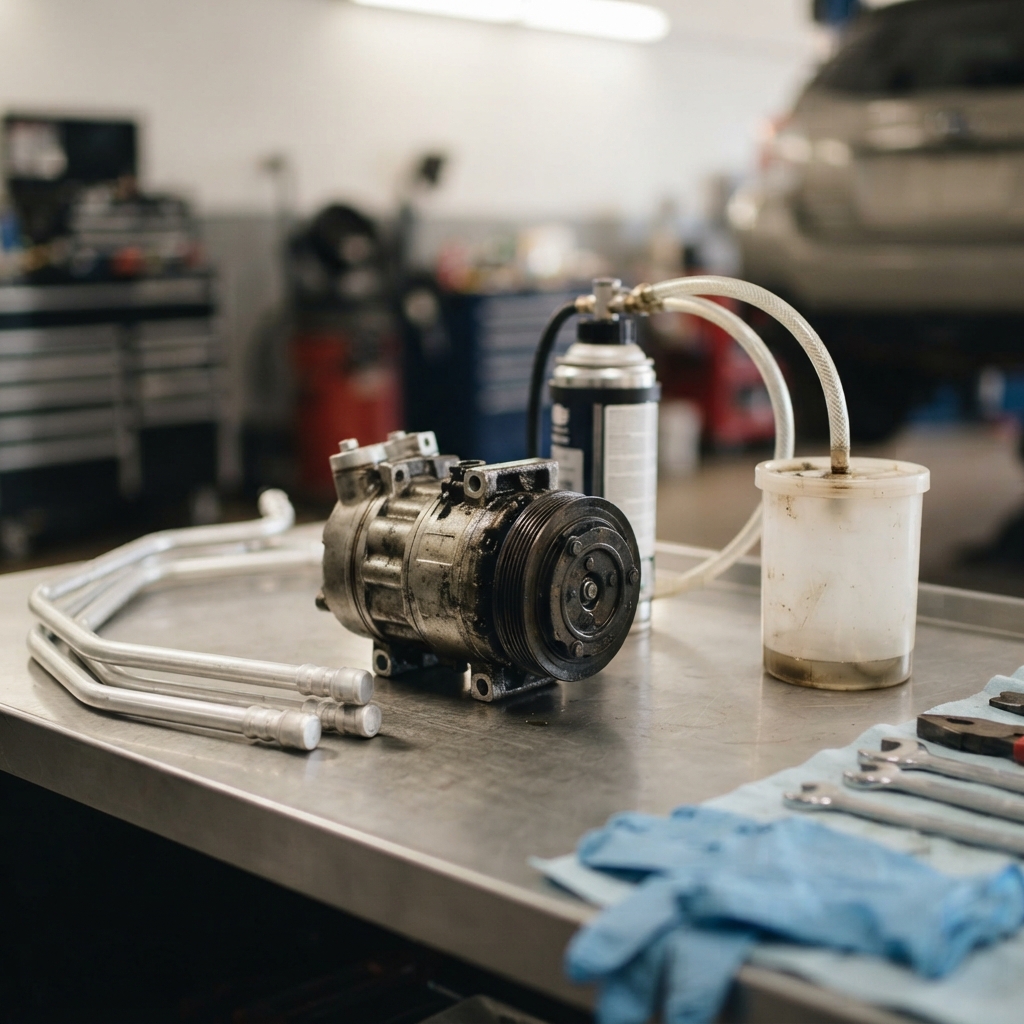
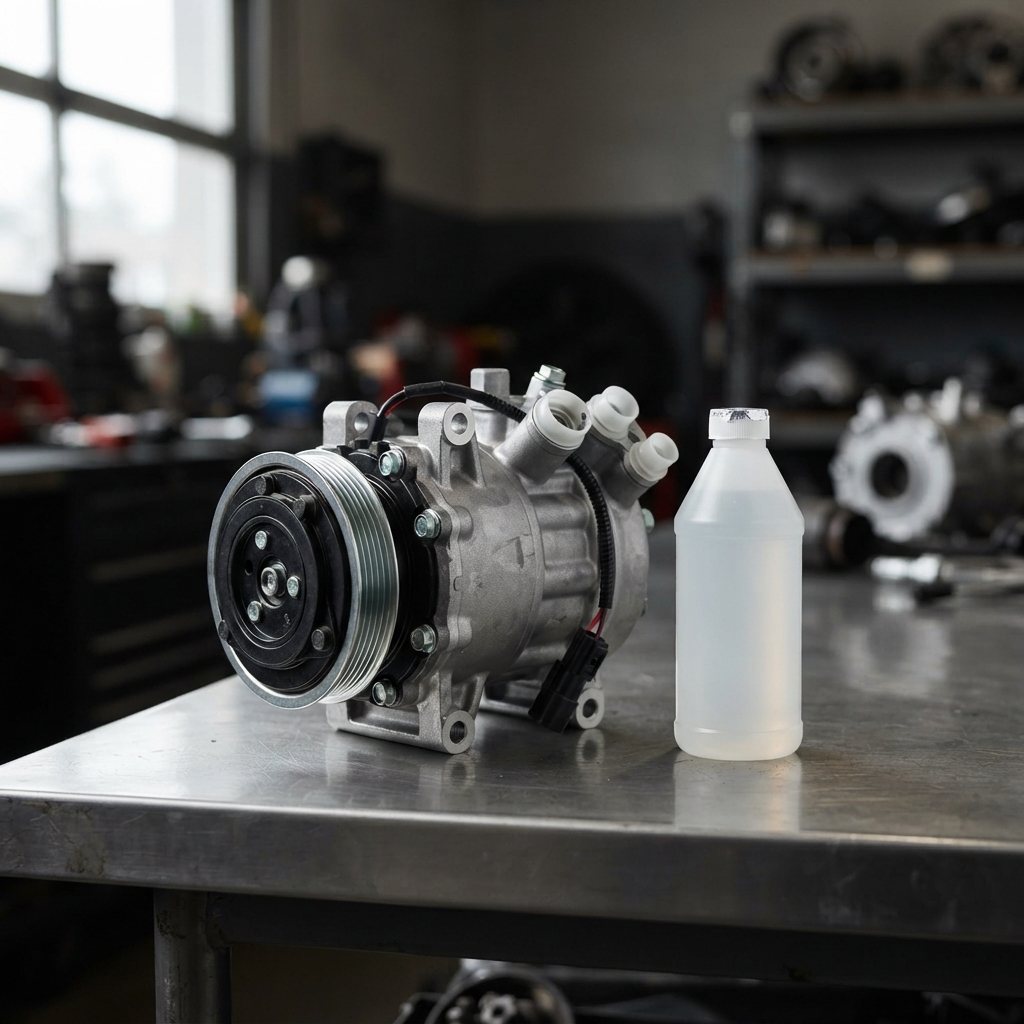
- Check the new compressor. Many replacement compressors ship with a factory oil charge. Drain and measure it if the procedure requires it, then adjust.
- Add for replaced components. A new condenser, evaporator, receiver-drier or long hose run holds oil that left with the old parts.
- Never guess upward. Excess oil reduces heat transfer and can hydraulic-lock a compressor; too little destroys bearings.
- Record it. Write the oil type, grade and quantity on the job card and on the invoice. It is the first thing a warranty engineer will ask for.
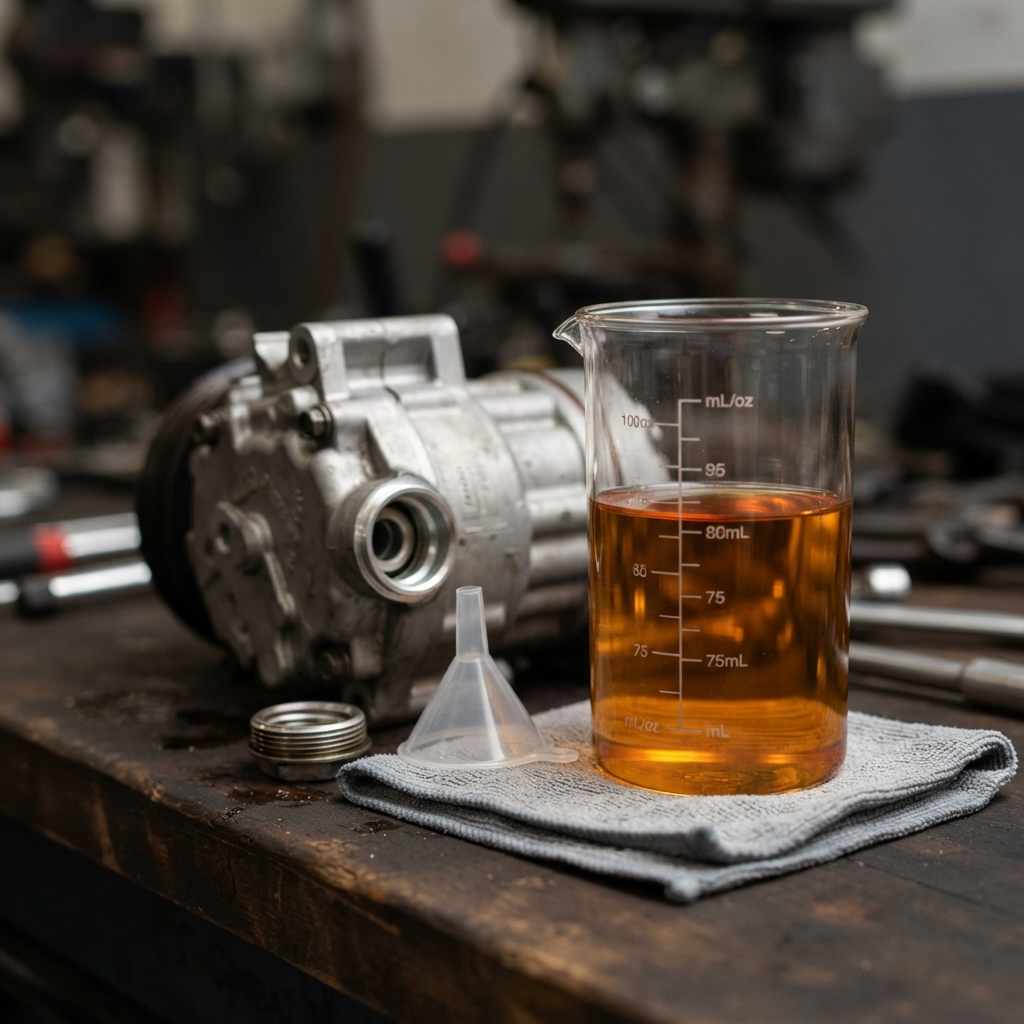
For a wholesale program, the same logic applies at catalogue level: the oil specification and charge should be attached to the SKU record, not left in a technician's memory.
Why moisture is the real enemy of car AC compressor oil
Water in a refrigerant circuit does three things. It forms acids with the oil and refrigerant, it corrodes aluminium and copper surfaces, and at the expansion valve it can freeze and block flow. PAG makes all three more likely because it holds moisture rather than shedding it.
The countermeasures are unglamorous and effective: keep containers sealed until the moment of use, cap every open connection, replace the receiver-drier whenever the circuit is opened, pull a proper vacuum before charging, and never store a compressor uncapped in a humid workshop. The dual-port accumulator filter drier service sequence covers the replacement steps in order, and a held, decay-tested vacuum is the only proof that moisture and leaks are under control.
Oil and refrigerant must be chosen together
Because the lubricant is selected for the refrigerant, any change of refrigerant changes the oil question. A program moving from R134a to a low-GWP fluid cannot carry the old oil across by default, and a compressor validated on one refrigerant is not automatically approved on the other even when the mounting pattern is identical.
The R1234yf vs R134a comparison covers that decision in detail, including why the same compressor family usually needs different seals, different lubricant approval and different service equipment. Read it before quoting a dual-fluid range.
Signs that a system has the wrong or degraded oil
| Symptom | What it usually means | What to check |
|---|---|---|
| Dark or gritty oil at drain | Overheating, contamination or refrigerant loss | Oil colour, debris, system flush history |
| Varnish on valve and tubes | Oil breakdown from excess temperature | High-side pressure, condenser airflow, oil grade |
| Noise at start-up | Oil drained from the sump while parked | Oil charge, suction line routing, refrigerant charge |
| Repeated shaft-seal leaks | High internal pressure or wrong oil | Charge, oil specification, seal material |
| Weak cooling with correct charge | Oil-fouled heat exchangers | Oil quantity, flush records, condenser condition |
None of these symptoms is conclusive on its own. The point is that oil is a diagnostic channel, not just a consumable, and a shop that records oil condition builds a failure history it can actually use.
What to verify when buying compressors in volume
For importers and distributors, oil control starts at purchase order. Four checks prevent most of the problems in this article.
- Oil grade on the record. The compressor's specified oil type and viscosity should be documented, not inferred from the refrigerant.
- Factory fill stated. Know whether the unit ships with oil and how much, so the installer can adjust to the system total.
- Sealing and packaging. A compressor should arrive capped and dry, with no oil residue in the carton that suggests a leak in transit.
- Service data. Charge quantity, oil grade, pulley and port details belong in the same document as the part number.
That last point is where thin product data costs money. Two compressors can share a family name and still differ in displacement, pulley, clutch voltage and oil specification, which is exactly the pattern we describe in the variable versus fixed displacement guide. For the wider supplier checks — application data, performance evidence, production controls and warranty records — work through the AC compressor supplier qualification guide before you approve a new source.
Compressor oil in practice: what we supply
We build piston-type automotive A/C compressors in Guangzhou, and oil specification is part of the release record for each part number rather than a line on a generic datasheet. For example, the 10PA17C-type compressor listed for the Toyota HiAce RZH10 is a specific application part, not a universal 10PA17C, and its fitment and oil data are tied to that application record.
Condenser and evaporator replacement is the other half of the oil question, because those components hold oil that leaves with the old part. Our aluminium A/C condenser uses a tube-and-fin core with integrated inlet and outlet fittings and vehicle-specific mounting points, and the product record asks buyers for core dimensions, port position, mounting dimensions and receiver-drier requirements before fitment is confirmed.
If you are building a range that has to serve several refrigerant generations, the useful starting point is the application list and the compressor platform, not the oil label alone. The compressor catalogue shows the current platforms, and our team can work from a vehicle list, an OE number or a sample.
Common mistakes with car AC compressor oil
- Assuming all PAG oil is the same. Chemistry and viscosity are separate specifications, and both matter.
- Topping up with a universal oil. Mixing chemistries can leave the compressor with a viscosity nobody validated.
- Draining a new compressor without measuring. You lose the reference point for the system total.
- Forgetting component oil. A new condenser or evaporator takes oil with it, and the sump ends up short.
- Leaving containers and ports open. Moisture enters in minutes in a humid workshop, not days.
- Reusing oil after a compressor failure. Debris and acid stay in the oil; the circuit needs a flush and a new drier.
- Recording nothing. Without oil type and quantity on the job record, every later diagnosis starts from zero.
Frequently asked questions
What kind of oil goes in a car AC compressor?
PAG oil in the viscosity grade the compressor manufacturer specifies, for R134a and R1234yf systems. POE is used where the compressor or system requires it. Never choose the oil from the refrigerant name alone.
Can I use PAG 46 instead of PAG 100?
Only if the compressor is approved for PAG 46. The grade sets the oil film thickness in a specific design; substituting a thinner or thicker grade is a lubrication change, not a convenience.
How much car AC compressor oil do I add?
Start from the vehicle or system total, subtract what the new compressor already contains, and add the amount required for any replaced condenser, evaporator, drier or hose. The exact figures come from the service specification, not from a universal rule.
Does car AC compressor oil expire?
Sealed containers have a shelf life set by the oil maker, and an opened container should be treated as contaminated once it has been exposed to humid air. Date the container when you open it and discard oil that has been open for a long period.
Why does my AC compressor fail after an oil change?
The usual causes are the wrong viscosity, mixed chemistries, too little or too much oil, moisture left in the circuit, or debris from a previous failure. Failure analysis normally shows one of these, which is why the oil record matters.
Can I mix PAG and POE oil?
No. Mixing changes viscosity and can produce deposits or poor lubricity. Use the single lubricant the compressor is approved for, and flush according to the service procedure if the system changes chemistry.
Is car AC compressor oil the same as engine oil?
No. Engine oil is formulated for combustion by-products and does not have the miscibility or dielectric behaviour the A/C circuit needs. Using it will damage the compressor.
Does the oil affect warranty on a replacement compressor?
Yes. A compressor installed with an unapproved oil, the wrong grade or the wrong quantity is normally outside warranty, and the failure analysis usually identifies it. Keep the oil type and quantity on the invoice.
Conclusion
Car AC compressor oil is a specification, not a commodity: the right chemistry for the refrigerant, the right viscosity for the compressor, the right quantity for the system, and dry storage from factory to fitment. Distributors who put oil type, grade and charge on the SKU record prevent most of the failures that otherwise arrive as warranty claims months later.
If you are specifying compressors for a mixed fleet, send the application list, OE numbers and the oil specification you need to our team through the contact page before anything is quoted. For the diagnostic side of the same system, the AC compressor not engaging sequence and the clutch coil testing guide cover what to measure when the compressor does not engage at all.