How to Choose an Automotive Air Conditioning Compressor Manufacturer: From Structural Identification to Bulk Procurement
ZUA Auto Parts uses this buyer-focused framework to turn the topic into a clearer product inquiry, while application, construction, and evidence must still be confirmed for each SKU.
Finding a suitable car AC compressor manufacturer is usually not as simple as comparing the appearance of the casing or the unit price. The automotive air conditioning compressor directly participates in the refrigerant cycle, affecting not only cabin cooling but also the compatibility with belt drives, clutch control, electrical interfaces, and the entire HVAC system. For automotive parts distributors, aftermarket brands, service networks, and vehicle system manufacturers, the real challenge lies in assessing: the supplier's ability to consistently manufacture the target structure, their ability to provide reliable application matching data, and their ability to maintain consistent quality control across prototype, small-batch, and subsequent production stages.
This article focuses on a type of automotive air conditioning compressor with a pulley and electromagnetic clutch assembly. It explains which structural details, manufacturing capabilities, and verification items should be examined before purchasing, and distinguishes which information can be initially determined from the product's appearance, and which must be confirmed by the supplier through drawings, samples, or test documents. The article's goal is not to provide a compatibility conclusion for a specific model, but rather to help buyers establish a more robust supplier selection method.
First, look at the product: What are the structural features of this type of compressor?
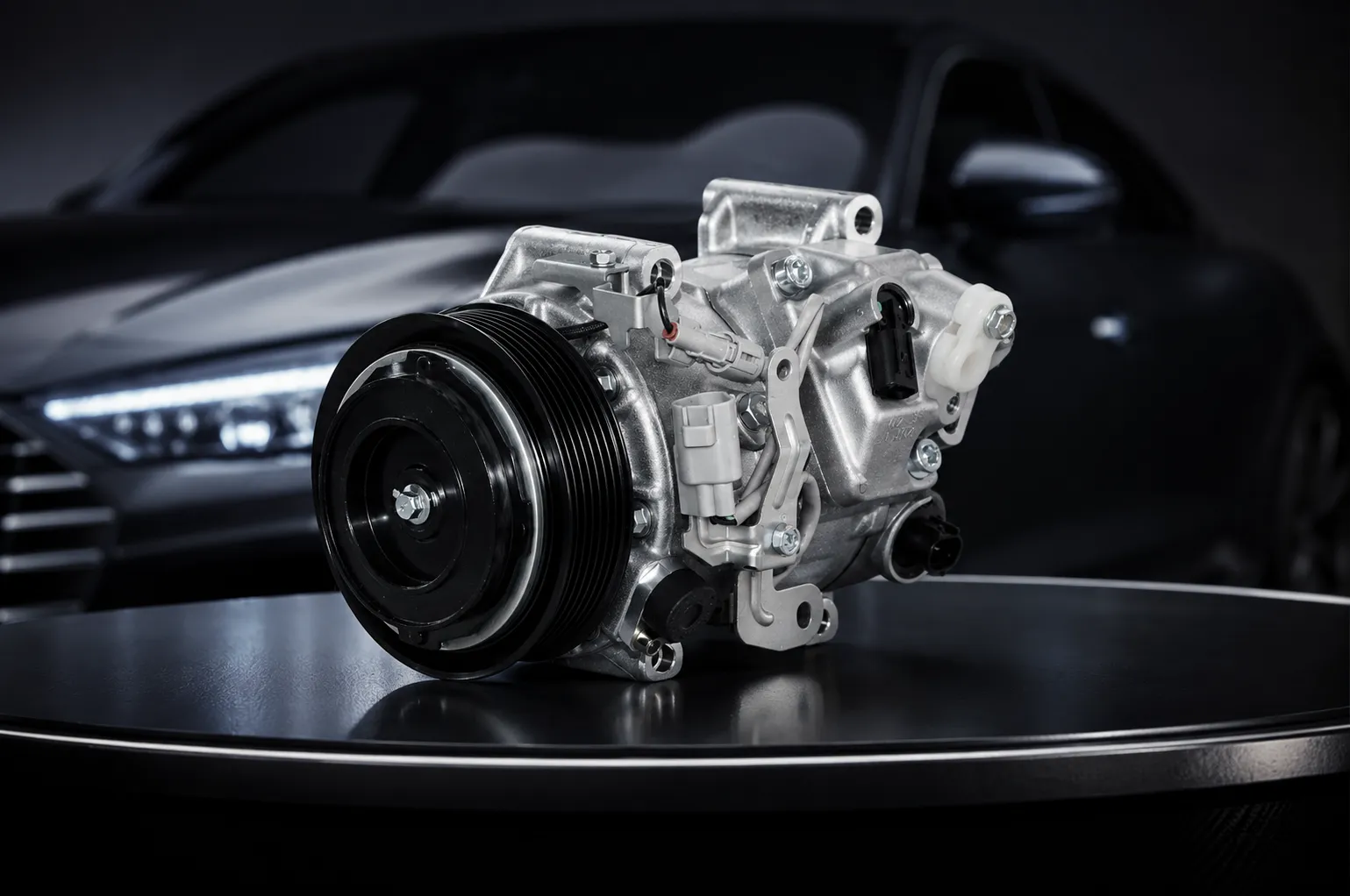
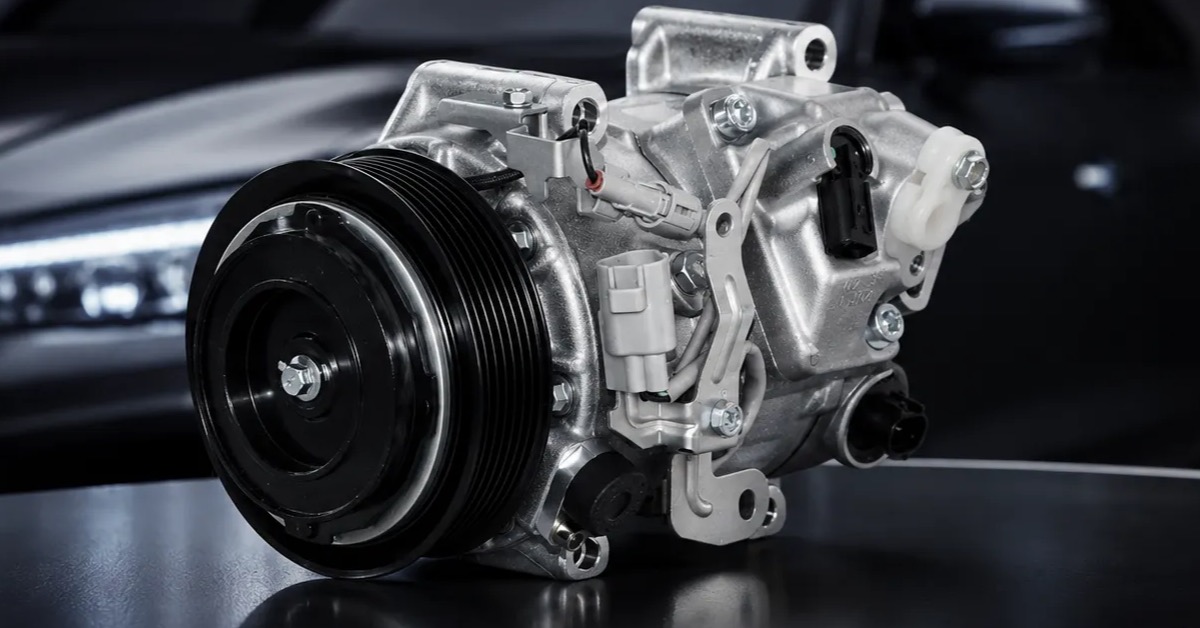
In terms of product form, this type of compressor uses a compact, irregular metal casing with multiple mounting ears and bolt holes, and a large black multi-ribbed pulley at the front end. Fasteners and a structure resembling the end face of an electromagnetic clutch are visible in the center of the pulley. This means that the compressor is typically mechanically driven via an engine accessory belt, and the start-up, shutdown, and regulation of the air conditioning system are controlled by a clutch or electronic control components.
The casing is primarily made of silver metallic components, and its appearance suggests it may be an aluminum alloy casting. However, the specific alloy grade, heat treatment condition, or wall thickness cannot be determined solely by appearance. Refrigerant connection ports are also visible on the casing, one of which has a white protective cap. The protective cap helps prevent contamination during transportation and assembly, but the buyer still needs to confirm the sealing condition, port dimensions, and required matching seals upon product delivery.
The presence of multiple electrical connectors and accompanying wiring harnesses suggests that the product may include electronic control functions, or at least have electrical interfaces related to a clutch. The supplier's product range includes internally controlled variable displacement compressors, externally controlled variable displacement compressors, and fixed displacement compressors; therefore, this product could potentially be of the externally controlled variable displacement type, but the image alone cannot rule out other configurations. The control method cannot be determined solely by the number of connectors or the shape of the housing during procurement.
Quick Procurement Assessment: Which Information Can Be Initially Confirmed, and Which Should Not Be Guessed?
| Observation or supplier information | Preliminary judgment can be obtained | Content still needs to be confirmed |
|---|---|---|
| With multi-ribbed pulley and clutch end face | It is highly likely to be belt-driven and have a front-end clutch assembly. | Pulley diameter, number of grooves, offset, direction of rotation, and clutch operating parameters |
| Multiple mounting ears and bolt holes | Suitable for specific engine or vehicle mounting locations | Mounting hole spacing, reference surface, bolt specifications, and clearance from surrounding components. |
| Electrical connectors and wire harnesses | This may involve clutch or electronic control functions. | Plug type, pin definition, voltage, control signal and circuit protection requirements |
| Refrigerant interface and protective cap | It has the basic structure to connect to the automotive air conditioning circuit. | Refrigerant type, oil type, interface specifications, operating pressure, and sealing material |
| The supplier possesses testing equipment and an IATF 16949 system declaration. | This indicates that it possesses the basic conditions for management and testing in the automotive industry. | Specific model test records, process control plans, batch traceability, and change management. |
The "Cannot Guess" section in this table is crucial. Product photos that don't show model numbers, part numbers, dimension scales, or refrigerant markings cannot prove whether the product is brand new, remanufactured, or an OE equivalent replacement. For buyers selling across different vehicle models, incorrect compressor matching is often more than just a matter of installation; it can cause uneven belt wear, clutch malfunction, refrigerant and lubricant incompatibility, and even prevent the repaired system from building pressure properly.
The manufacturing process determines whether a supplier can deliver consistently.
Housing Machining and Critical Dimensions
The manufacturing of automotive air conditioning compressors typically involves casting or forming the metal housing, CNC machining of functional surfaces, machining of holes, end cap assembly, and sealing. For the purchaser, the most important factor is not the general statement "whether there is a machining center," but rather how the supplier controls the dimensions of mounting surfaces, bearing housings, refrigerant interfaces, housing mating surfaces, and rotating parts.
The supplier's information indicates that its manufacturing facility covers an area of over 10,000 square meters, employs more than 200 people, and has an independent R&D team. The information also mentions automated assembly lines and coordinate measuring equipment. For customers requiring continuous supply, these capabilities help establish process control from parts processing to final assembly. However, area and equipment quantity do not necessarily equate to a model's qualification; the buyer should still request dimensional inspection plans, a list of critical characteristics, and sample inspection results for the target model.
Clutch, pulley and electrical component assembly
The front pulley serves both as a belt drive component and is associated with the clutch or control mechanism; therefore, assembly deviations may manifest as abnormal noise, belt vibration, engagement problems, or wear during operation. The buyer should request the supplier to specify the assembly method of the pulley to the compressor shaft, the clutch clearance control method, the dynamic balancing or vibration inspection arrangements, and the fixing and protection methods for the electrical connectors after assembly.
The product contains visible plastic electrical components and wiring harnesses. In actual projects, similar plug shapes do not necessarily indicate identical pin definitions. Especially when replacing original equipment manufacturer (OEM) parts, the connector model, pin functions, control logic, and vehicle-side wiring harness should be verified together. For externally controlled variable displacement compressors, the compatibility between the control valve and the vehicle control unit should be further confirmed, rather than simply ordering based on the purchasing habits for fixed displacement products.
Sealing, Leakage and Environmental Validation
The compressor is a critical component in a closed refrigerant circuit, and leak control is a core aspect of procurement audits. The supplier's report that they possess a helium leak detector, vibration testing equipment, and salt spray testing equipment demonstrates their capability to conduct relevant inspections or verifications. Helium leak detection can be used to identify small leak paths, vibration testing can be used to observe the performance of structures and assemblies under mechanical stress, and salt spray testing is commonly used to evaluate the corrosion resistance of relevant metal surfaces or protective measures.
However, the equipment list is not equivalent to product testing results. During the inquiry phase, it's best to clarify: whether leak testing is performed after single-piece assembly or includes other processes; how the testing conditions and judgment criteria are defined; whether vibration, salt spray, and functional tests are specific to the target model; and how non-conforming products are isolated and traced. Do not write "equipped with testing equipment" to imply that a certain model has already reached specific lifespan, noise, or efficiency targets without supporting documentation.
When selecting an auto AC compressor supplier, it is recommended to conduct a four-tiered review process.
First layer: Application matching
First, provide the complete OE number or cross-reference number, then verify the vehicle model, engine version, and installation location. If no readily available part number is available, at least the mounting hole positions, pulley parameters, interface photos, connector photos, compressor displacement, or control type should be submitted. For commercial vehicle or construction machinery applications, the vehicle's operating environment and usage load must also be described, as "identical external appearance" does not necessarily prove identical internal specifications.
Second layer: Technical documents
Suppliers are required to provide product drawings, key dimensions, interface definitions, refrigerant and lubricant requirements, and installation and storage precautions. Specific data regarding voltage, operating pressure, cooling capacity, noise level, efficiency, warranty period, and service life must be based on the target model documentation. If the supplier has not yet finalized the design, they should clearly define which parameters are provisional to avoid discrepancies between the purchase order and mass production documentation.
Third level: Process and quality capability
The supplier declares that its quality management system is IATF 16949 certified and possesses an R&D team, automated assembly lines, coordinate measuring equipment, and various testing equipment. This information is valuable for automotive projects. Further audits should focus on whether there is incoming material inspection, first-article verification for critical processes, assembly error-proofing, batch identification, change orders, and closed-loop management of non-conforming products. Certificate names can serve as an entry point, but cannot replace verification of on-site processes and target model records.
Fourth layer: Business collaboration methods
The supplier's information indicates they can handle OEM, ODM, custom development, trial orders, and small-batch purchases. This is particularly useful for aftermarket brands and importers, as projects may begin with small-scale validation and then expand procurement based on vehicle model coverage and market feedback. Buyers should clarify minimum order requirements early on, whether samples can be provided in customized configurations, whether packaging and labeling support the brand's strategy, and how final samples will be approved before mass production. Specific pricing, delivery times, and warranty terms are not provided in the existing information, and commitments cannot be made on behalf of the supplier based on experience.
Common Procurement Mistakes: Why Cheaper Alternatives Might Be More Expensive
The first mistake is purchasing only based on vehicle model name without verifying the engine version and OE number. The second is only looking at the compressor body without checking the pulley groove count, position, and connectors. The third is confusing fixed displacement, internally controlled variable displacement, and externally controlled variable displacement. The fourth is ignoring refrigerant and oil requirements. Material compatibility, control methods, and maintenance procedures may differ between different systems.
Another often underestimated issue is the installation environment. Even if the compressor can be mounted on a bracket, it may interfere with belts, tensioners, exhaust components, or the chassis. Therefore, sample confirmation should include checking installation dimensions and peripheral clearances, rather than just making a static judgment on whether it can be installed. For bulk purchases, it is recommended to retain sample photos, measurement records, test reports, and approved versions. If the supplier changes parts or adjusts the process later, a reassessment is necessary.
A list of inquiries for wholesale buyers
- Target OE number, cross-reference number, vehicle model and engine information;
- Compressor control type: fixed displacement, internal control, or external control with variable displacement;
- Pulley diameter, number of wedge grooves, installation offset, rotation direction, and clutch information;
- Mounting hole positions, interface dimensions, connector type and pin definitions;
- Applicable refrigerants, lubricating oils, and recommended charging or maintenance requirements;
- Leakage detection, dimensions, functionality, vibration, or other verification records for the target model;
- Batch traceability, packaging labeling, change management, and handling of non-conforming products;
- The specific processes for sample production, trial orders, custom development, and small-batch procurement.
For importers or distributors looking for wholesale automotive compressors, the most practical approach is to first create an "application matrix," clearly listing the vehicle model, displacement, connectors, pulleys, and refrigerant requirements for each part number, and then have the supplier confirm each item. This is safer than using a single product photo to cover multiple vehicle models and also facilitates subsequent inventory management.
Frequently Asked Questions
Are all these types of products necessarily externally controlled variable displacement compressors?
This cannot be confirmed in this way. The product has multiple electrical connections, and the supplier offers various compressor product types; therefore, external control of variable displacement is only one possibility. It should be confirmed based on the model number, control valve, connector definitions, and technical documents.
Can I determine vehicle compatibility directly from a photo?
Not recommended. Photos cannot provide accurate dimensions, part numbers, refrigerant markings, rotation direction, and pin information. Vehicle compatibility requires verification of at least the mounting pattern, pulley design, interface, connector, refrigerant, and OE or cross-reference number.
Does the manufacturer support small-batch purchasing?
The available information indicates that the supplier states they can provide trial orders and small-batch purchases, while also supporting OEM, ODM, and custom development. The actual minimum order quantity, sample costs, delivery arrangements, and customization boundaries should still be confirmed in writing during the inquiry phase.
Next step: First confirm the model number, then proceed with sample verification.
When selecting an automotive air conditioning compressor supplier, a reliable path typically involves "application data verification—technical document review—sample inspection—necessary testing—small-batch verification—mass production approval." The supplier's disclosed production space, R&D team, automated assembly line, IATF 16949 quality system, and leak detection, measurement, vibration, and salt spray equipment provide a starting point for further review, but should not be considered as complete performance proof for a particular model.
If you are procuring replacement parts, establishing an aftermarket product line, or developing a custom compressor project, the next step should be to submit the OE number, vehicle model information, installation and interface requirements to the supplier, and request matching confirmation, key parameters, and verification data for the target model. Only by specifying this information in concrete model details and traceable documentation can bulk procurement truly have an engineering basis.