How to Evaluate a Car AC Condenser Manufacturer for Replacement and Supply Programs
For buyers sourcing through ZUA Auto Parts, this framework connects the technical question to a controlled product inquiry; exact fitment and quoted specifications remain SKU-specific.
Choosing a car AC condenser manufacturer is not simply a matter of comparing photographs or selecting the lowest quoted price. The condenser is a pressure-bearing heat exchanger, installed at the front of the vehicle where it faces road debris, moisture, salt, vibration, and restricted airflow. A suitable supplier must therefore be able to provide the right vehicle fitment, sound aluminum construction, controlled leakage performance, and documentation that supports installation and ongoing service. This article explains what buyers should verify before approving a condenser for aftermarket repair, distributor supply, or a vehicle-specific replacement program.
Why the condenser deserves closer supplier evaluation
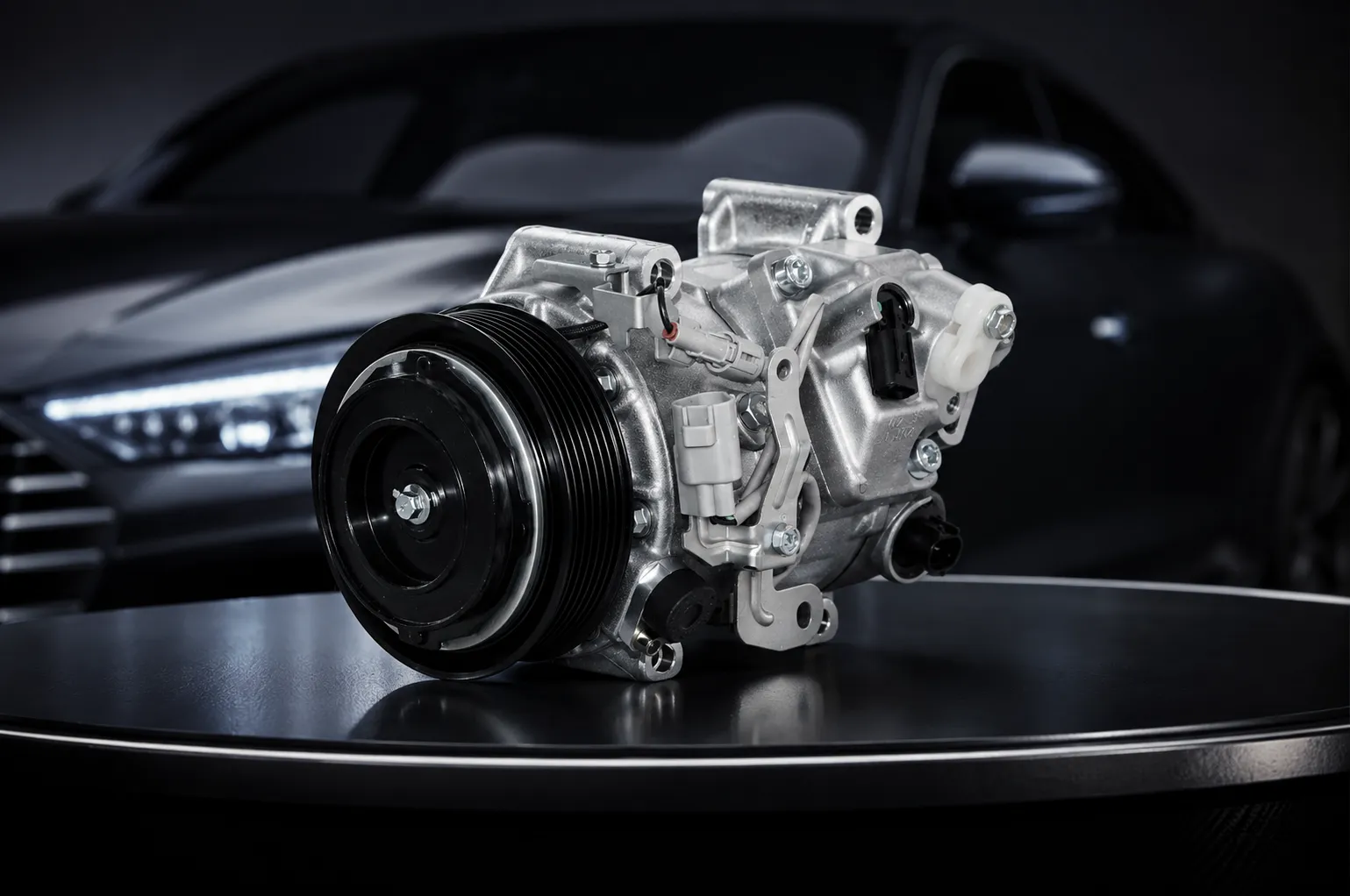
In a typical automotive air-conditioning system, the compressor raises the refrigerant pressure and temperature before sending the refrigerant to the condenser. The condenser releases heat to ambient air as the refrigerant moves through its tubes and fins. The refrigerant then continues toward the expansion device, where the next stage of the cooling cycle begins.
That operating position creates several practical demands. The part must fit within a confined space, align with the vehicle’s refrigerant lines, clear neighboring components, and transfer heat despite changing airflow and contamination. A condenser can look acceptable on a workbench yet still create problems if its ports are incorrectly positioned, its brackets do not match the vehicle, or its internal passages are unsuitable for the intended system.
For a sourcing manager, the decision is therefore broader than “does this part resemble the old one?” The useful question is whether the supplier can consistently reproduce the required design and verify it before shipment.
Quick reference: what to verify before approval
| Evaluation area | What to confirm | Why it matters |
|---|---|---|
| Fitment | Vehicle application, OE or cross-reference number, dimensions, brackets, and port position | Prevents installation delays and incorrect replacement stock |
| Core design | Tube-and-fin or parallel-flow construction, header arrangement, fin layout, and airflow path | Influences heat rejection, packaging, and compatibility |
| Materials and joining | Aluminum construction, joining method, surface treatment, and process controls | Affects durability and resistance to leakage |
| Leak control | Test method, acceptance criteria, and test records for the supplied configuration | Refrigerant leakage can lead to immediate field complaints |
| Quality system | Scope of the supplier’s quality-management certification and product-specific inspection plan | A company certificate does not replace part-level evidence |
| Program support | Sampling, drawing review, packaging, labeling, and change-control arrangements | Important for repeat orders and multi-market distribution |
Construction features visible in a typical automotive condenser
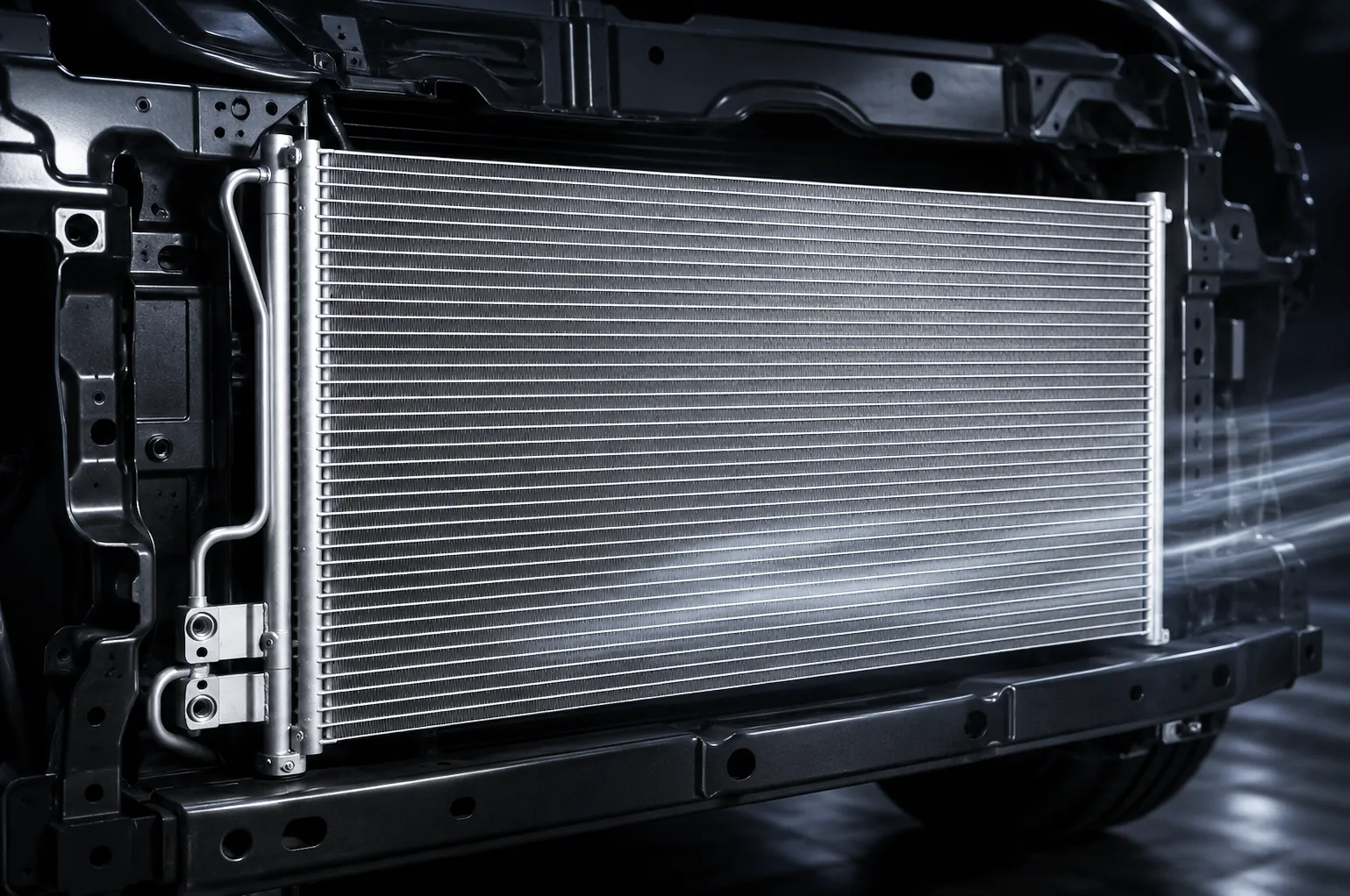
The product represented in the supplied information has a rectangular aluminum heat-exchanger core with dense horizontal cooling fins and internal tubes. Narrow side channels or header sections appear at both ends, while black mounting brackets are integrated along the sides and corners. Aluminum refrigerant pipes run along the right side, and two upper refrigerant connection ports include visible threaded or retaining hardware and sealing areas.
This layout is common in vehicle condenser assemblies because it combines a relatively broad frontal area with compact depth. The unit is generally positioned ahead of the engine coolant radiator, where ram air and fan airflow can pass through the fin field. The mounting brackets are not cosmetic details; their location affects alignment, vibration loading, service clearance, and the possibility of contact with adjacent components.
The core appears consistent with a brazed aluminum condenser and may use a parallel-flow or tube-and-fin arrangement. That distinction should not be assumed from an image alone. Buyers should request a technical drawing or specification sheet identifying the internal construction, tube arrangement, dimensions, connection geometry, and any integrated features. If the replacement is intended for a specific vehicle, the supplier should confirm the application against an OE reference or an approved cross-reference list.
Materials, brazing, and corrosion exposure
Aluminum is widely used for automotive condensers because it offers low mass and good thermal conductivity. The trade-off is that thin aluminum tubes and fins require careful handling during production, packaging, transport, and installation. Fin damage can reduce airflow through portions of the core, while distorted ports or mounting points can create fitment and sealing problems.
Many automotive condenser designs depend on brazed joints to connect tubes, headers, and related passages. The important buying issue is not merely whether a supplier uses brazing, but whether the process is controlled. Ask how joints are inspected, how production variation is monitored, and which leak test is applied after assembly. The supplied manufacturer information states capability for performance testing, helium leak detection, and salt-spray testing. Those capabilities are useful, but a buyer should still ask whether the tests apply to the specific condenser being purchased and whether records can be provided for production batches or approval samples.
Salt exposure is especially relevant for vehicles used in coastal areas or regions where winter road de-icing is common. A salt-spray test may provide information about corrosion resistance under a defined laboratory method, but it should not be treated as a direct prediction of service life. The test duration, sample configuration, acceptance criteria, and surface condition all matter.
Fitment is the first technical gate
A well-made condenser is still the wrong part if it does not fit the vehicle. Before requesting a quotation, provide as much application information as possible: vehicle make and model, model year, engine or powertrain variant, market, OE number, connection type, and photographs of the original part where available.
Do not rely on overall length and width alone. Check the following details:
- Core height, width, and depth
- Overall assembly dimensions, including pipes and fittings
- Mounting bracket position and hole or stud arrangement
- Refrigerant inlet and outlet location
- Port size, thread, sealing method, and retaining hardware
- Clearance to the radiator, fan shroud, bumper structure, and body panels
- Whether a receiver-drier, desiccant cartridge, pressure sensor port, or other accessory is integrated
The available product information does not confirm vehicle makes, model years, OE part numbers, or exact fitment. Those items should be treated as open points during technical review rather than inferred from the visible design.
Questions to ask an auto condenser supplier
A credible auto condenser supplier should be comfortable discussing both the part and the control process behind it. Ask for a product drawing, application list, material information, and inspection plan. For a replacement program, request a sample against the approved reference part and compare the critical dimensions before committing to volume.
Leak testing deserves specific attention. Ask whether the supplier uses helium leak detection, pressure decay, or another method; what the acceptance limit is; and whether the limit applies to the finished assembly or only selected subassemblies. Do not invent a target leakage rate internally unless it is based on the vehicle manufacturer’s requirement, an agreed engineering specification, or an applicable test standard.
The manufacturer information also reports an IATF 16949-certified quality-management system. This is a company-level claim and can be relevant when screening automotive suppliers, but it does not independently verify the specifications or test results of an individual condenser. Confirm the certificate’s validity and scope, then review product-specific controls such as incoming material inspection, brazing-process monitoring, dimensional checks, port protection, final cleaning, and release inspection.
Common mistakes in condenser sourcing
Approving from an image alone
Product images are useful for an initial review of brackets, piping, and general construction. They cannot establish internal passage design, pressure capability, refrigerant compatibility, or leakage performance. A drawing and sample inspection are more reliable.
Ignoring connection details
Port geometry is often where an apparently similar condenser fails. A small difference in fitting height, thread, sealing surface, or pipe angle may prevent the original line from being installed without stress. Forced alignment is a poor workaround because it can load the joint and create a later leak.
Assuming every accessory is included
The available information does not confirm whether the unit includes a receiver-drier, desiccant cartridge, pressure sensor port, or other accessories. State the required configuration clearly on the purchase specification. Otherwise, two parties may believe they are quoting the same assembly when they are not.
Confusing quality certification with product approval
A certified management system indicates that a supplier operates within a defined quality framework. It does not mean every part automatically matches a vehicle application or passes a buyer’s engineering requirements. Part approval still needs dimensional, functional, and leakage evidence.
Practical advice for importers, distributors, and workshops
For a small number of service replacements, prioritize verified fitment, protected packaging, clear labeling, and availability of installation information. For a distributor or importer, build a part-number control system that separates vehicle applications instead of relying on broad descriptions such as “universal condenser.” Keep the approved drawing, sample images, inspection requirements, and revision status together.
For an OEM, ODM, or vehicle-specific program, involve the supplier early in the packaging and interface review. The manufacturer described in the supplied information reports capability for customized development and related automotive A/C component production. That may be useful where the condenser must be adapted to a particular vehicle package, but the scope should be defined in writing: design ownership, validation responsibility, change notification, tooling, test documentation, and production approval.
Packaging also deserves attention. Fins should be protected from crushing, connection ports should be capped or otherwise shielded from contamination, and brackets and pipes should not carry unintended transport loads. These are ordinary details, but damaged fins and open fittings can turn a sound production part into a workshop complaint.
FAQ
What does an automotive condenser do?
It removes heat from high-pressure refrigerant by transferring that heat to ambient air. The refrigerant then moves toward the expansion device as part of the vehicle’s A/C cycle.
Is a parallel-flow condenser always better?
Not automatically. Parallel-flow and tube-and-fin designs have different packaging, airflow, pressure-drop, and application characteristics. The correct choice depends on the vehicle system and the approved replacement design.
What should be confirmed before placing an order?
Confirm the vehicle application, OE or cross-reference number, dimensions, bracket locations, port geometry, included accessories, refrigerant-system requirements, leak-test expectations, packaging, and required documents.
Next step for buyers
Prepare an application sheet with the original part number, vehicle details, critical dimensions, connection photographs, and any known service requirements. Send that information to the automotive condenser factory and request a controlled technical review rather than a price-only quotation. Ask for the drawing, sample plan, test-method description, quality documents, and confirmation of what is included in the finished assembly. That process takes more effort at the beginning, but it is usually far less expensive than correcting fitment, leakage, or compatibility problems after the parts reach the field.