How to Evaluate an Auto AC Hose Supplier for Vehicle-Specific Refrigerant Lines
For buyers sourcing through ZUA Auto Parts, this framework connects the technical question to a controlled product inquiry; exact fitment and quoted specifications remain SKU-specific.
Choosing an auto AC hose supplier is not simply a matter of finding a flexible tube at the right price. Automotive air-conditioning lines must fit a defined vehicle route, connect reliably to system components, tolerate vibration and thermal cycling, and remain leak-tight in service. For sourcing managers and product engineers, the real decision is whether a supplier can deliver a repeatable hose-and-pipe assembly that matches the vehicle application and can be supported with appropriate manufacturing and test documentation.
This article explains what to examine when buying automotive refrigerant line assemblies, particularly products that combine formed metal tubing, flexible hose sections, fittings, and mounting hardware. It also outlines the questions that should be answered before approving a prototype, replacement part, OEM/ODM program, or wholesale order.
What the Product Is and Why the Construction Matters
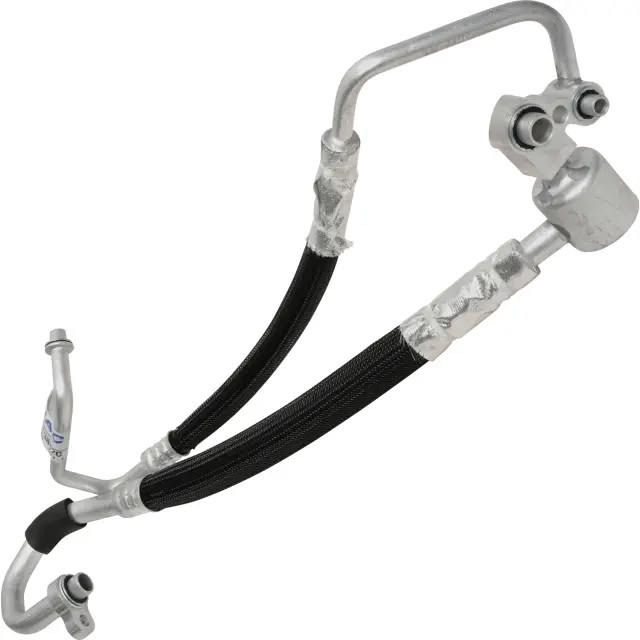
The product category covered here is an automotive air-conditioning refrigerant line or hose-and-pipe assembly. Its job is to carry refrigerant between components such as the compressor, condenser, evaporator, and expansion device. The exact flow path depends on the vehicle design and the specific line. A product image alone is not enough to confirm whether an assembly is a suction line, discharge line, liquid line, or another section of the circuit.
The illustrated type of assembly uses more than one construction method. Formed metal tubing creates the routed sections and maintains the desired geometry. A flexible corrugated or braided hose section allows the line to absorb engine movement, vibration, and relative displacement between components. Black flexible hose segments may be joined with crimped or molded connections, while metal end fittings provide the interface with other air-conditioning components.
Mounting clips and brackets are also functional parts of the design, not decorative additions. They keep the line away from hot surfaces, moving parts, and neighboring components. If a bracket is misplaced or a bend is altered, the assembly may technically connect but still create installation problems, noise, chafing, or long-term fatigue.
Quick Reference: What to Confirm Before Buying
| Buying question | Why it matters |
|---|---|
| Is the assembly vehicle-specific? | Routed bends, offsets, fitting positions, and brackets usually depend on the vehicle platform. |
| Which section of the A/C circuit does it serve? | Pressure, temperature, connection type, and validation requirements can differ by circuit position. |
| How are rigid and flexible sections joined? | Crimping, brazing, welding, or other processes affect design review and leak control. |
| What inspection and testing are available? | Leak detection, dimensional checks, fitting verification, and pressure-related testing help control field risk. |
| Can the supplier support development? | OEM and replacement programs may require drawings, samples, tooling coordination, and design changes. |
Key Manufacturing Steps in an Automotive A/C Assembly
Tube forming and bending
The rigid tubing in this type of product is formed into a vehicle-specific shape with multiple bends and offset sections. The objective is not merely to reproduce a two-dimensional outline. The finished line must clear nearby components in three dimensions and arrive at each connection with the correct orientation.
During sourcing, ask how the supplier controls bend position, end-form location, and assembly orientation. A supplier may be able to produce a visually similar line, yet still miss a critical clearance or bracket position. Prototype approval should therefore use the relevant drawing, sample, or vehicle installation reference rather than an image alone.
Hose preparation and crimping
Flexible hose sections provide movement accommodation, but the hose ends and crimped connections remain important leak-control points. Typical production may include hose cutting, fitting insertion, crimping, and visual inspection. The supplier should be able to identify the hose construction and the approved connection method for the intended application.
Do not assume that a hose with the correct outside appearance is suitable for every refrigerant circuit. The material, pressure capability, temperature capability, fitting design, and compatibility with the specified refrigerant and lubricant must be verified against the actual program requirements. Those details were not supplied for the pictured assembly and should not be guessed.
Fittings, brackets, and joining operations
Metal end fittings may include connection ports, capped or ported features, and interfaces designed for vehicle components. Brackets and black mounting clips are positioned along the route to secure the line. Depending on the design, the manufacturing route may also include brazing, welding, or another joining process. These operations should be confirmed in the supplier’s process documentation rather than inferred from appearance.
For a replacement part, the practical test is straightforward: does the assembly install without forcing the fittings, twisting the hose, or moving the original mounting points? For an OEM or ODM project, the review needs to go further, covering drawings, process controls, sample approval, traceability, and change management.
What Capabilities Should a Supplier Offer?
A capable automotive hose manufacturer should provide more than basic hose cutting. The supplied product information indicates support for automotive A/C compressor-related products, customized development, OEM/ODM production, component machining, assembly, and performance testing. Those capabilities are relevant because refrigerant lines often combine several manufactured parts into one installation-ready assembly.
The same supplied information reports helium leak-detection capability and IATF 16949 certification. These are potentially useful indicators, but buyers should confirm the claims through current certificates, scope information, and product-specific quality records. A management-system certification by itself does not prove that every line design has passed the required validation.
Ask the supplier to explain the inspection sequence. Useful questions include whether dimensional checks are performed after forming, how crimp quality is verified, how fittings and brackets are checked, and whether the completed assembly receives leak testing. If helium leak detection is used, request the applicable test method and acceptance criteria. Do not accept an unexplained statement that a product is simply “tested.” The method and result must relate to the risk being controlled.
How to Select Between a Replacement and Custom Supply Program
For aftermarket replacement parts
A replacement buyer typically needs reliable vehicle identification, correct connection geometry, and repeatable installation. The supplier should be able to work from an OE or reference number, vehicle application data, a physical sample, or a controlled drawing. Confirm whether the supplied line includes all shown brackets, clips, port features, and protective components.
Packaging also deserves attention. Long formed lines can be damaged or permanently distorted if packed under excessive pressure. The supplier should describe how assemblies are protected during storage and transport, especially at fittings and flexible hose sections.
For OEM, ODM, and private-label programs
A custom program needs a more formal handoff. Provide the routed geometry, connection requirements, installation constraints, expected service environment, and applicable refrigerant information. If the design is still developing, involve the supplier before the geometry is frozen. Their tube-forming, machining, assembly, and testing experience may reveal a clearance or joining issue early, when changes are less expensive.
For wholesale purchasing, separate commercial volume discussions from technical approval. A low unit price does not compensate for incorrect geometry, avoidable leakage, or a line that requires rework during vehicle installation. First qualify the design and process; then compare supply terms on an equivalent specification.
Common Sourcing Mistakes
- Ordering from a photograph without confirming vehicle application, reference number, or drawing.
- Assuming all automotive A/C hose assemblies use the same pressure, temperature, or refrigerant requirements.
- Ignoring brackets and clips because the hose itself appears to match.
- Requesting a “universal” line for a route that is clearly vehicle-specific.
- Accepting a leak-test claim without asking for the method, criteria, and product scope.
- Changing tube material, fitting design, or hose construction without reviewing compatibility and validation needs.
One practical warning: never judge routing from a flat photograph alone. An assembly can look correct from one angle while a bend, port, or bracket is displaced enough to cause interference in the engine compartment.
Buyer Checklist for Supplier Qualification
Before moving forward, ask for a technical package that covers the specific assembly rather than a general company brochure. At minimum, clarify:
- Vehicle make, model, year, engine or platform application, and OE reference where applicable.
- Line function and connection position within the A/C circuit.
- Controlled drawing or sample approval process.
- Tube and hose material information, subject to the program specification.
- Fitting, bracket, clip, and joining details.
- Dimensional inspection and assembly-orientation controls.
- Leak-detection method and acceptance criteria.
- Available performance or validation testing.
- Change-control, traceability, and documentation practices.
- OEM/ODM development and production support.
The exact dimensions, alloy, refrigerant type, operating pressure, temperature range, leak rate, warranty, and lead time for the pictured product are not established by the available information. A responsible supplier should confirm these items for the actual part number and application.
Frequently Asked Questions
Can this type of assembly be supplied as a universal automotive A/C hose?
Usually, the visible formed geometry suggests a vehicle-specific routed assembly rather than a straight universal hose. A universal replacement may be possible for some service situations, but the fittings, bends, clearances, and mounting points must be checked carefully.
Does a flexible section mean the entire line is a hose?
No. The assembly shown combines rigid formed tubing with flexible hose sections and metal fittings. This hybrid construction is common where routing accuracy and vibration isolation are both required.
Is helium leak detection enough for approval?
It may be an important part of leak control, but approval depends on the complete application and validation plan. Confirm the test method, acceptance criteria, test location, and whether the results apply to the finished assembly.
What should an importer or wholesaler send when requesting a quotation?
Send the vehicle application, reference number or drawing, required quantity, connection details, packaging expectations, and any available sample. If the part is for a new design, include the installation envelope and the intended A/C system requirements.
Next Step: Request a Controlled Technical Review
The best starting point is not a price-only inquiry. Send the supplier the available drawing, sample, OE reference, or vehicle information and ask for a part-specific review. Request confirmation of the line function, construction, manufacturing route, inspection plan, leak-test capability, and customization scope. For buyers comparing car air conditioning hose wholesale options, this technical exchange creates a fair basis for comparing suppliers and reduces the risk of approving a part that only looks correct.