Car AC not cold at idle is usually an airflow problem before it is a refrigerant problem. When the system cools at road speed and fades when the vehicle stops, the condenser is not shedding heat, the condenser fan is not doing its job, or the compressor is not being asked for capacity at low engine speed.
That pattern matters because the obvious response — adding refrigerant — often makes it worse. A system that is already correctly charged and has a weak fan will run higher head pressure after a top-up, not colder. This guide sets out a test order that separates airflow, charge and compressor control, so a workshop or a distributor supporting workshops can reach the right part without guessing.
Car AC not cold at idle: the short answer
If the vent temperature drops by a clear margin once the vehicle is moving, suspect condenser airflow first: the condenser fan, its relay or control module, a mechanical fan clutch, or a condenser blocked by debris. If the temperature is poor at all speeds, suspect charge, a leak, or compressor control. If it is cold at idle and warm at speed, the problem is more likely inside the cabin air path or an overcharge.
| What the driver reports | Most likely area | First check |
|---|---|---|
| Cold while driving, warm when stopped | Condenser airflow | Is the condenser fan running with A/C on and engine hot? |
| Warm at idle, improves above 1,500 rpm | Compressor control or charge | Clutch command, control valve response, pressures at both speeds |
| Weak at all speeds, gradually worse | Refrigerant charge or a leak | Static and running pressures, leak detection |
| Cold at idle, warm at speed | Cabin airflow or overcharge | Cabin filter, blend door, high side pressure at speed |
| Cold for 10-15 minutes then fades | Evaporator icing | Evaporator temperature sensor, expansion device |
Step 1: confirm the pattern before touching anything
Start with a controlled test rather than a road test impression. Park the vehicle in shade, set the ambient temperature reference, close the doors and run the A/C on maximum cooling with recirculation on. Record vent temperature at idle, then at 1,500-2,000 rpm held for 30-60 seconds, then again at idle after the system has stabilised.
A car AC not cold at idle complaint that disappears as soon as engine speed rises points to airflow or low-speed compressor capacity. No change at all points to charge, a blend door, or a compressor that is not engaging. A system that is cold at idle and warm at speed is a different fault again and should be treated as a separate diagnosis.
Step 2: check condenser airflow and the condenser fan
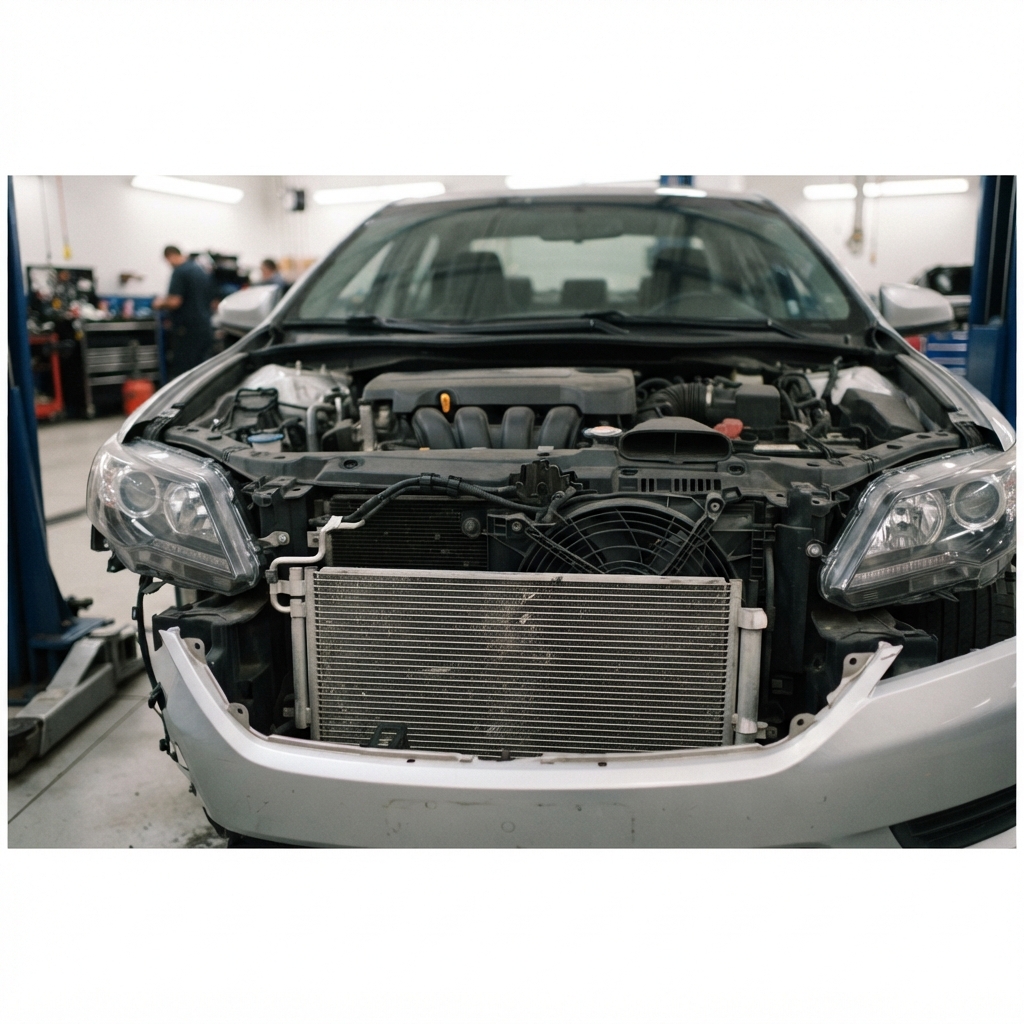
The condenser sits at the front of the vehicle, ahead of the coolant radiator, and it removes heat from the refrigerant that the compressor has just pressurised. At road speed, ram air does most of that work. At idle there is no ram air, so the condenser fan has to take over. MAHLE's technical description of the air conditioning condenser makes the same point: the fan behind the condenser switches on automatically when the driving wind is not sufficient, and a defective fan or a dirt-blocked core causes thermal overload and reduced cooling.
A radiator fan not working is often reported as an A/C fault, because the A/C is the first thing the driver notices when the fan stops and the engine temperature has not yet moved. That is why the fan test comes before any refrigerant work when the car AC not cold at idle pattern is confirmed.
Electric fan checks
- Command. With A/C on and the engine at operating temperature, the fan should run. If it does not, check the relay, the fan control module and the PWM signal before condemning the motor.
- Signal. Many vehicles control the fan with a PWM signal rather than a simple relay. Measuring duty cycle at the connector separates a module fault from a motor fault. The radiator fan PWM control guide covers the measurement method.
- Airflow, not just rotation. A fan can spin and still move too little air because of a missing shroud, a damaged blade or a blocked core. The cooling fan airflow measurement guide explains what a bench test should record, and the dual versus single fan comparison covers which assembly architecture suits a given heat load.
- Blockage. Leaves, insects, plastic bags and bent fins reduce airflow across the condenser. Clean from the front with low-pressure water, not a high-pressure jet that folds the fins. If the core itself has failed, the checks in the condenser quality testing guide separate a blocked core from a leaking one.
Mechanical fan checks
A viscous fan clutch that no longer locks up will idle too slowly and move almost no air when the vehicle is stationary. Check for oil residue on the hub, excessive free play and a fan that never changes note as engine temperature rises. A fan that is permanently locked is the opposite fault and will roar at speed.
Step 3: read the pressures at idle and at raised rpm
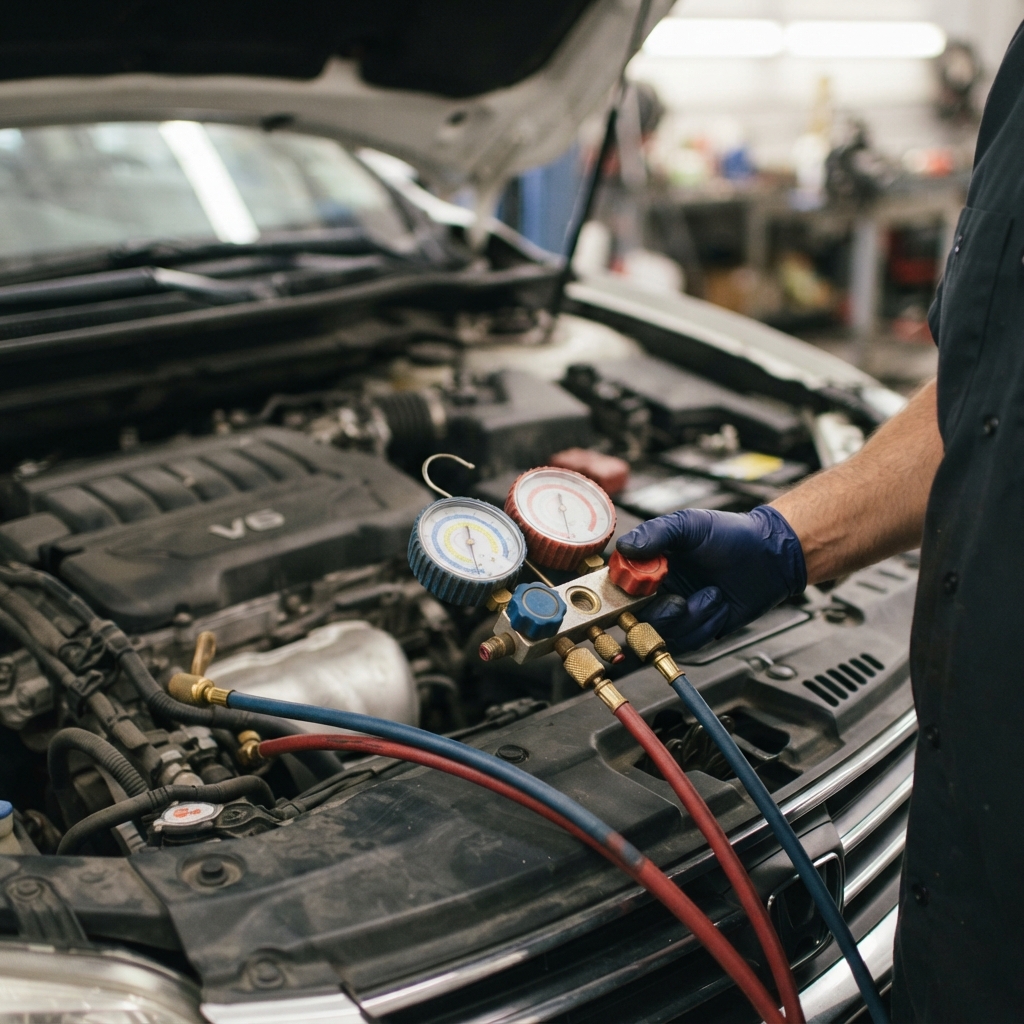
Pressures turn the symptom into a decision. When the complaint is car AC not cold at idle, record low side and high side at idle, then at 1,500-2,000 rpm, with the condenser fan commanded on. Compare the two readings rather than judging a single number, because absolute values depend on ambient temperature and humidity.
| Low side at idle | High side at idle | What changes with rpm | Likely interpretation |
|---|---|---|---|
| High, close to high side | High | Little change | Compressor not pumping; control valve or internal fault |
| Low | Low | Both rise slightly | Low refrigerant charge or a restriction before the compressor |
| Normal | Very high | High side climbs at idle, falls with airflow | Condenser airflow or fan fault, or overcharge |
| Normal | Normal at rpm, high at idle | High side falls sharply above 1,500 rpm | Confirms airflow-limited condenser performance |
AC high side pressure that tracks engine speed and condenser airflow is the signature of a heat-rejection problem. AC high side pressure that stays high even with a known-good fan and a clean core points to overcharge, a restriction, or a condenser that is internally blocked.
Step 4: verify charge and rule out a leak
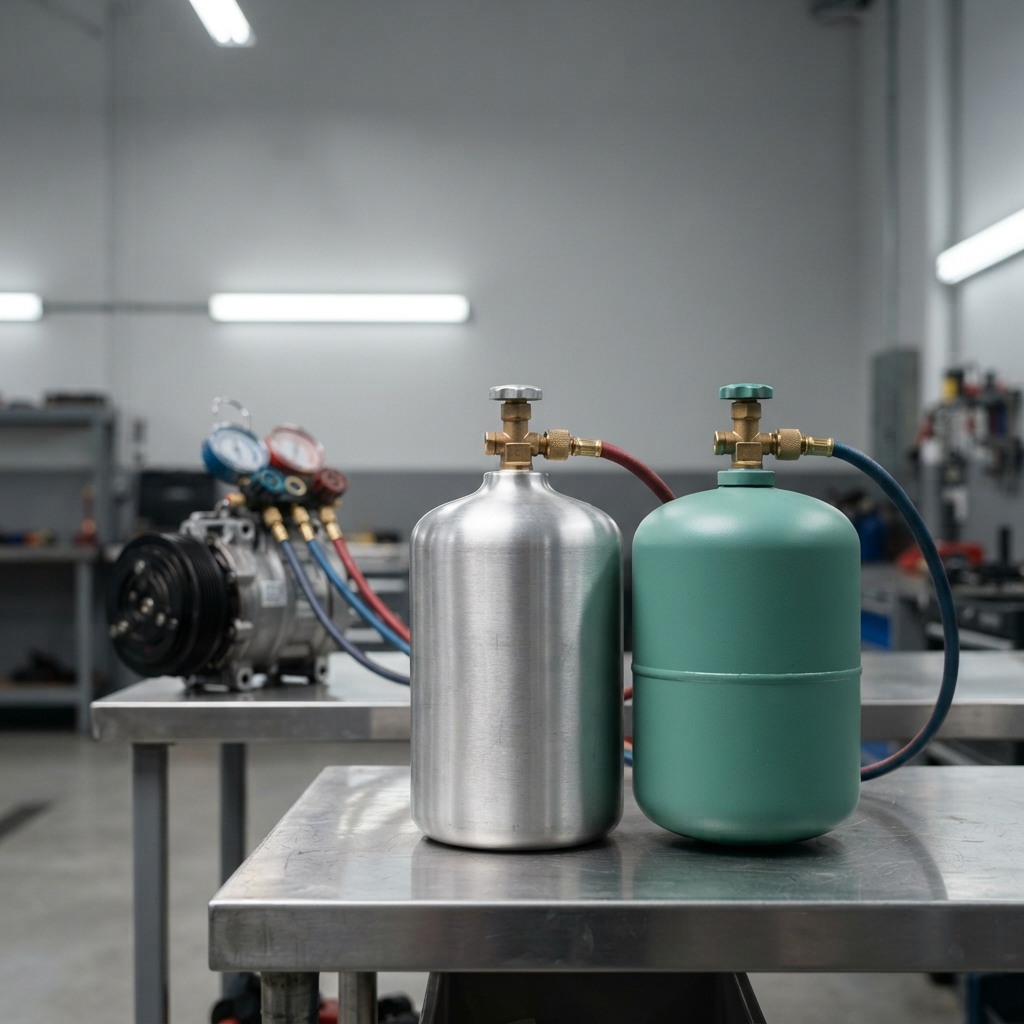
Refrigerant charge is a weight, not a pressure. The label under the bonnet states the system charge, and the correct procedure is to recover, evacuate and recharge by weight. Topping up until the gauges look right is how systems end up overcharged and how a small leak becomes an annual habit.
If the system is low, there is a leak, and the leak has to be found before the charge is restored. Recovery and recharge equipment performance is defined in SAE J2788, which is incorporated into US regulation, and the EPA's certified MVAC equipment list identifies equipment that meets it. That accuracy matters here because a charge that is 10% off will show up as an idle cooling complaint that never quite goes away. Where a leak has to be proven or located rather than assumed, the helium leak testing guide sets out how leak paths are isolated and recorded.
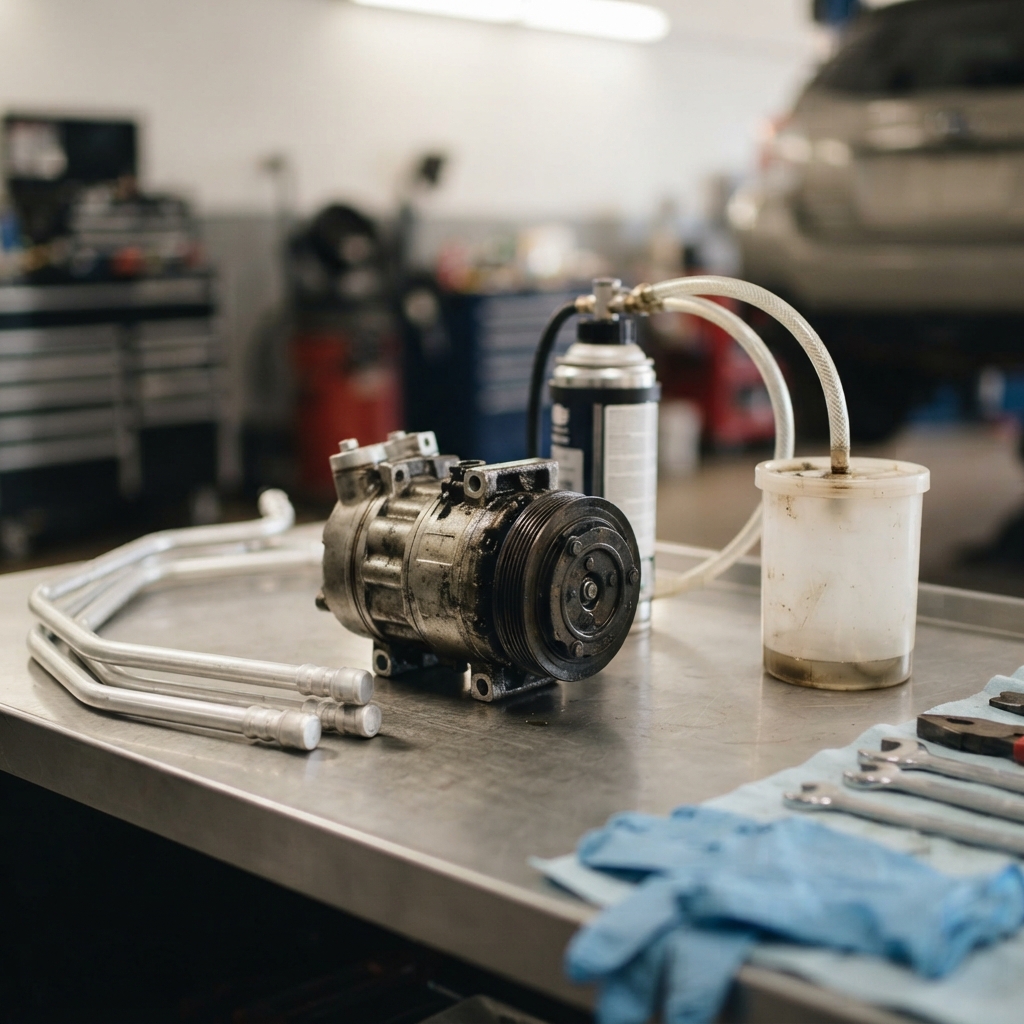
Charge also interacts with oil. A system that has lost refrigerant has also lost the oil that circulates with it, so a compressor that has been running low may be damaged even after the charge is restored. The car AC compressor oil guide covers the oil balance and the moisture rules.
Step 5: check compressor control at idle
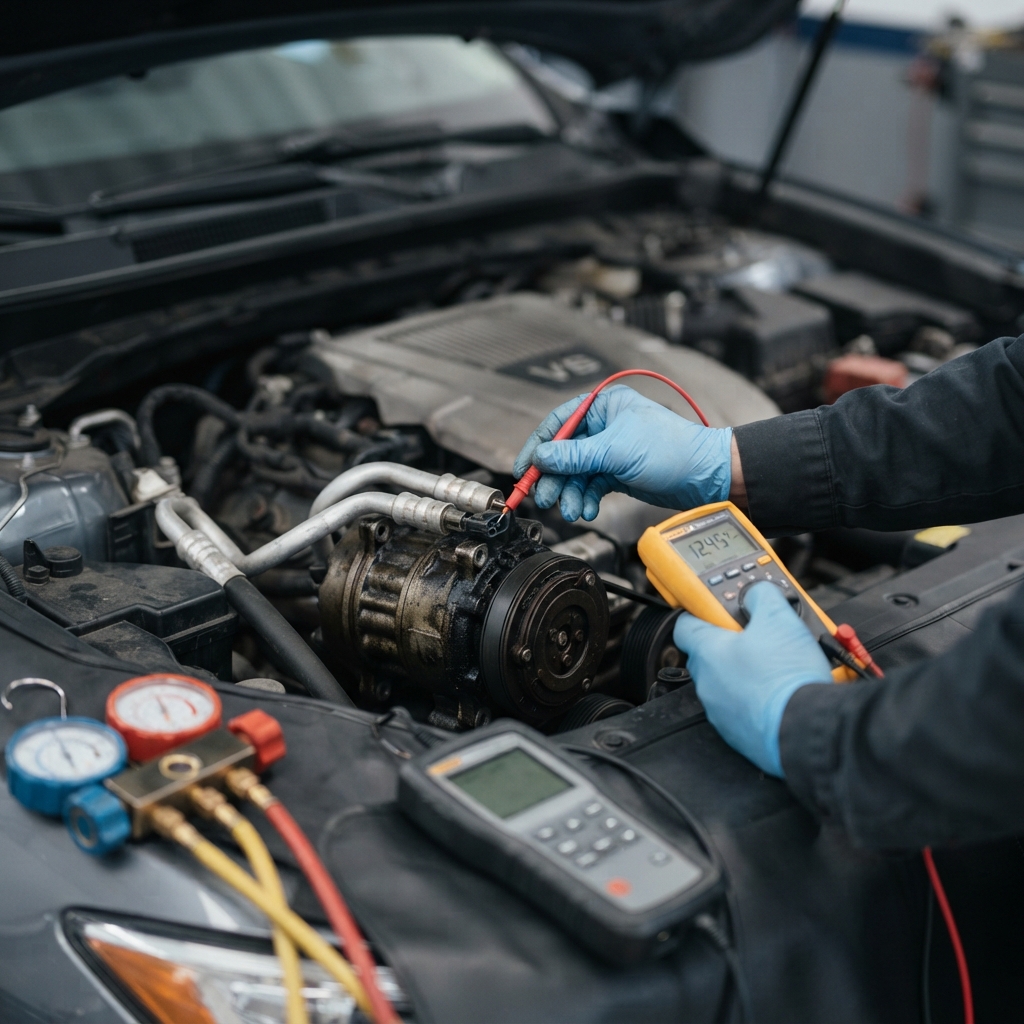
On a fixed-displacement compressor with a clutch, the clutch should engage when the A/C is requested and cycle on the low-pressure or evaporator-temperature signal. If it does not engage at all, work through the compressor not engaging diagnostic sequence before replacing the compressor.
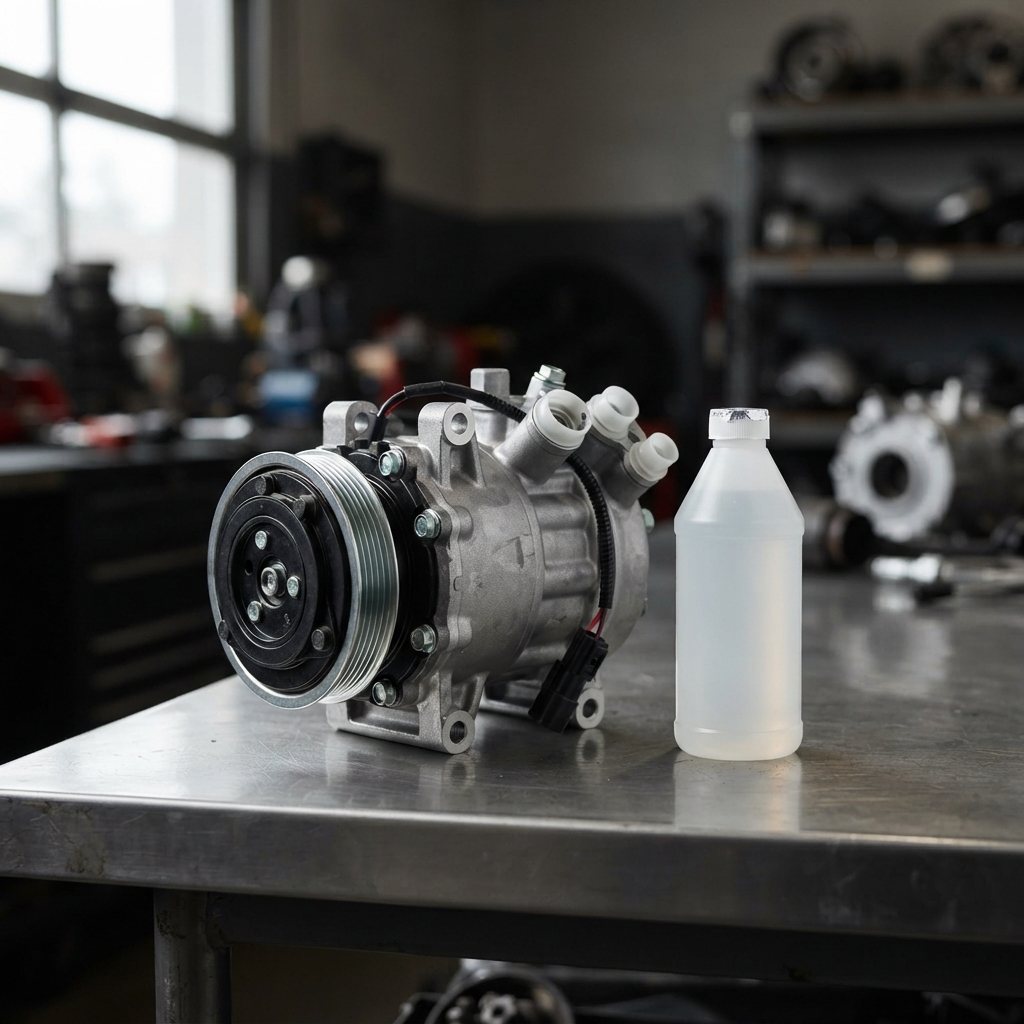
On a variable displacement compressor, there may be no clutch at all. The control valve regulates displacement in response to a command, and at idle the compressor may be deliberately held at low displacement to protect the engine and the belt. A sticking control valve can produce exactly the car AC not cold at idle symptom: adequate capacity at speed, almost none at idle.
Two checks separate the two designs. First, confirm what the vehicle actually has, from the compressor model and the presence of a clutch or an electrical connector on the rear housing. Second, command the system and watch the response: a clutch that engages but produces no pressure change points to an internal fault, while a clutch that never engages points to the command chain. The clutch coil testing guide covers resistance, current and air gap checks.
Step 6: check the cabin air path
Airflow that never reaches the evaporator cannot be cooled, and a restricted cabin filter is the most common cause. A filter loaded with pollen and leaves reduces volume at every speed, and the effect is most obvious at idle when the blower is already at its lowest useful output.
- Cabin filter. Replace it on the manufacturer's interval, and inspect it whenever cooling performance is questioned.
- Blower output. Compare blower speeds and listen for a motor that is slow or noisy. The blower motor diagnostic map connects voltage drop, current and wheel condition to the symptom.
- Blend door. A door that does not fully close the heater path lets hot air into the vent stream, which reads as weak cooling at low airflow and can look like a refrigerant fault.
- Recirculation door. A door stuck on fresh air pulls hot outside air into the cabin at idle, which is exactly when the system has the least capacity to spare.
What not to do when the AC is warm at idle
Three shortcuts cause most of the comebacks on this symptom.
- Do not add refrigerant to a correctly charged system. Overcharge raises head pressure and reduces cooling, and it can trip the high-pressure cut-out.
- Do not wire the fan to run permanently. It hides the real fault, overheats the motor and can mask a module failure that also affects other functions.
- Do not use sealant or stop-leak products. They contaminate the circuit, clog expansion devices and make the eventual repair more expensive. If a compressor has already failed mechanically and left debris in the circuit, the correct response is the system flush and component replacement sequence, not a sealant.
What this means for distributors and workshops
For a distributor, idle cooling complaints are a stocking signal. A workshop that sees this symptom repeatedly needs condenser fans and modules, fan relays, blower motors, cabin filters, expansion devices and both compressor architectures available with application data, not just a compressor line.
The condenser side of that range is harder than it looks, because two condensers that fit the same space can differ in core type, port position and mounting points. The condenser catalogue fitment guide explains which fields have to match before a part is offered as a replacement. Our A/C compressor and component range is organised by application, so the fan assembly, condenser and compressor for a given vehicle can be matched from the same record. If you are building a range for a market where idle cooling is a seasonal complaint, send the vehicle list and the failure pattern through our contact page and we will work from the application data.
Common mistakes in idle cooling diagnosis
- Starting with refrigerant. Assuming the car AC not cold at idle complaint means low charge destroys the evidence before the pressure test begins.
- Judging pressures at one engine speed. The idle-versus-rpm comparison is the diagnostic signal.
- Ignoring the condenser core. A fan that runs perfectly cannot cool a core that is blocked with debris.
- Replacing the compressor without checking the command. A clutch that never engages is an electrical fault, not a mechanical one.
- Assuming a variable compressor is faulty. Low displacement at idle can be normal; the question is whether capacity rises when it should.
- Forgetting the cabin side. A restricted filter or a leaking blend door produces the same complaint as a refrigerant fault.
Frequently asked questions
Why is my car AC cold while driving but warm at idle?
Because at idle there is no ram air through the condenser. If the condenser fan is weak, blocked or not commanded on, the condenser cannot reject heat and cooling fades whenever the vehicle stops.
Can low refrigerant cause poor cooling only at idle?
It can, because a marginally charged system has less reserve when compressor speed and airflow are lowest. But low charge usually degrades cooling at all speeds, so the idle-only pattern points more strongly to airflow.
How do I know if my condenser fan is working?
With A/C on and the engine at operating temperature, the fan should run. If it does not, check the relay, module and PWM signal at the connector before replacing the motor.
Does a dirty condenser cause warm air at idle?
Yes. A core blocked with leaves, insects or bent fins cannot transfer heat, and the effect is worst when the vehicle is stationary and ram air is absent.
Can a bad cabin filter make the AC warm at idle?
It reduces airflow through the evaporator, so the vent feels weak and less cold. It does not change refrigerant pressure, which is why the pressure test and the airflow test answer different questions.
Why does my AC work at idle but not at speed?
That is usually a different fault: an overcharge, a restricted condenser, or a blend door that opens at speed. It should be diagnosed separately from the idle-only complaint.
Is it normal for a variable displacement compressor to reduce output at idle?
Yes, some control strategies reduce displacement at idle to protect the engine and belt. The fault is when capacity does not increase as speed and demand rise.
How much refrigerant should be added?
The exact charge is on the vehicle label and must be weighed in after recovery and evacuation. There is no universal top-up figure that is safe across systems.
Conclusion
Car AC not cold at idle is a sequence problem more often than a parts problem. Confirm the pattern, check condenser airflow, compare pressures at idle and raised rpm, verify charge by weight, then test compressor control and the cabin air path. Following that order finds the real cause and avoids the overcharge that turns a small fault into a repeat visit.
If you supply workshops in a market where this complaint is common, the useful range is the fan assembly, the condenser and the compressor matched by application. Send the vehicle list and the symptom pattern through our contact page and we will start from the application record.