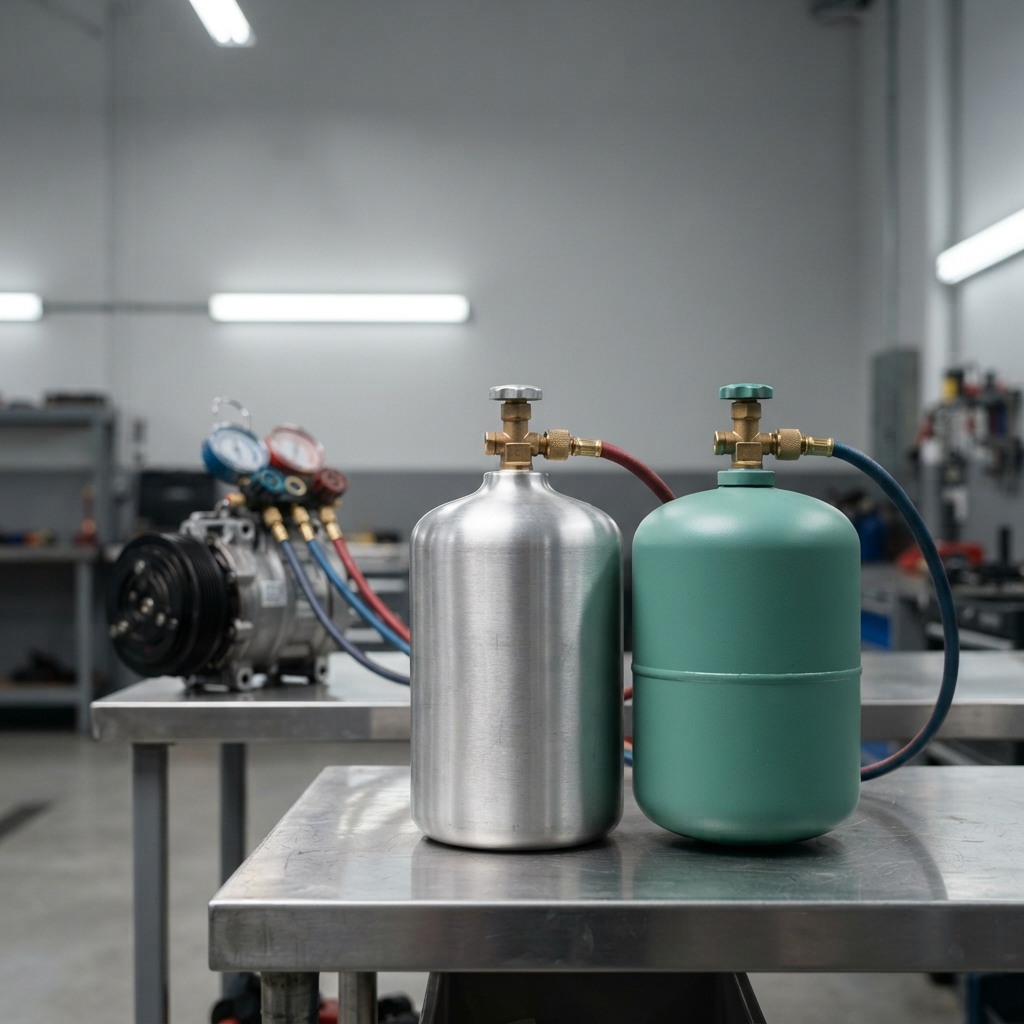
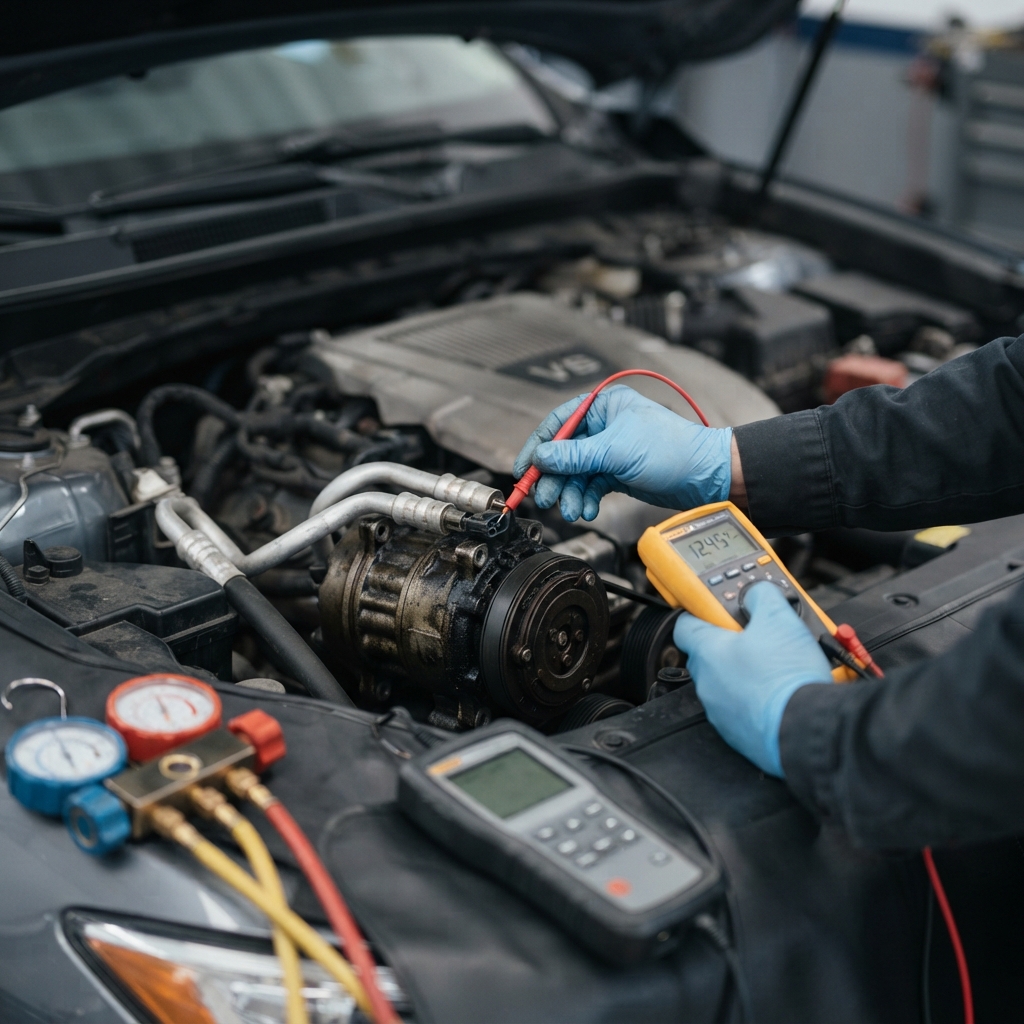
Car AC system flush is a repair procedure, not scheduled maintenance. It removes metal particles, sludge and contaminated oil from the refrigerant circuit after a compressor has failed internally, and it only works when the parts that cannot be cleaned are replaced at the same time. Most air conditioning systems never need one. A system that has circulated debris from a seized compressor will destroy its replacement within weeks unless the circuit is cleaned and the contaminated components are renewed.
This guide explains what a car AC system flush removes, when it is justified, which parts must be replaced instead of cleaned, and the sequence that keeps the repair from returning as a warranty claim. It is written for workshops, distributors and sourcing teams that handle compressors in volume.
Car AC system flush: the short answer
A car AC system flush is justified when the compressor has failed mechanically and debris has entered the circuit, when the oil is black or gritty, or when the system history is unknown and the refrigerant or oil may have been mixed. It is not a fix for a leak, not a substitute for a receiver drier, and not a routine service item at any mileage.
| Situation | Flush? | Reason |
|---|---|---|
| Compressor seized or failed with metallic debris | Yes, plus component replacement | Particles lodge in the condenser, expansion device and hoses, then migrate to the new compressor |
| Black, gritty or burnt-smelling oil at drain | Yes, with a full oil and drier reset | Oil breakdown and debris indicate overheating or a previous failure |
| Unknown history, mixed refrigerant or oil | Usually yes | The correct lubricant and charge cannot be guaranteed otherwise |
| Working system, routine service | No | Introduces solvent, moisture and connection risk with no benefit |
| System low on refrigerant but otherwise clean | No | The problem is a leak, not contamination |
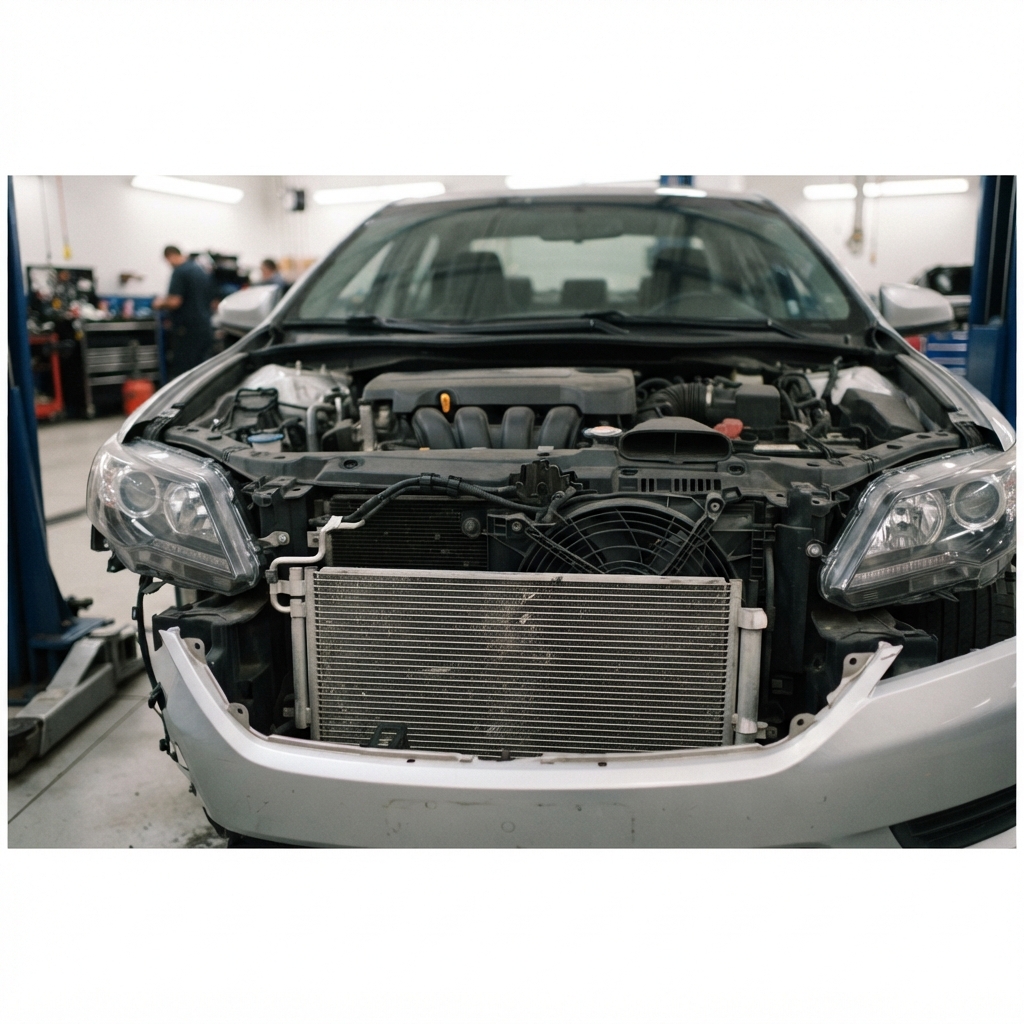
| Parallel-flow condenser with debris | No — replace the condenser | The multi-channel tube cannot be cleaned reliably |
What a car AC system flush actually removes
When a compressor fails internally, the debris does not stay inside the compressor housing. The discharge line carries it into the condenser, where much of it settles in the small passages, and from there it reaches the expansion device, the evaporator and the suction line. A flush is designed to lift and carry out:
- Metal particles from scored pistons, failed bearings, a broken swash plate or a shattered valve plate.
- Desiccant beads and dust from a receiver drier or accumulator that has broken up internally.
- Sludge and varnish formed when oil overheats and breaks down.
- Moisture and acid held in the old oil, which corrode aluminium and copper surfaces.
- Wrong or mixed oil left by an earlier repair that used a universal lubricant.
- Seal and gasket fragments from a failed shaft seal or O-ring.
The distinction that matters commercially is between contamination that can be carried out in a liquid stream and contamination trapped in a component with no through-flow path. A flush handles the first. Nothing handles the second except replacement.
When a flush is required, and when it is not
Cases where flushing is the right call
The clearest case is a compressor that failed mechanically rather than electrically. A clutch coil that has gone open circuit, or a control valve that no longer responds, usually leaves the circuit clean. A compressor that has seized, broken a piston or produced a black oil sample has distributed debris through the system, and that debris is what kills the next compressor. The clutch coil testing guide separates an electrical fault from a mechanical one before any flush decision is made.
The second case is an unknown history. Vehicles bought at auction, systems serviced by several workshops, and systems where the refrigerant or oil type cannot be confirmed are candidates, because the correct lubricant and charge cannot be established from the label alone.
Cases where flushing is the wrong answer
A leak is not a contamination problem. If the system is low but the oil is clean, the correct sequence is leak detection, repair, evacuation and recharge by weight, not a flush. Flushing a leaking system adds solvent and time to a job that still leaks.
Routine maintenance is the other trap. Some workshops offer a flush as an up-sell at service intervals. On a sealed system that is working correctly there is nothing to remove, and every additional connection is an opportunity to introduce moisture or damage an O-ring.
It is also worth separating the symptom from the repair. A vehicle that cools poorly is not automatically a flush candidate; the idle cooling diagnostic sequence covers the airflow, charge and compressor-control checks that should come first.
AC system cleaning is not the same as flushing
Much of what is sold as AC system cleaning is external work: washing the condenser fins, cleaning the evaporator coil, clearing the drain and replacing the cabin filter. That work restores airflow and removes odours, but it never touches the inside of the refrigerant circuit and cannot remove debris from a failed compressor. A car AC system flush is an internal procedure performed on an opened, isolated circuit. Confusing the two is how a vehicle leaves a workshop with a clean condenser and a contaminated compressor.
Three methods called "flushing", and what each can do
The word flush covers procedures with very different capabilities. Mixing them up is how a workshop charges for a service that does not address the contamination.
| Method | What it does | Limitation | Typical use |
|---|---|---|---|
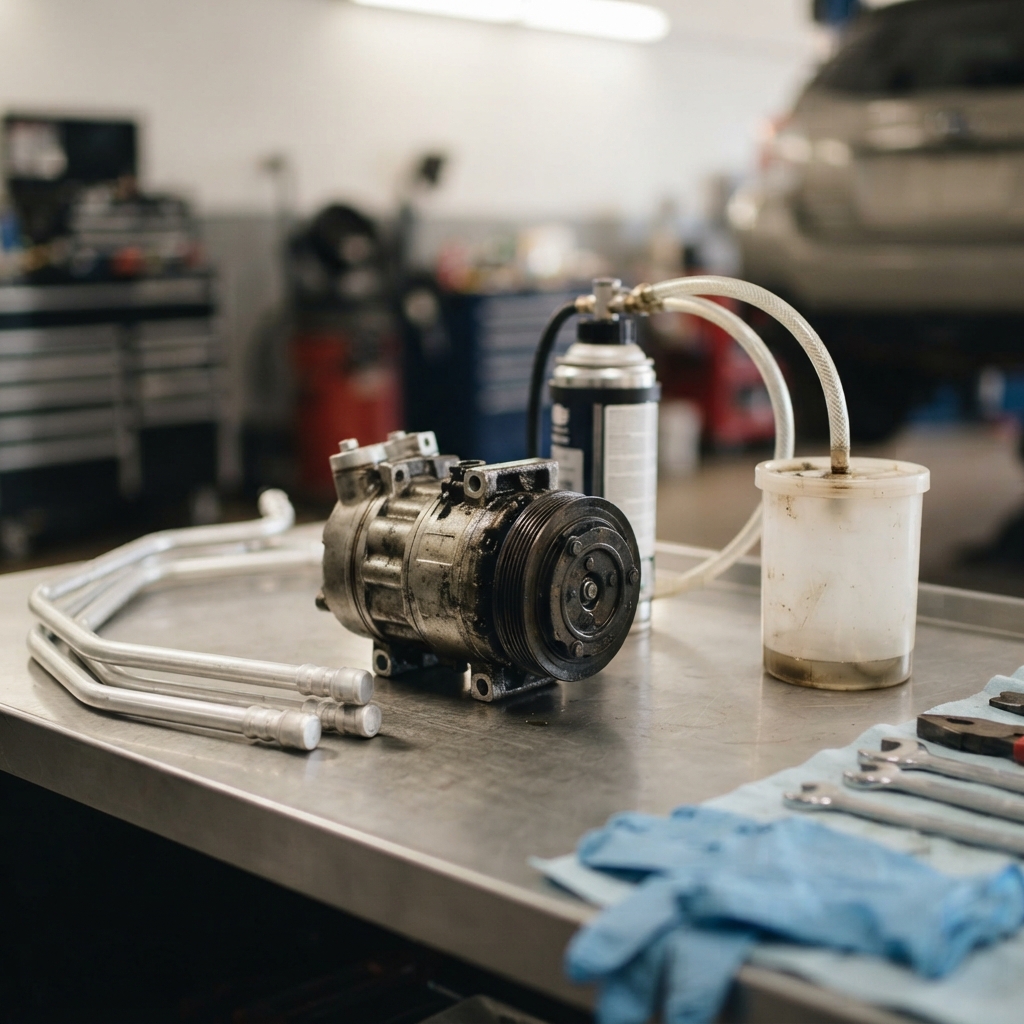
| Solvent or aerosol flush with an AC flush kit | Pushes a dedicated cleaning solvent through isolated lines, evaporator and condenser | Needs the right solvent, full drying and component isolation; cannot clean parallel-flow cores reliably | Debris removal after compressor failure |
| Refrigerant flush | Uses refrigerant and the service machine to move oil and light contamination | Does not remove solid particles or varnish; governed by recovery rules | Light oil removal when changing lubricant chemistry |
| Component replacement | Removes the contaminated part entirely | Higher parts cost | Condenser, drier, expansion device, muffled hoses |
A solvent flush is usually sold as an AC flush kit: solvent, a hose and a nozzle that connect to the opened circuit. The kit is only as good as the solvent and the drying step that follows it. A refrigerant flush uses the service machine to carry oil out of the circuit; it is useful when changing lubricant chemistry, but it does not remove solid debris.
Only a solvent flush can move solid particles through open circuits. It requires the compressor to be removed from the loop, the expansion device to be removed or replaced, and the circuit to be flushed in the direction of normal flow, section by section.
What must be replaced rather than flushed
Every failed-compressor job should be treated as a system repair. The parts below are either impossible to clean or too cheap to risk reusing.
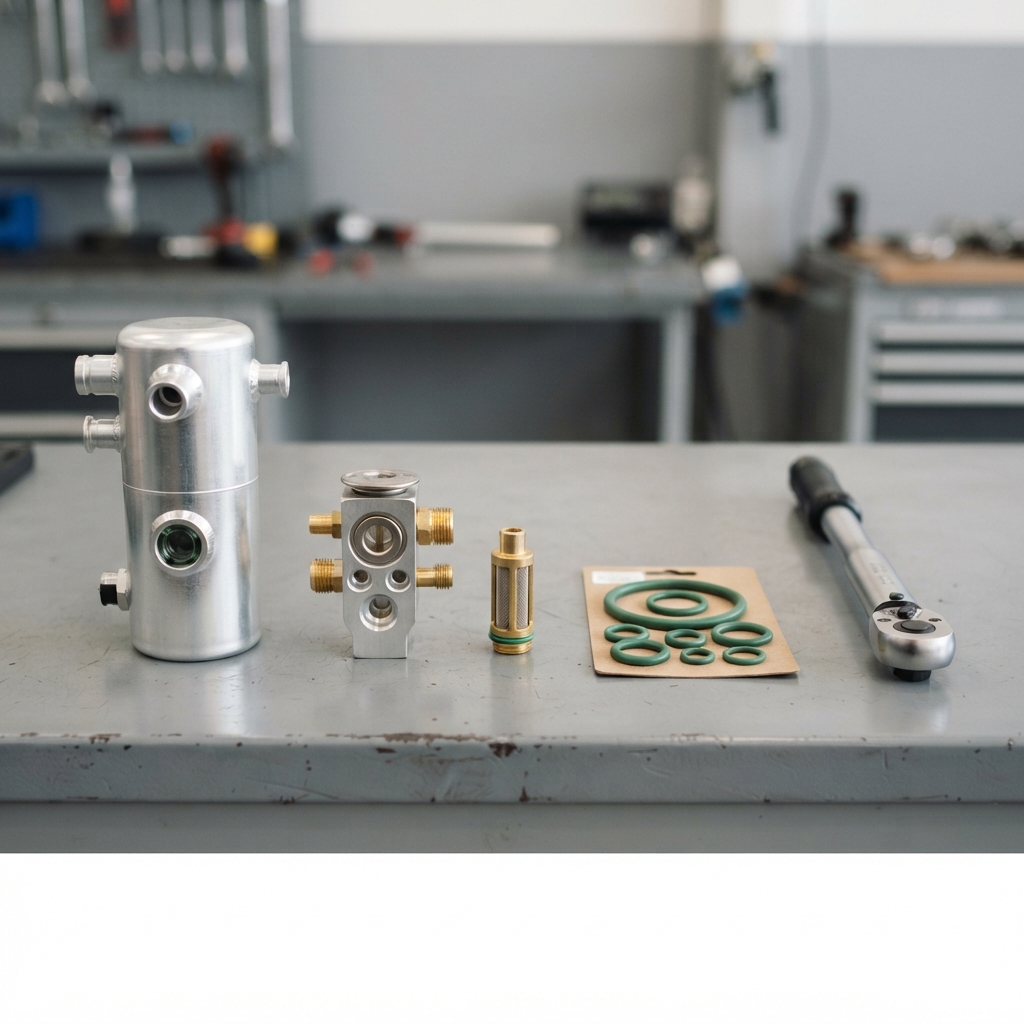
- Receiver drier or accumulator. The desiccant has absorbed moisture and may have captured debris. It is a one-time component. The dual-port accumulator filter drier service sequence covers port identification and replacement order, and the filter drier quality testing guide explains what to check on the new part.
- Expansion valve or orifice tube. Small passages and a calibrated orifice cannot be verified clean after debris has passed through. Replace the orifice tube or valve as a matter of course.
- Condenser. Parallel-flow cores should be replaced when contaminated. A tube-and-fin condenser can sometimes be flushed, but only when the debris load is light and the core passes a flow check.
- Muffled or internally coated hoses. A suction hose with a muffler traps debris and oil. Replace where the original specification calls for it.
- Seals and O-rings at every opened joint. Reusing a compressed O-ring after a flush is a leak waiting to happen; the hose-side details are covered in the A/C hose quality testing guide.
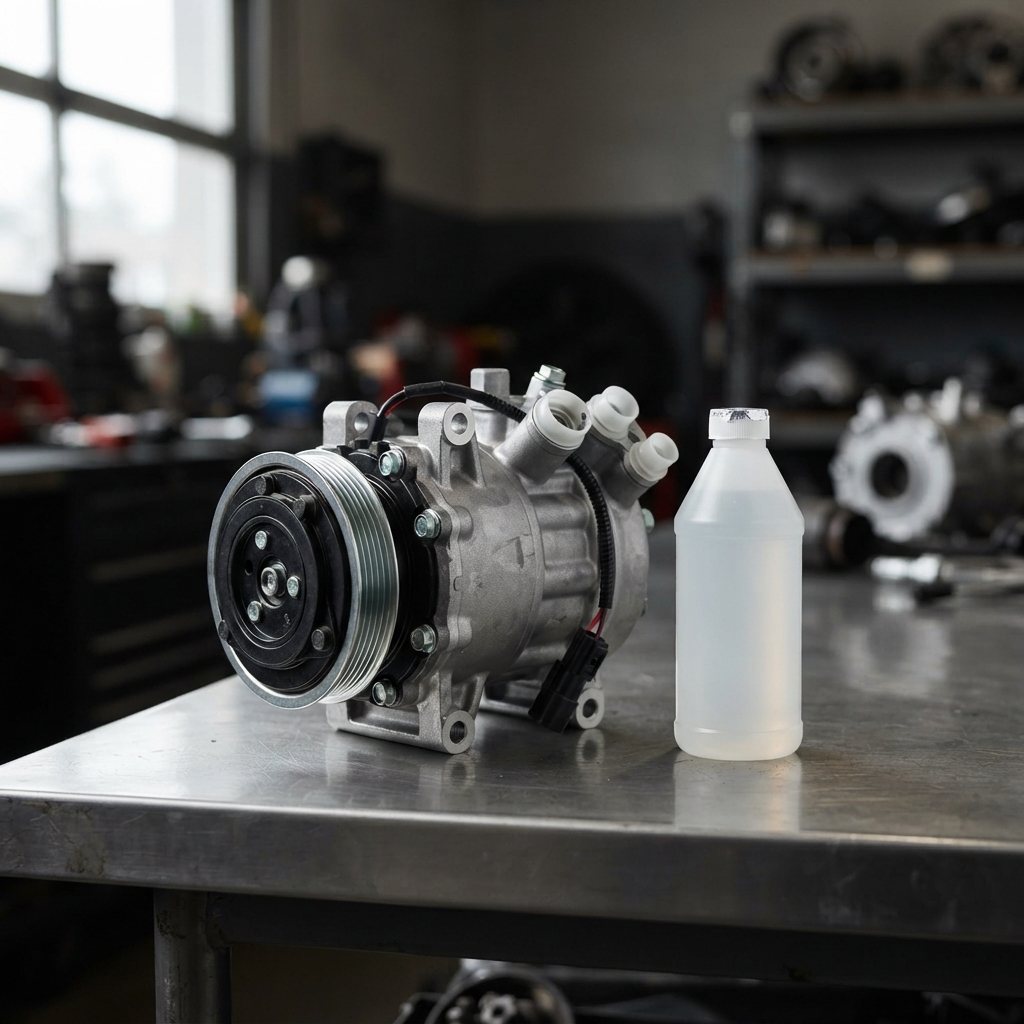
This is where buying decisions affect the repair. A replacement compressor supplied with the correct oil charge, the right pulley and a documented application is easier to release into a flushed system than a bare unit with no data. The checks in our compressor quality control guide map directly to what a workshop should expect from a replacement part.
A safe flush sequence, step by step
The exact procedure varies by vehicle and by the equipment manufacturer's instructions, which always take precedence. The sequence below is the logic that keeps the job controlled.
- Recover the refrigerant legally. Recovery must be carried out with certified equipment and by a certified technician. In the United States, Section 609 of the Clean Air Act governs motor vehicle air conditioning service, and the EPA list of certified MVAC equipment identifies equipment that meets the requirement. Recovery performance is defined in SAE J2788, incorporated into US regulation through 40 CFR Part 82, Appendix C.
- Remove the failed compressor and inspect the oil for metal, grit and colour. A clean sample changes the scope of the job.
- Remove or replace the expansion device. It cannot stay in the circuit during a flush and should not be reused afterwards.
- Isolate and flush section by section in the direction of normal flow: lines, evaporator, condenser where permitted. Never flush through the new compressor, the new drier or the expansion device.
- Dry the circuit. Residual solvent dilutes the new oil and attacks seals. Dry with dry nitrogen until no solvent remains, then hold a vacuum and confirm it decays within specification.
- Replace the receiver drier, expansion device, condenser where required, and all opened seals.
- Add the specified oil for the new compressor and the replaced components, then charge by weight.
- Record the oil type, quantity, solvent used and pressures on the job card. It is the first evidence a warranty engineer will ask for.
Vacuum is not a formality. A held, decay-tested vacuum is the only proof that moisture has been removed and that no joint is leaking after reassembly. Where a leak has to be proven rather than assumed, the helium leak testing guide sets out how leak paths are isolated and recorded.
Solvent, drying and oil rules
Solvent choice is not a detail. A cleaner that leaves a residue, or one that is incompatible with the elastomers in the system, creates a new failure mode. Use only a solvent intended for mobile A/C circuits, follow the maker's dwell and drying instructions, and treat the drying stage as equal in importance to the flush itself.
Oil is the second half of the job. The new compressor carries a factory charge, the replaced components hold oil that left with the old parts, and the system total must still match the vehicle specification. The chemistry must match the refrigerant as well: a system moving between R134a and R1234yf cannot carry the old lubricant across by default, which is why the R1234yf versus R134a comparison and the PAG oil guide belong next to any flush decision on a mixed fleet.
What this means for distributors and repair programs
For a distributor, the flush question is a range question. A program that sells compressors without also supplying the drier, the expansion device and the correct oil leaves the workshop to improvise, and improvisation is what produces comebacks. The compressor supplier qualification guide covers the application data and warranty records to request before a source is approved, and the variable versus fixed displacement comparison explains why two compressors with the same family name can still differ in displacement, pulley and oil specification.
We build piston-type automotive A/C compressors in Guangzhou and supply matching condensers and accumulator filter driers, so a replacement part can be specified with its oil charge and application record rather than as a bare unit. The product range lists the current platforms, and a vehicle list, an OE number or a sample is enough to start a fitment check.
Frequently asked questions
Is a car AC system flush necessary?
Only after a mechanical compressor failure, when the oil is contaminated, or when the system history is unknown. A sealed, correctly charged system that has never had a failure does not benefit from a flush.
Can I flush the AC system without removing the compressor?
No. Solvent must not pass through the compressor, and the failed unit has to come out anyway. Flushing through an installed compressor pushes debris into the new oil circuit.
Can a condenser be flushed instead of replaced?
A tube-and-fin condenser can sometimes be flushed if the debris load is light and it passes a flow check. A parallel-flow condenser cannot be cleaned reliably and should be replaced.
What happens if I don't flush after a compressor failure?
Debris left in the condenser, hoses and expansion device migrates to the new compressor. The usual result is a second failure within weeks to months, often with a warranty claim attached.
How much does a car AC system flush cost?
Cost depends on labour time, solvent, and how many components are replaced. The flush itself is rarely the largest line on the invoice; the drier, expansion device, condenser and oil usually are, which is why quoting a flush alone understates the job.
Does a flush fix a refrigerant leak?
No. A flush removes contamination inside the circuit. A leak has to be found and repaired, then the system evacuated and charged by weight.
Which solvent should be used?
Only a solvent specified for mobile A/C circuits by its manufacturer, applied and dried per those instructions. General-purpose cleaners and brake cleaner leave residues that damage seals and oil.
How do I know the system is dry after flushing?
Dry nitrogen purge followed by a vacuum hold that decays within the specification for the system. A vacuum that will not hold points to moisture still boiling off or a joint that is not sealed.
Conclusion
A car AC system flush is a targeted repair for a contaminated circuit, not a service interval item. It is justified after a mechanical compressor failure, on a system with black or gritty oil, or where the history is unknown, and it only works when the receiver drier, expansion device and contaminated condenser are replaced rather than cleaned. Get the sequence right, dry the circuit properly, charge by weight, and record what was done.
If you are building a compressor range that has to survive real workshop conditions, send your application list, OE numbers and the oil specification you need through our contact page before anything is quoted. For the diagnostic side of the same system, the compressor not engaging sequence and the warranty claim guide cover what to measure and what evidence to keep.